Home - Index -
News - Kronkursförsvaret 1992 - EMU - Cataclysm -
Wall Street Bubbles - Huspriser
Dollarn - Biggles - HSB - Löntagarfonder
- Skuldkrisen 80-tal - Contact
Climate change
I dag publicerar jag och sex andra forskare i tidskriften Natureen sammanfattning av det vetenskapliga läget när det gäller risken för den här typen av tröskeleffekter ("tipping points") där biofysiska system ofrånkomligt tippar över och kickar igång en självförstärkande global uppvärmning med extrema konsekvenser.
Johan Rockström SvD 2019-11-27
Conducting irreversible experiments with the only planet we have is irresponsible.
It would only be rational to refuse to do anything to mitigate the risks if we were certain the science of man-made climate change is bogus.
Since it rests on well-established science, it would be ludicrous to claim any such certainty.
Martin Wolf, Financial Times 8 July 2014
Allt Du behöver veta om vädret och The Jet Stream
Rolf Englund blog 12 November 2014
Ovanligt varmt havsvatten i Atlanten, stark västafrikansk monsun och ingen El Niño - orkan
Den här variationen kallas för den atlantiska multidekadala oscillationen, AMO, och består av en varm och en kall fas.
SvT 7 september 2017
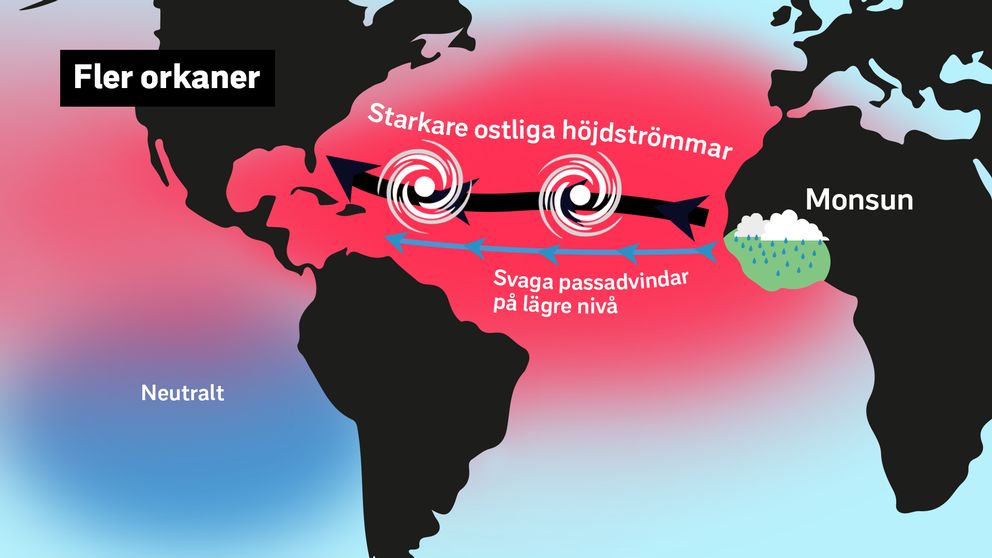
Vattnet i den tropiska Atlanten är alltid varmt relativt sett, men precis som det mesta så varierar även det över tid.
Den här variationen kallas för den atlantiska multidekadala oscillationen, AMO, och består av en varm och en kall fas.
Dessa faser kännetecknas av 20-40 åriga perioder där vattentemperaturen i Atlanten oftare är varmare respektive kallare.
Sedan mitten på 1990-talet (ungefär från 1995) befinner sig Atlanten i en varm fas av AMO.
Dessförinnan rådde en kall fas som sträckte sig ända tillbaka till mitten på 1960-talet och innan dess en varm fas ända från slutet av 1920-talet.
Full text
Top of page
Metan är en kraftfull växthusgas - drygt tjugo gånger kraftigare än koldioxid.
Hittills har Sibiriens metan legat infruset under permafrosten och i det kalla kustvattnet i flera tusen år. Men...
Men
en av klimatforskarnas värsta farhågor är att metanet ska tina när jorden blir varmare.
Karin Bojs, DN 2008-08-29
Sea Level Rise: What It Is, Why It Matters, and What Can Be Done?
John Hawthorne, 9/13/17
Two major factors are believed to contribute to this specifically.
First, as the planet’s temperature rises, the water in our oceans begins to physically expand, and thus take up more room.
For coastal regions, this will impact the sea being at the shore to being well over the shore—flooding onto land.
Water expansion is responsible for about one-third of the change in sea level.
Second, higher world temperatures also make various ice sheets at different points melt.
Obviously, this water has to go somewhere, and it usually washes into the already-expanding seas.
This melting accounts for the remaining two-thirds of sea level change.
Coastal erosion is another potential consequence of sea level rising.
As more and more water breaks upon the shore, beaches and other areas will be slowly eroded. This not only means your favorite beach might be much smaller,
but it also means the water will be much closer inland, and can continue its erosion there.
(The sand and other barriers are often our first line of defense against the erosion caused by bodies of water.)
Full text
Earth’s Most Famous Climate Scientist Issues Bombshell Sea Level Warning
sea level rise of at least 10 feet /3.04800 meters/ in as little as 50 years
Slate 20 July 2015
The study—written by James Hansen, NASA’s former lead climate scientist, and 16 co-authors, many of whom are considered among the top in their fields—
concludes that glaciers in Greenland and Antarctica will melt 10 times faster than previous consensus estimates,
resulting in
sea level rise of at least 10 feet in as little as 50 years.
10 feet = 3.04800 meters
Full text
Sea level rise is caused primarily by two factors related to global warming: the added water from melting land ice and the expansion of sea water as it warms. The first chart tracks the change in sea level since 1993 as observed by satellites.
The second chart, derived from coastal tide gauge data, shows how much sea level changed from about 1870 to 2000.
NASA
http://ocean.nationalgeographic.com/ocean/critical-issues-sea-level-rise/
Top of page
News
The Republican victory in the midterm elections was a triumph for its strategy of
sustained vilification of the president and obstruction of his policies.
The most important consequence of this election may therefore be to
bury what little hope remained of getting to grips with the risk of dangerous climate change.
Martin Wolf, FT 11 November 2014
Full text
Conducting irreversible experiments with the only planet we have is irresponsible.
It would only be rational to refuse to do anything to mitigate the risks if we were certain the science of man-made climate change is bogus.
Since it rests on well-established science, it would be ludicrous to claim any such certainty.
Martin Wolf, Financial Times 8 July 2014
Given this, two recent events are encouraging for those (like me) who believe elementary common sense requires us to act.
One was the publication of the President’s Climate Action Plan last month.
The other event, also last month, was the publication of a report – aptly entitled Risky Business – by a heavyweight bipartisan group that
included former New York mayor Michael Bloomberg, former US Treasury secretaries Hank Paulson and Robert Rubin and former US secretary of state George Shultz.
Full text
Top of page
How much of the world’s fossil fuel reserves will eventually be burnt?
Either the world will abandon its pledge to keep emissions below the level thought to produce a temperature rise of 2C
or the fossil fuel companies are holding stranded assets and investing in unusable ones.
Investors are implicitly betting on the former possibility.
Martin Wolf, Financial Times 17 June 2014
How much of the world’s fossil fuel reserves will eventually be burnt? This is not just a question for those concerned with climate policy. It is also a question for investors even if they believe (absurdly, in my view) that the science of climate change is a hoax.
What, they must ask themselves, would it mean for my investments in fossil fuel exploration and production if policy makers acted on their expressed belief in the science of climate change?
Full text
The Stock Market
Martin Wolf
Top of page
Havsisens försvinnande i Arktis medför troligen enorma utsläpp av metangas från havsbottnen.
Kostnaderna för utsläppen kan bli 60 biljoner dollar - nästan lika mycket som den nuvarande storleken på världsekonomin.
Det hävdar forskare i en studie som publiceras i tidskriften Nature.
Dagens Industri 24 juli 2013
Full text
Nature
Global inaction shows that the climate sceptics have already won
The real and present dangers are too uncomfortable to confront
Martin Wolf, Financial Times May 21, 2013
Full text
In Britain there is no government backstop for flood insurance. If you build a house in a vulnerable spot, you bear the cost yourself.
However, America has a scheme known as the National Flood Insurance Program,
which was created in 1968 “in response to a widespread belief that flood hazard was uninsurable by the private sector alone”.
Gillian Tett, Financial Times, July 19, 2013
Coastal cities and climate change
Americans are building beachfront homes even as the oceans rise
The Economist, June 15th 2013 print edition
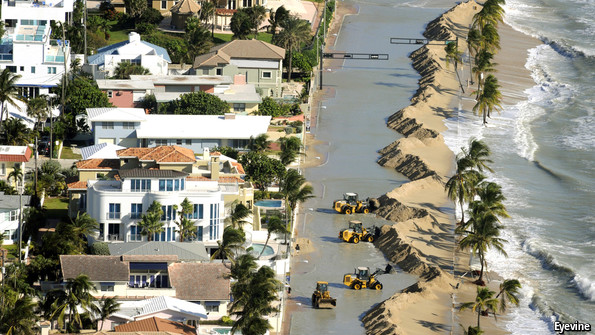
Most Floridians live in coastal counties.
Buildings cluster on low ground; more people than in any other state live on land less than four feet (1.2 metres) above the high-tide line.
Florida’s limestone bedrock makes it easy for salt water from surging seas to contaminate its freshwater aquifers.
And it relies heavily on canals for flood control, which a sea-level rise of just six inches would devastate.
Full text
Top of page
Heating The Earth: A Guide to Global Warming
Atlanta Air Conditioning and Heating Experts, February 2013
Sir David /Attenborough/ believes the washout summer may be down to climate change.
As a credible explanation he points to research by the University of Sheffield which suggests
melting Arctic ice has slowed the jet stream, causing it to break into loops which have ushered to the UK unseasonably cold and wet weather systems.
"There is no question that climate change is happening; the only arguable point is what part humans are playing in it,"
The Independent, 14 July 2012
Full text
According to Philip Eden, writing in the Sunday Telegraph, the first half of June across the UK was the wettest for 150 years - and let's not forget April was the wettest on record too.
The weather pattern is so stuck in a rut that there's every chance that low pressure will dominate our weather for the rest of June and into the first half of July too - meaning more cool and at times wet weather - with a few fine warm days in-between.
And it's all down to the position of the jet stream.
BBC, 20 June 2012
Full text
In the UK, the bewildering amount of apparently endless rain has led to the door of researchers such as Professor Jennifer Francis of Rutgers University in the US. She studies the fast-changing climate in the Arctic, where she says the average thickness of ice floating on the ocean has shrunk from around 3m in the early 1990s to between 1m and 1.5m.
Her work suggests this could be affecting the northern polar jet stream – fast-moving rivers of air several miles high that race from west to east around the northern hemisphere and push around weather systems.
The jet stream is driven by the difference in temperature between the colder polar region and warmer latitudes further south. But with that temperature difference shrinking as the Arctic warms, it may make the jet stream weaker and more meandering, effectively “blocking” wet or hot weather patterns, and causing extreme weather.
Financial Times 13 July 2012
Much of North America was gripped by the coldest weather in decades as extreme conditions,
caused by a polar vortex, spread east and south.
The US National Weather Service warned of “dangerously cold Arctic air” overtaking the eastern two-thirds of the country,
with temperatures below freezing “in most places from the central plains to the east coast and as far south as the gulf coast.”
Financial Times, January 7, 2014
Full text
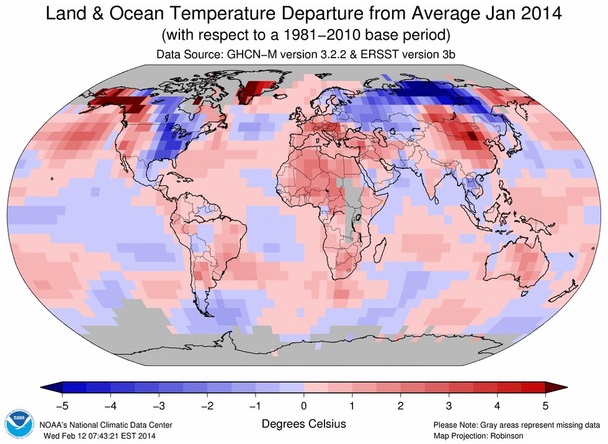
Much of America is about to be overrun by another miserable cold-dozer next week,
but on the planetary scale, things have actually been warm. January's temperatures were the hottest for the month since 2007
and this was the fourth warmest January since records began in 1880.
Atlanticcities 21 February 2014
Full text
“Polar vortex” has taken an uncontested lead in the competition for buzzword of 2014.
It’s brought Arctic chill to the continental United States
Temperature difference between the Arctic and North America is shrinking.
That’s one factor causing wobbliness in the jet stream
Bloomberg, 7 January 2014
Bright white ice reflects energy back into space; dark blue water absorbs it.
Arctic temperatures are about 2 degrees Celsius warmer there than they were in the mid-1960s.
(The average temperature increase for the Earth’s atmosphere overall is about 0.7 degree C, since 1900.)
In other words, the temperature difference between the Arctic and North America is shrinking.
That’s one factor causing wobbliness in the jet stream, the west-east current that circles the Northern Hemisphere,
according to Jennifer Francis, research professor at Rutgers University.
Normally, that river of air keeps low-pressure cold air contained above the Arctic and holds higher-pressure warm air above the temperate regions, where most people live.
Full text
http://www.metoffice.gov.uk/learning/wind/what-is-the-jet-stream
Väderkartan är konstig (inte som den var förr)
- Ett lågtryck över de brittiska öarna rör sig mot nordost och väntas under morgondagen ge regn i Götaland (företrädesvis i Göteborg).
Ungefär så har det alltid låtit och sett ut på väderkartan så länge jag kan minnas.
Men nu tycker jag väderkartan ser annorlunda ut.
Rolf Englund blog 12 Juni 2010
Full text
Jet stream, From Wikipedia,
Google’s Climate Change in Our World has created an animated map of the earth from space that illustrates the potential impact of climate change over the next century, Reuters reports.
Upp till två tredjedelar av den djupfrysta tundran på jorden kommer troligen att smälta bort inom 200 år
Då frigörs enorma mängder växthusgaser som ytterligare spär på uppvärmningen.
SvT/TT 22 februari 2011
Full text
Top of page
Why Copenhagen must be the end of the beginning
Martin Wolf, FT December 1 2009
Sceptics offer two counter-arguments: first, that the science underlying climate change is highly uncertain; second, that costs exceed benefits.
Yet it is not enough to argue that the science is uncertain. Given the risks, we have to be quite sure the science is wrong before following the sceptics. By the time we know it is not, it is likely to be too late to act effectively. We cannot repeat experiments with just one planet.
First, we need prices for carbon that apply over relevant planning horizons. That price cannot be fixed forever, but must change with events. But it needs to be far more stable than in the European Union’s market for permits (see chart). A tax seems more attractive to me than “cap and trade”, for this reason.
Second, where the abatement occurs must be separated from who pays for it. Abatement needs to happen where it is most efficient. That is why emissions of developing countries must be included. But the cost should fall on the wealthy. This is as much because they can afford it as because they produced the bulk of past emissions.
Full text
Socialismen har genom finanskrisen och klimathotet fått två gratischanser att visa att den lever och att dess praktik borde vara adekvat att tillämpa mot båda. Men ingenting hörs.
Inte ens Göran Greider har längre något konstruktivt att säga om socialismen. Den måste vara död.
Danne Nordling 15/6 2009
I Dagens Nyheters kulturdel igår 14/6 skriver poeten Göran Greider, chefredaktör för Dala-Demokraten (S), en Essä-artikel om klimatpolitiken utifrån ett radikalt vänsterperspektiv.
Han recenserar en ny bok av vänstermannen Anthony Giddens med titeln The Politics of Climate Change.
Full text
Anthony Giddens at Amazon
Hvad vilja socialdemokraterna nu när socialismen är död?
Rolf Englund 2009-06-04
The world is facing an increasing risk of "irreversible" climate shifts
because worst-case scenarios warned of two years ago are being realized,
an international panel of scientists has warned.
CNN 12/3 2009
The perpetrator wasn't an asteroid or comet,
like the impact that wiped out the dinosaurs 65 million years ago
MCCLATCHY, August 27, 2008
An estimated 95 percent of all marine species and up to 85 percent of land creatures perished, according to Peter Ward, a paleobiologist at the University of Washington in Seattle.
Scientists call it "The Great Dying." Life took millions of years to recover.
Some 251 million years ago.
The perpetrator wasn't an asteroid or comet, like the impact that wiped out the dinosaurs 65 million years ago and inspired movies such as "Deep Impact" and "Armageddon."
The lessons of the P-T massacre are "directly applicable to the present," said John Isbell, a geoscientist at the University of Wisconsin in Milwaukee. He said the world today is in danger of exceeding a CO2 "threshold" that could set off an environmental upheaval as great as the one 251 million years ago.
http://www.mcclatchydc.com/256/story/50899.html
The biggest danger, many experts warn,
is that global warming will cause
sea levels to rise dramatically.
Top of page
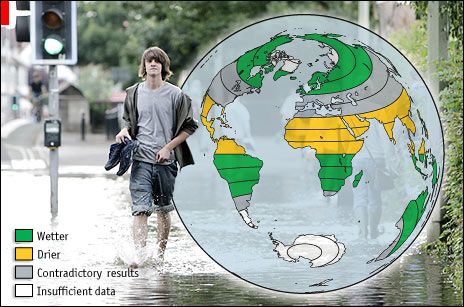
The Economist 25/7 2007
Karin Bojs:
IPCC:s nya rapport är årtiondets viktigaste dokument
Om vi ska få utvecklingen att svänga, då måste det ske absolut senast 2015.
DN 17/11 2007
Full text
The IPCC states that climate change is "unequivocal" and may bring "abrupt and irreversible" impacts.
BBC
Planet in Peril
CNN
IPCC draft report [9.3MB] pdf
STOCKHOLM, Aug 22 (IPS) - A spectre is haunting the cities and villages of most developing nations, warns a senior official of a World Bank-affiliated organisation.
"It's the spectre of a food, fuel and water crisis," says Lars Thunell, executive vice president of the Washington-based International Finance Corporation (IFC), a member of the World Bank group.
Read more about him here
Arktis vita, snötäckta is håller på att försvinna under sommarhalvåret
till förmån för mörkt, öppet hav.
Det får konsekvenser för hela jordklotet.
DN 22/9 2007
With just 10 more years of "business as usual" emissions from the burning of coal, oil and gas, says the NASA/Columbia paper,
"it becomes impractical" to avoid "disastrous effects."
ABC News 29/5 2007
The study appears in the journal Atmospheric Chemistry and Physics. Its lead author is James Hansen, director of NASA's Goddard Institute for Space Studies in New York.
6. Borrkärnorna från Antarktis och Grönlands isar visar att jorden först blev varmare, och sedan höjdes halten av växthusgaser i atmosfären.
Svar: Det är alldeles riktigt....
Vetenskapsredaktionen, DN 27/5 2007
Full text
Det bara temperatur- och koldioxidkurvornas samvariation som utgör "beviset" /för att människan förorsakar växthuseffekten.
Som vi vet sedan länge är detta inget säkert bevis eftersom temperaturen varierar med ett försteg på ca 600 år.
Danne Nordling om Al Gore 21/5 2007
Kritikerna har en alternativteori till varför jordens klimat förändras.
De menar att det är solens magnetiska aktivitet, inte koldioxidhalten i atmosfären, som påverkar temperaturerna på jorden.
Enligt dessa forskare kommer jordens temperatur faktiskt att börja sjunka snart på grund av minskad solaktivitet. Denna avkylning kommer att kulminera om ett femtiotal år i en extremt kall period, liknande den så kallade ”lilla istiden” som inträffade 1645–1715.
Insändare av Maggie Thauersköld, SvD
FN:s klimatpanel IPCC grundar sina antaganden på att världens befolkning kommer att fortsätta förbruka allt mer av fossila bränslen.
Men sanningen är den motsatta. Produktionen av olja i världen kommer inom högst ett decennium att nå sin absoluta topp - "Peak Oil"
Kjell Aleklett DN Debatt 18/5 2007
En australiensisk expert på klimatberäkningar har efter att ha jobbat med frågan i 6 år kommit fram till att bevisen för växthusteorin inte håller.
Det centrala beviset existerar inte ens. Allt det övriga är modeller och teoretiska beräkningar.
Danne Nordling 31/8 2008
David Evans tar upp fyra invändningar i tidningsartikeln
Full text
Unfortunately for Evans’ global heating skepticism, but fortunately for the advancement of understanding of the Earth’s climate and anthropogenic global heating, it appears that the facts have changed on him yet again.
August 13, 2008 by Brian Angliss
En kvalificerad lärobok för universitetsstudenter kan inte förklara hur växthusteorin hänger ihop och inte ge belägg för underlaget.
Man kan dock räkna ut att teorin förutsätter att hela uppvärmningen sedan år 1900 beror på mänsklig påverkan.
Men det redovisas ingenstans. Det är inte seriöst.
Danne Nordling blog 5/3 2007
Här kommer en fortsättning av referatet av vad läroböckerna skriver om klimatförändringarna och växthuseffekten.
Full text
Början på sidan
Vi varnar för alarmismen kring klimathotet.
I svenska mediers rapportering hörs sällan avvikande röster – trots att forskarna är långtifrån eniga.
Professor Bengt Kriström skiljer fakta från spekulation och minns tidigare domedagsscenarier.
När politiker känner vart vinden blåser blir även åtgärderna lätt populistiska – Hans Bergström sågar Oljekommissionen
Neo nr 1/2007
Det är så det brukar låta från högerhåll.
Om det över huvud taget finns ett klimatproblem så kommer marknaden att lösa det åt oss på egen hand. Skatter och regleringar luktar vänsterprogg och måste bekämpas till varje pris.
Anna Dahlberg, Expressens ledarsida 25/1 2007
Forskningsläget kring växthuseffekten är oklart, slår högermagasinet fast i ledaren, och varnar för tendenser inom näringslivet att hoppa på den gröna linjen. Det är "glättigt" och "kortsiktigt", skriver chefredaktören Sofia Nerbrand. Jo, det står faktiskt så.
Till president Bushs försvar måste man säga att han faktiskt har övergett högerns första försvarslinje - den som förnekar att klimathotet över huvud taget är ett problem som behöver tas på allvar.
Sofia Nerbrand:
Årtionden med höga skatter har proletariserat den svenska medelklassen
Läs mer här
Det råder inget tvivel om att Bengt Holgersson tar klimatfrågan på största allvar. Däremot är han tveksam till mediernas rapportering.
När han utreder effekterna av en väderförändring har han ett hundraårsperspektiv.
Undergången är inte här ännu, säger han. De omvälvande förändringarna av klimatet, världskatastrofen, väntar sannolikt inte om fem år. Men kanske om femtio år.
Bengt Holgersson, SvD Näringsliv 21/1 2007
Skånes förre landshövding Bengt Holgersson leder regeringens utredning om samhällets sårbarhet för klimatförändringar och extrema väderhändelser som har pågått sedan 2005.
Full text
P J Anders Linder om Björn Lomborg
Själv tycker jag att Sterns åtgärdsförslag
verkar ha rimlig profil
SvD 14/1 2007
Stern Review on the Economics of Climate Change
Click here
The report observes laconically, "the power sector around the world would need to be at least 60 percent decarbonized by 2050."
In plain language, that means replacing most of the world's coal-fired power plants with nuclear plants or some other cleaner form of generation.
Developing and deploying the necessary technologies will require a collective global effort.
But private capital is not likely to emerge in big enough quantities unless a significant cost is attached to carbon emissions - either in the form of a carbon tax or a mandatory cap on emissions. Since the dawn of the industrial revolution, the atmosphere has served as a free dumping ground for carbon gases. If people and industries are made to pay heavily for the privilege, they will inevitably be driven to develop cleaner fuels, cars and factories.
The New York Times November 2, 2006
There are two curious omissions in Sir Nicholas Stern’s report on global warming. Both open it to flanking attacks from sceptics.
The first is that nowhere in his 575-page tome does he reveal what discount rate he assumes to estimate the present value of future disasters.
Second, the word “nuclear” has been omitted from the executive summary, conclusions and the points for action liberally scattered through the report.
Max Wilkinson, former natural resources editor and chief leader writer of the Financial Times 3/11 2006
Sir Nicholas is entitled to his assumptions. But a very low discount rate, based partly on ethical considerations, creates a big problem. Who is going to pay for the vast projects that his analysis says are needed to keep the world cool? Consider nuclear power as an example. The International Energy Agency will say in a forthcoming report that a big new nuclear programme is needed to help reduce carbon emissions and to secure electricity supplies for the future. But because of the high capital costs and low running costs over decades, the economic viability of the nuclear option is sensitive to the discount rate assumed. At a 2 per cent rate, a range of international studies including the IEA’s show that nuclear is easily competitive with coal.
But what commercial enterprise would undertake the risks at such a low cost of capital?
Full text
Katastrofala översvämningar, svår torka, hundratals miljoner flyktingar och en världsekonomisk kollaps jämförbar med ett världskrig eller depressionen på 1930-talet.
En apokalyptisk framtidsvision målas upp i en brittisk rapport.
DN/TT 30/10
Pinsamt Karin Bojs, du borde ha ställt följdfrågan
hur byggandet av skyddsvallar, förstärkningar av dammar och folkomflyttningar etc skulle kunna ödelägga världsekonomin som depressionen på 30-talet. Den karaktäriserades av ett efterfrågebortfall som ledde till överkapacitet och arbetslöshet. Klimatförändringarna gör inte folk arbetslösa utan skapar fler jobb och anstränger produktionskapaciteten till det yttersta.
Danne Nordling 1/11 2006
Modelling work done for the review concluded the costs of climate change over the next two centuries could be equivalent to a reduction of 5 per cent in average consumption per head. This is itself equal only to the loss of two years of economic growth. But the costs of failure to act might be as much as 20 per cent of gross world product. The report compares such costs with those associated with “the great wars and the economic depression of the first half of the twentieth century”. Worse, in this case, “it will be difficult or impossible to reverse these changes”. Moreover, these costs would fall heavily on the poorest.
Martin Wolf Financial Times 1/11 2006
Av en händelse får jag intervjua den brittiska regeringens vetenskaplige rådgivare, Sir David King, precis samma dag som den så kallade Sternrapporten om klimatförändringarna blir offentlig.
Jag frågar förstås vad som är så märkvärdigt med Sternrapporten. Varför har den väckt så jättestor uppmärksamhet i Storbritannien? Det vet väl alla som är pålästa att människans utsläpp av växthusgaser
kan orsaka mycket stora globala problem, med översvämningar, flyktingströmmar, torka och så vidare.
- För första gången har vi en mycket detaljerad ekonomisk analys, skriven av en ansedd ekonom, säger han.
Sir Nicholas Stern som står bakom den nya rapporten har varit chef för Världsbanken, och hans rapport vänder sig till andra ekonomer.
Karin Bojs DN 31/10 2006
Åtgärder kan och bör vidtas. Men...
Vi ska ta klimatproblemen på allvar. Men ...
PJ Anders Linder, SvD 19/11 2006
Svenska Dagbladet på nyhetsplats 19/11 2006:
Klimatförändringarna är redan här. I Sverige. Och görs inget nu kommer det att bli ännu värre.
José Manuel Barroso, president of the European Commission
has undergone a remarkable conversion and emerged as a champion of the environmental cause.
Mr Barroso’s allies say a defining influence was Sir Nicholas Stern, the former World Bank economist
Financial Times 19/11 2006
When José Manuel Barroso became president of the European Commission in 2004, environmental groups feared the worst.
Yet in the last few weeks, Mr Barroso has undergone a remarkable conversion and emerged as a champion of the environmental cause.
So why the sudden enthusiasm for tackling climate change? Mr Barroso’s allies say a defining influence was Sir Nicholas Stern, the former World Bank economist, who made a compelling economic case for doing something about it.
Al Gore’s film on climate change, An Inconvenient Truth, also changed attitudes. When the former US vice-president came to an adoring Brussels last month, Mr Dimas bemoaned the fact that Europeans “cannot vote in US elections”.
David Miliband, Britain’s environment minister, argues that climate change is an issue that can help to rebuild European unity.
“The environment is the big issue on which the EU can connect with its citizens,” he told the Financial Times.
“This is not some sort of marketing exercise,” says his spokesman Johannes Laitenberger.
Full text
Those who believe in the free market are highly resistant to the idea of man-made climate change, let alone to arguments for government action to halt emissions of greenhouse gases.
Is this resistance rational? Or is it another case of the human desire to believe true what is merely convenient?
Martin Wolf, FT, November 14 2006
On one point these sceptics are correct: the man-made climate change hypothesis appeals to believers in environmental limits to growth, the evils of capitalism and the need for government regulation. Lord Lawson, the former British chancellor of the exchequer, makes that point well in a recent assault on the activists.* But what should matter is not the emotions that drive the people on either side of the debate, but rather whether the arguments advanced are persuasive.
Nigel Lawson Lecture, 3rd November 2006
In this case, as a recent paper from the Royal Society makes plain, the strength of the consensus is evident.** To bet everything on the assumption that the hypothesis is false would be irrational.
Royal Society: Facts and fictions about climate change
Sir Nicholas Stern, author of the British government’s new report on climate change
How and how convincingly does the review make this case?
The answer, I suggest, is: “Sufficiently so.”
Martin Wolf Financial Times 1/11 2006
Hitherto many economists, business-people and politicians, particularly in the US, have argued that, given both the uncertainties and the high costs of taking possibly unnecessary action, the best policy is to wait, see and, if necessary, adapt. The contribution of this report is to reverse that logic. It argues that, given these very same uncertainties and the relatively low costs of acting now, the best policy is action
Should the temperature rise by 5°C, there may be adverse effects on crop yields; significant rises in sea levels that threaten developing countries, such as Bangladesh, but also coastal cities, such as London, Shanghai and New York; water shortages affecting more than a billion people; mass extinctions; increasingly intense storms; and, conceivably, huge shifts in the climate system, with local cooling and intense local warming.
Full text
No more excuses on climate change
The argument has changed. Irreversibly.
Philip Stephens, Financial Times, October 31 2006
Science has long provided a compelling reason to act against global warming. The study authored by Sir Nicholas Stern, the former World Bank economist, has now added the vital economic rationale.
Not so long ago the debate about climate change was framed, carelessly, as one in which upfront economic costs had to be weighed against a distant and uncertain risk. How much of our present prosperity should we sacrifice against the possibility the planet might one day get too hot? This was always a false choice, but also one well suited to the timidity of politicians and the suspicion of voters.
The Stern report debunks it. The science of man-made climate change is beyond reasonable contradiction.
Full text
The world has to act now on climate change or face devastating economic consequences,
according to a report compiled by Sir Nicholas Stern for the UK government.
Here are the key points of the review written by the former chief economist of the World Bank.
BBC 30/10 2006
Britain and the Netherlands will on Friday attempt to force climate change to the top of the EU's agenda, warning that the world is only 10-15 years away from “a catastrophic tipping point”.
Financial Times 20/10 2006
In a joint letter ahead of an EU summit in Finland on Friday, the two say Europe should work with countries such as China and India to develop low carbon technologies and set world standards.
“We have a window of only 10-15 years to take the steps we need to avoid crossing a catastrophic tipping point,” the two prime ministers claim.
Read the letter at Downing Street
“What we see in the Arctic is a [dead] canary in the coal mine.”
A Nasa satellite has documented startling changes in Arctic sea ice cover between 2004 and 2005.
BBC 14/9 2006 - NASA
Tidskriften Science
Metangas läcker ut från Arktiska Oceanen norr om Sibirien
Det skyddande lock som permafrosten utgjort verkar ha tinat och nu flödar metanet upp i atmosfären.
äger professor Örjan Gustafsson vid Stockholms universitet.
*Ekot fredag 5 mars 2010
8 miljoner ton metan per år läcker ut från de Östsibiriska grundhaven.
De siffrorna presenterar Örjan Gustafsson tillsammans med ledande ryska arktisforskare i den vetenskapliga tidskriften Science.
Full text
Scientists are warning that Siberia could be a far larger source of greenhouse
gases than we had ever thought.
BBC 9/11 (nine/eleven) 2006
Frozen bubbles in Siberian lakes are releasing methane at rates that appear to be "... five times higher than previously estimated", in a paper published today in the journal Nature.
Science Daily 8/9 2006
Methane Bubbling Likely to Accelerate Global Warming, Fox News
Global warming over the coming century could mean a return of temperatures last seen in the age of the dinosaur and lead to the extinction of up to half of all species.
Not only will carbon dioxide levels be at the highest levels for 24 million years, but global average temperatures will be higher than for up to 10 million years, said Chris Thomas of the University of York.
"In geological terms 100 years is effectively instantaneous," Thomas noted.
CNN 8/9 2006

