Home - Index - Krisen 1992 - EMU - Economics - Cataclysm - US Dollar - Houseprices
Lawrence Summers resigns as Preident of Harvard
THE SCIENCE OF GENDER AND SCIENCE, PINKER VS. SPELKE
Former U.S. Treasury Secretary Lawrence Summers:
“The consequences of another economic downturn dwarf and massively exceed
any adverse consequences associated with inflation pushing a bit above 2 percent,”
Summers said at a European Central Bank conference in Sintra, Portugal.
Bloomberg 18 June 2018
Summers said interest rates are unlikely to return to historically normal levels before the next recession,
leaving central banks unable to respond with the level of force necessary to effectively address the slump.
He added that another downturn would worsen the forces of populism and protectionism that have been on the rise in much of the developed world.
The (non) disappearing Phillips Curve: why it matters
The existence, and recent disappearance, of the Phillips Curve is the hottest topic among macro investors and policy makers at the moment.
Gavyn Davies' blog, 22 October 2017
Heed the fears of the financial markets
Experience suggests that the best indicator of a country’s future economic prospects is the decisions its citizens make about keeping capital at home or exporting it abroad.
The renminbi is under pressure because Chinese citizens are eager to move their money overseas.
Were it not for the substantial recent depletion of China’s reserves, the renminbi would have fallen further
Larry Summers, FT January 10, 2016
The core idea behind secular stagnation was that the neutral real rate had for a variety of reasons fallen and might well be below zero
In more technical economic language, secular stagnation is the hypothesis that the IS curve has shifted back and down so that the real interest rate consistent with full employment has declined.
More straightforwardly, if you see weaker growth despite lower real interest rates that tends to confirm the secular stagnation idea.
Lawrence Summers, FT 22 December 2015
Things got so bad that former Treasury Secretary Larry Summers took to Twitter to
compare the day’s events to previous meltdowns and say, “we could be in the early stage of a very serious situation.”
Bloomberg 25 August 2015
Lawrence Summers, veteran policy maker and serial holder of strong opinions.
The thesis that the world is approaching a lasting period of low growth has decisively moved into the mainstream conversation about economics.
Alan Beattie, FT 10 April 2015
On Secular Stagnation: A Response to Bernanke
Lawrence H. Summer 2015
Lawrence Summers on ‘House of Debt’
Did the response to the financial crisis focus too much on banks while neglecting over-indebted homeowners?
Lawrence Summers, Financial Times June 6, 2014
“secular stagnation”
In a fascinating discussion with other leading international economists, Professor Summers argued that the only compelling solution to low growth was public investment.
Unconventional monetary policy, he argued, was no match for the problem, and in any case ran the risk of creating asset bubbles and renewed financial instability.
He also expressed grave concerns about the distributional consequences of sustained periods of negative real interest rates.
Jeremy Warner, Telegraph, 23 Jan 2014
Summers on bubbles and secular stagnation forever
Larry Summers’ speech to the IMF Research Conference on November 8, the video of which started circulating at old fashioned money multiplier rates this Sunday.
Izabella Kaminska, FT Alphaville 18 November 2013
Why stagnation might prove to be the new normal
In the past decade, before the crisis, bubbles and loose credit were only sufficient to drive moderate growth
Even if the economy accelerates next year, this provides no assurance that it is capable of sustained growth at normal real interest rates.
Lawrence Summers, December 15, 2013
The Hubble bubble theory of the continuous expansion of the financial universe
All of which is a whimsical way of suggesting that perhaps Larry Summers has a point.
Perhaps inflating asset bubbles one after the other isn’t such a bad idea. Perhaps it’s even necessary?
Izabella Kaminska, FT Alphaville 6 December 2013
Asset price bubbles and Central Bank Policy
"A bravura performance"
Lawrence Summers has poured gallons of icy water on any remaining optimists.
Speaking on a panel at the International Monetary Fund’s annual research conference,
the former US Treasury secretary suggested that there could be no easy return to pre-crisis normality in high-income economies.
Instead, he sketched out a disturbing future of chronically weak demand and slow economic growth.
Martin Wolf, November 19, 2013
Larry Summers, Paul Krugman, Gavyn Davies
Utan bubblor kollapsar ekonomin
Andreas Cervenka, SvD Näringsliv 19 november 2013
Why Obama should not pick Summers for the Fed
Even worse, he has warned that policies such as quantitative easing and low interest rates
threaten to create malinvestment and new asset bubbles.
Scott Sumner, Financial Times, August 7, 2013
That 1999 Time magazine cover is finally catching up with Lawrence Summers.
That was the year Summers was celebrated along with Alan Greenspan and Robert Rubin as “The Committee to Save the World”
for their free-market solutions to Asia’s financial crisis.
The timing always struck Asians as odd, given that they were still picking up the pieces
from a meltdown made worse by the trio’s ill-conceived and overbearing remedies.
William Pesek, a Bloomberg View columnist, Aug 5, 2013
"Nu måste det bli en kvinna som Fed-chef"
Supporters of Mr. Summers dismiss the idea that gender is a factor in the decision.
They say that they simply regard him as the best person for the job.
New York Times, July 25, 2013
Ben Bernanke Time Magazine "Person of the Year"
Time magazine famously named Mr. Greenspan, Robert Rubin and Lawrence Summers “The Committee to Save the World” — the “Three Marketeers” who “prevented a global meltdown.”
Tim Iacono 16/12 2009
No country can be expected to generate huge primary surpluses for long periods for the benefit of foreign creditors.
Meeting debt burdens at rates currently charged by the official sector for credit – let alone the private sector – would involve burdens on Greece, Ireland and Portugal comparable to the reparations’ burdens Keynes warned about in The Economic Consequences of the Peace.
Lawrence Summers, Financial Times, 18 July 2011
How to save the eurozone
Teaching investors a lesson is a wish not a policy.
US policymakers were applauded for about 12 hours for their willingness to let Lehman go bankrupt.
Lawrence Summers, Financial Times, 18 July 2011
In short, the approach of lending more and more from the official sector to countries
that cannot access the market at premium rates of interest is unsustainable
Lawrence Summers, Financial Times, 18 July 2011
Larry Summers, the Obama administration’s top economic adviser, will step down
after the November midterm elections and return to Harvard University
FT September 21 2010
Mr Summers’ exit would mark the third high-profile departure from President Barack Obama’s economic team since July. Tim Geithner, Treasury secretary, planned to stay on to help the president build a new economic team, senior administration officials said.
Mr Obama was gracious towards Mr Summers today as he announced the move, praising him for his “brilliance, experience, and judgment”. He added: “While we have much work ahead to repair the damage done by the recession, we are on a better path thanks in no small measure to Larry’s wise counsel.”
For his part, Mr Summers said he would “miss” working with Mr Obama but said he was looking forward to teach and write about the “economic fundamentals of job creation and stable finance as well as the integration of rising and developing countries into the global system”.
http://blogs.ft.com/money-supply/2010/09/21/the-last-day-of-summers/
Summers won't be missed by many in the Beltway ,
1. The beltway surrounding Washington, D.C.
2. The political establishment of Washington, D.C., including federal officeholders, lobbyists, consultants, and media commentators.
judging by the amount of time people spent complaining about his alpha economist behavior. And it's no surprise that the president wants to make changes.
Fortune September 21, 2010
After all, the near collapse of the economy – averted by vigorous government action -- is ancient history. The unexpectedly quick turnaround of the financial sector – the signature accomplishment of the Summers-Geithner team – is now seen as having been inevitable and not necessarily even laudable. The handouts to millionaire bankers and deep-pocketed investors still rankle, whatever Charlie Munger might think of the choices facing policymakers.
Add to that a double-barrelled unemployment problem. Joblessness is near a three-decade high and underemployment affects 1 in 6 Americans. Big companies are hoarding cash rather than investing
Lawrence Summers, chief economic adviser to President Barack Obama, described the world’s leading economies as “in or near liquidity trap conditions”
With the shock of 2008 fading into memory, the moment of reckoning for the global economy has arrived.
Will the bounce back from the nadir become established as a return to sustainable expansion – or will initial relief mutate into the despair of a renewed slowdown?
Chris Giles, FT July 27 2010
The great austerity debate
Over the next week some of the world’s leading policymakers and economists will be addressing in the FT the all-consuming contemporary economic debate: austerity versus stimulus. The writers, including Larry Summers, Jean-Claude Trichet and the FT’s Martin Wolf will argue whether cutting now risks suffocating the fragile recovery of the global economy.
FT July 18 2010
As Summers puts it, “The global imbalances have to add up to zero and so, if the US is going to be less the consumer importer of last resort, then other countries are going to need to be in different positions as well.”
Obama’s most important international assignment may turn out to be coaxing the rest of the world into accommodating this reshaping of the US economy.
Chrystia Freeland, FT July 10 2009
It needs to be recognised that in the months ahead there is the real possibility that significant financial institutions will encounter not just liquidity but solvency problems as the economy deteriorates and further writedowns prove necessary.
It is quite possible that we are now at the most dangerous moment since the American financial crisis began last August.
Lawrence Summers, FT, June 29 2008
Government sponsored enterprises
Capital infusions to date fall far short of prospective losses.
Without new capital, the financial sector will operate with too much risk and leverage
or will put the economy at risk by restricting the flow of credit.
Lawrence Summers, FT March 31, 2008
More than 10m would have negative equity in their homes and more than 2m foreclosures would take place over the next two years.
Lawrence Summers, Financial Times February 24 2008
Why America must have a fiscal stimulus
Lawrence Summers
Mr Palmedo is one of the adherents of what gold people call “Summers-Barsky”, a theory of the relationship between gold and real returns on investment developed by two Harvard professors in 1985.
One of them, Lawrence Summers, went on to become US Treasury secretary, president of Harvard University and, ultimately, an FT columnist.
FT January 2008
Gold
former US Treasury Secretary Larry Summers described himself as a “chastened prophet”
– a description that former Chairman of the Fed Paul Volcker also embraced.
Both warned about the risks associated with large US current account deficits several years ago.
Brad Setser May 25, 2007
Wake up to the dangers of a deepening crisis
The odds now favour a US recession that slows growth significantly on a global basis.
There is the risk that the adverse impacts will be felt for the rest of this decade and beyond.
Lawrence Summers, FT November 25 2007
Beware moral hazard fundamentalists
The world has at least as much to fear from a moral hazard fundamentalism
that precludes actions that would enhance confidence and stability
as it does from moral hazard itself.
Lawrence Summers, Financial Times September 24 2007
Over the past 20 years major financial disruptions have taken place roughly every three years
Financial crises differ in detail but, just as there are plot cycles common to literary tragedies, they follow a common arc.
Lawrence Summers, Financial Times August 27 2007
What if we get the other kind of apocalypse? Not the bond-friendly disinflationary kind that drives interest rates down
but the bond wrecking rising inflation and contracting economy–stagflationary–type?
That's what former Harvard president Lawrence H. Summers believes.
ITulip 29/3 2007
If consumer spending declines and interest rates fall or appear likely to fall, there is the real possibility that the foreign lending to the US that has financed imports far in excess of exports will start to dry up,
leading to a combination of higher long-term interest rates and a weaker dollar.
Lawrence Summers, FT, March 26 2007
In retrospect, Japanese officials made several important policy errors.
In order to avoid further yen appreciation after the 1987 Louvre agreement, they followed easy monetary and financial policies that gave rise to huge asset price bubbles and expansions in credit that set the stage for the subsequent downturn.
Lawrence Summers, FT February 25 2007
The new year will begin with the greatest divergence for a generation between the general view of global risks as reflected by conventional wisdom and the risks as priced in financial markets.
Lawrence Summers, FT 27/12 2006
The headlines and opinion writers focus on how the US is badly bogged down in wars in Afghanistan and Iraq; on an increasingly unstable Middle East and dangerous energy dependence; on nuclear proliferation that has already occurred in North Korea and that is coming in Iran; on the potential weakness of lame-duck political leaders in the US and other major democracies; on record global trade imbalances and rising protectionist pressures; on increased levels of public and private sector borrowing combined with record low saving in the US; on falling home prices and middle class economic insecurity.
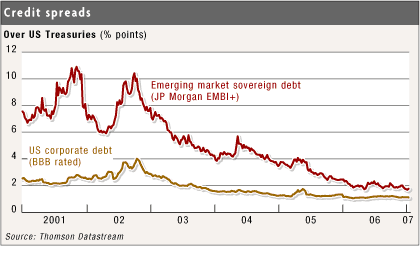
At the same time, financial markets are pricing in an expectation of tranquillity as far as the eye can see. Stock prices in the US are at all-time highs. The risk premiums to cover the possibility of default that corporations or developing countries have to pay to borrow money are at or near historic lows. In addition, estimates of the volatility of the stock, bond and foreign exchange markets inferred from the prices of options are near record lows.
The more persuasive is this “liquidity” story, the more plausible it becomes that the correction is going to be more painful than conventional wisdom believes.
Commenting on Wolfgang Münchau and Lawrence Summers
Martin Wolf, FT 10/1 2007
Reflections on Global Account Imbalances and Emerging Markets Reserve Accumulation
Lawrence H. Summers, March 24, 2006
Harvard president warns on global imbalances
Financial Times 28/1 2006
Larry Summers: The US Current Account Deficit and the Global Economy,
Per Jacobsson Lecture, IMF, October 3 2004
Conspiracy
The Memo confirmed every conspiracy freak’s fantasy: that in the late 1990s, the top US Treasury officials secretly conspired with a small cabal of banker big-shots to rip apart financial regulation across the planet.
When you see 26.3 percent unemployment in Spain, desperation and hunger in Greece, riots in Indonesia and Detroit in bankruptcy, go back to this End Game memo, the genesis of the blood and tears.
The Treasury official playing the bankers’ secret End Game was Larry Summers.
http://www.vice.com/en_uk/read/larry-summers-and-the-secret-end-game-memo
