
Home
Economics - Cataclysm -
Stockmarket chrashes - Finanskrisen The Great Recessiom - Secular Stagnation
ZIRP - QE
Niall Ferguson, FT February 10 2010
John Authers, FT 30 January 2018
Räntorna är de lägsta på åtminstone 5 000 år.
Detta betyder att priset på obligationer är de högsta på 5 000 år.
Andreas Cervenka, SvD 27 januari 2016
Rolf Englund blog 13 augusti 2013
zc
Investors start to fret about ballooning US public debt
The CBO calculates that servicing costs will triple in size to nearly $1tn by 2028
Gillian Tett FT 8 November 2018
US government currently pays $1.43bn each day (yes, day) to service its public debt — 10 times more than any other G7 country (Italy is a distant second in this grim league).
What is doubly thought-provoking is that this $1bn bill has materialised when interest rates are still fairly low by historical standards. And that invites a crucial question for the US Congress: what will happen to that debt, and servicing costs, if (or when) interest rates climb to a more normal level?
Until recently, neither investors nor voters seemed to care particularly.
US government deficit will be (drumroll, please) approximately $1.4 trillion per year for the next five years, which will mean $29 trillion total debt by 2024.
And that’s without a recession. Throw in a recession, and we’ll get to $30 trillion long before then.
Stocks just a sideshow to the real drama of bond markets
Banking’s diminished role in lending has enormous, still under-appreciated implications
Robin Wiggglesworth FT 2 November 2018
U.S. inflation is the world's most important economic variable.
CNBC 8 October 2018
Starting this month and for an indefinite period, the Fed will be dumping existing Treasury debt into the bond pits at a $600 billion rate---even as the borrowing requirement during the year now underway is projected to soar toward the $1.2 trillion mark.
That means there will be $1.8 trillion of homeless Federal debt swirling around the financial markets,---and it will eventually be absorbed.
The huge question, of course, is a what yield
David Stockman October 5th, 2018
Stockman: The mother of all yield shocks
The ECB has bought €2.5tn of eurozone debt securities under a QE programme that is set to stop at the end of this year.
The central bank’s monthly purchases halve to €15bn of bonds in October.
FT 4 October 2018
The chance of an inflation shock may be higher than you think
Dan McCrum FT Alphaville 13 August 2018
The funny thing is that Trump has an overwhelming case.
US experienced its last annual trade (goods) surplus in 1975.
David Stockman 5 March 2018
$2.34tn of treasuries will be sold in the next two years.
The main, obsessive focus for debate around the Fed right now is whether it will raise policy rates three or four times this year.
Gillian Tett 7 June 2018
But if Urjit Patel, the governor of India’s central bank, is correct, this obsession with US interest rates misses the point.
The US central bank is planning to shed trillions in assets, but markets are calm
Gillian Tett FT 1 March 2018
This turnround is remarkable, particularly now that we are in uncharted waters.
More specifically, after quadrupling its balance sheet between 2009 and 2017, the Fed is now trying to shed an eye-popping $2tn of assets in a mere four years.
Nothing remotely like that has ever been attempted by a central bank.
Wall Street players - including the financial press - have been prospering inside the Bubble so long that they do indeed think it is reality.
We had a close encounter yesterday during an appearance on CNBC.
David Stockman 28 February 2018
The thirty-something anchors were shocked to hear that Washington's upcoming $1.8 trillion 2019 Treasury borrowing might generate a resounding "yield shock",
thereby upending the current huge stock market bubble where 4%+ bond yields are most definitely not priced in.
Inflation risk spooks equity markets (nice charts)
Lars Christensen, 14 February 2018
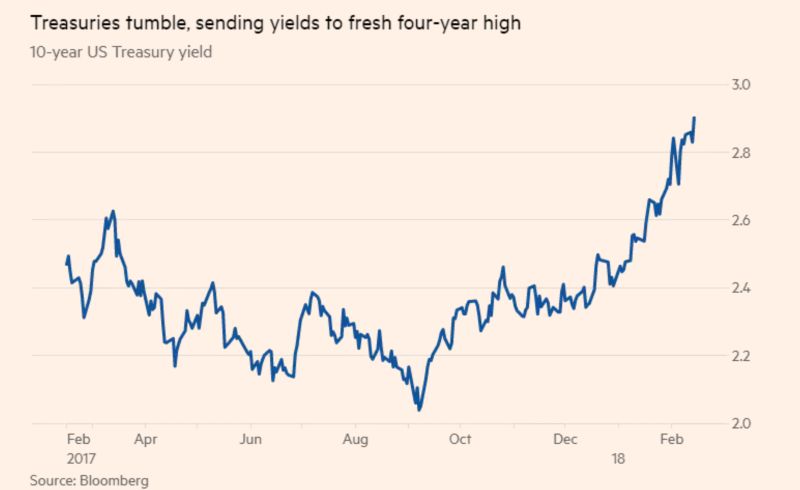
Increase in US inflation sparks bond market sell-off
Treasury yields hit 4-year highs as Wall St fears sharper rate increases
FT 15 February 2018
Man Who Says "Bubbles Only Identified When They Burst" Detects Bubbles
Alan Greenspan says there are "Bubbles in Stocks and Bonds".
Mike "Mish" Shedlock, 2 February 2018
Vincent Deluard of INTL FCStone
I believe that 2018 will be the mirror opposite of 1999.
A triple squeeze will drain global excess savings: the U.S. will become the world’s largest oil producer,
Germany will abandon its policy of budget surpluses, and India’s economic growth will outstrip China’s.
The three gluts arose together, and together they will vanish.
Who will supply the world’s capital after the retirement of these massive hoarders?
John Authers, FT 7 February 2018
It will take much higher yields to convince Americans and other impecunious borrowers to quit their decade-long addiction to foreign savings. Hence, my answer to the original question is that yields will rise much higher, and that the bond bear market will last much longer.
I hate to admit this, but I think I have found a good historical parallel for what is happening in the markets.
And it is with spring and summer of 2007, on the eve of the credit crisis.
John Authers, FT 6 February 2018
No hedge fund that wishes to survive is going to sit patiently on their repo silos at 95% leverage
To the contrary they are likely to not only begin selling with malice aforethought,
but also to actually pivot to the other side.
David Stockman, Friday, February 2nd, 2018
That is, start "shorting" what in effect the Fed has announced it will be shorting to the tune of $600 billion per year commencing next October.
Rädslan sprider sig efter apokalyptiskt börstapp
SvD 4 februari 2018
Tappet med 666 punkter i fredags fick Twitter att explodera. Sifferkombinationen är nämligen en biblisk symbol för ett odjur som visar sig under apokalypsen: "Number of the beast".
A bond market shock of biblical proportions is now just around the corner
David Stockman, Thursday, February 1st, 2018
At the same time, the casino gamblers have built an edifice of grotesquely inflated financial asset prices that depend entirely on the ultra-low yields and cap rates that have been confected by the central banks and their front runners.
The pity is that a bond market shock of biblical proportions is now just around the corner---yet neither end of the Acela Corridor sees it coming.
So now is the time to head for the emergency exits.
---
Acela is Amtrak's flagship service along the Northeast Corridor (NEC) in the Northeastern United States
between Washington, D.C. and Boston via 14 intermediate stops including Baltimore, Philadelphia, and New York City. /Wikipedia
US bond market sell-off deepens
10-year Treasury yield rises to fresh four-year high at just under 2.8%
FT 2 February 2018
“We think that the current level of rates do not yet pose a major risk for equity multiples,” Marko Kolanovic, a senior strategist at JPMorgan, wrote in a note on Thursday.
Cash it's not about a return on your money; it's about return of your money.
Mitch Goldberg, CNBC 1 February 2018
The next global economic downturn – probably in 2019 – will be traumatic for everybody,
given that we have already used up our monetary and fiscal powder, and exhausted popular consent for globalisation.
Ambrose Evans-Pritchard 31 January 2018
Resistance is broken. Now what?
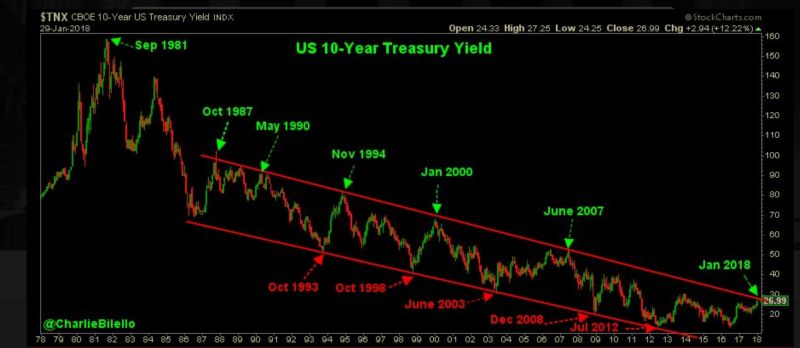
US Treasury yields on Monday broke through what had long been billed as an important point of resistance, at 2.66 per cent, and rose above 2.7 per cent.
That appeared to break the fabled long-term downtrend in 10-year Treasury yields
John Authers, FT 30 January 2018
Big questions to be answered concern timing, consequences and even what is meant by ‘normalisation’
Prophets of doom predict (or hope) that the world will at last suffer for the sins of activist central bankers.
Martin Wolf, FT 21 January 2018, state of the art article with nice charts
On timing, the BIS is far from alone in arguing that policy should have tightened long ago.
If central banks do not deliver a robust economic take-off, they will surely fail to achieve the policy room they would like. Yet, even if they do achieve such a take-off, they may still not gain that room because the new normal turns out different from the old one. Worse, if pessimists are right, the policies used to achieve take-off may raise the chances of a subsequent crisis.
Wells Fargo's head of interest rate strategy is detecting a major trouble spot in the bond market.
Michael Schumacher's chief concern right now: Who's going to buy all those extra Treasury notes?
CNBC, 25 Jan 2018
---
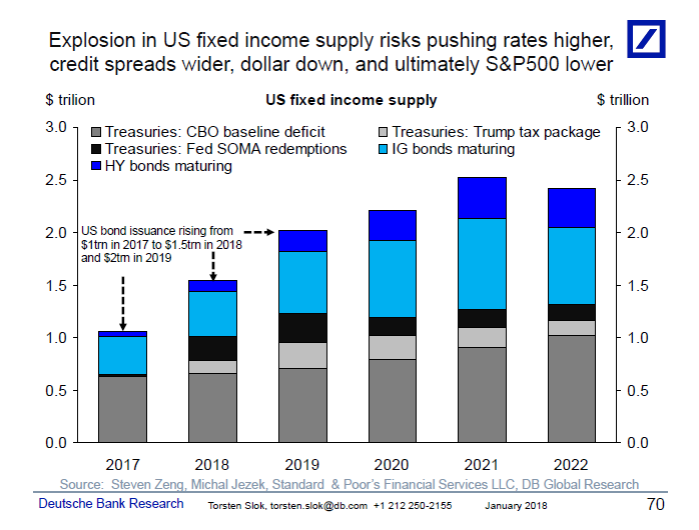
As the US Treasury gets set to issue upwards of $1.2 trillion of new bonds in the fiscal year (2019) starting in October
and the Fed ramps its bond dumping rate to $600 billion per year, the question recurs:
Who is going to buy $1.8 trillion of bonds within a 12-month period at current rates (2.65%).
David Stockman 26 January 2018
We'd lay odds on nobody.
And we'd further bet that the Donald's delusional triumphalism at Davos will soon be mocked by the bond market carnage that lies just around the bend.
zerohedge.com/news/2018-01-22/we-cant-pretend-interest-payments-arent-rising-anymore
Treasury Department to issue $1 trillion of debt in 2018,
almost double the amount seen in 2017
Market Watch 16 January 2018
“All the market indicators right now look very similar to what we saw before the Lehman crisis,
but the lesson has somehow been forgotten,” said William White
Ambrose Evans-Pritchard, 22 January 2018
The latest stability report by the US Treasury’s Office of Financial Research (OFR) warned that a 100 basis point rate rise would slash $1.2 trillion of value from the Barclays US Aggregate Bond Index, with further losses once junk bonds, fixed-rate mortgages, and derivatives are included.
Margin debt on Wall Street has risen to an all-time high, as has the share of risky bonds with minimal protection.
William White is the Swiss-based head of the OECD’s review board and ex-chief economist for the Bank for International Settlements.
Bill White world’s central banks were making a mistake with their single-minded focus on monetary policy, Mauldin
Starting in 2003, officials at the Basel-based institution, started to warn that the world economy was plagued by excessive levels of debt.
This made the system dangerously distorted; so went the off-the-record murmurs from men such as William White (a genial Canadian, BIS chief economist) and Claudio Borio (an Italian, who was White’s deputy).
Gillian Tett
Derivatives contracts indicate that investors believe the 10-year Treasury yield
will be below the 3 per cent mark in two, five and even 10 years’ time.
Robin Wigglesworth, FT 12 January 2018
Equivalent German and Japanese bond futures show that investors think their benchmark bond yields will stay below 2 per cent and 1 per cent respectively over the same timeframes.
The global bond rout has begun, leaving equities on borrowed time
Ambrose Evans-Pritchard, 10 JANUARY 2018
Nobody knows where the pain threshold lies for a global financial system with a record debt ratio of 332pc of GDP – up 56 percentage points even since the Lehman bubble – and with an unprecedented sensitivity to US monetary policy through offshore dollar funding markets.
Nor does anybody know what the breaking point is for a world that has been lured into an "intertemporal" trap by a quarter century of central bank ideology, reducing the Wicksellian natural rate of interest to levels never seen before in the history of modern markets.
We are flying blind.
The Moment of Truth for the Secular Bond Bull Market Has Arrived
John Mauldin 10 January 2018
Anyone who started investing after 1981 has never experienced a bear market in Treasuries.
The vast majority of today’s investors have only ever invested when Treasury yields are falling.
The $50 Trillion Question for Bonds
Bloomberg 10 January 2018
While calling the turn in bonds, especially in Europe, has been a widow-making trade in recent years, recent moves certainly look like the trend is no longer your friend.
Bond guru Bill Gross signals a new era for Treasury markets
The bond bear market is finally upon us after more than 25 years, bond guru Bill Gross said
CNBC 10 January 2018
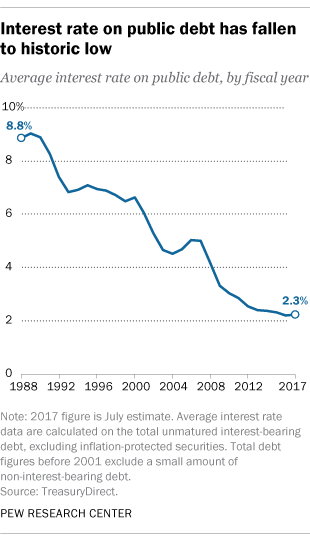
Stock valuations are high by historical standards, the report noted. The cyclically adjusted price-to-earnings ratio of the S&P 500 is at its 97th percentile relative to the last 130 years.
In the bond market, sensitivity of bond prices to interest rate moves has steadily increased since the crisis, the report said.
In early 2017, the duration of the Barclays U.S. Aggregate Bond Index reached an all-time high of just over six years.
At current levels of duration, a 1 percentage point increase in interest rates would lead to a decline of almost $1.2 trillion in the securities underlying the index.
The risks from a big stock or bond market drop ‘are high and rising,’ government watchdog says
https://www.marketwatch.com/2017-12-05
The Office of Financial Research (OFR)
Republican tax package will definitively put an end to 36-year upswing for Treasuries
With hindsight, we can identify the inflection point as July 5 this year when 10-year Treasuries closed at a rock bottom yield of 1.37 per cent.
John Plender 5 December 2017
While William McChesney Martin had famously remarked that the task of central bankers was to take away the punchbowl just as the party gets going, monetary policy was reactive rather than pre-emptive and conspicuously slow
We’re in bubble territory again, but this time might be different
Martin Wolf, FT 10 November 2017
“The real problem is that when the bond-market bubble collapses, long-term interest rates will rise,” Greenspan said.
“We are moving into a different phase of the economy -- to a stagflation not seen since the 1970s.
That is not good for asset prices.”
Bloomberg 1 August 2017
“By any measure, real long-term interest rates are much too low and therefore unsustainable,” the former Federal Reserve chairman, 91, said in an interview.
Hedge funds that built up bullish long-end Treasury wagers to the highest outright level since 2008 are
rushing for the exit as a government bond rout that started in Europe following a weak French debt auction
is spreading to the U.S. market.
Bloomberg 6 July 2017
This may be just the beginning according to DoubleLine Capital’s Chief Executive Officer Jeffrey Gundlach
Keep Eye on Sovereign Debt for Next Minsky Moment
The recent turmoil in bonds offers a good example of what's to come as the global economy recovers
and central bankers curb stimulus.
Alberto Gallo, Bloomberg 5 juli 2017
This time around the issue isn't only excess debt -- it is also that prolonged loose monetary policy may have left us with at least three collateral effects.
The first is a misallocation of economic resources.
The second is a rise in wealth inequality, where the wealth effect from rising asset prices benefited asset owners and the old more than the young and the poor.
The third is a suppression of risk premia and volatility across financial markets.
But the biggest worry for investors is that the calm environment established by QE may conceal a storm, and that such extraordinary measures may have encouraged the formation of asset bubbles ready to pop when loose monetary policy ends.
Unlike in 2008, the culprit isn't low-quality subprime mortgage debt, but sovereign bond markets.
Bob Michele, head of fixed income for JPMorgan Asset Management, “What they were trying to communicate, is that the 30-year bull market is over and things should go back to normal”.
In this case normal means higher interest rates, which are bad for bond prices, and leads to the second conclusion:
after three decades of mostly falling bond yields, changing course is extremely difficult when prices for trillions of dollars worth of assets hang on every word.
FT 30 June 2017
George Saravelos at Deutsche Bank, who says that out of Sintra emerged “a co-ordinated shift by developed world central banks in a more hawkish direction”. He dubs it “the Sintra pact”.
For investors scrambling to keep pace with a hawkish shift in the world’s biggest central banks,
the second half of 2017 just got a lot more interesting.
Bloomberg 29 June 2017
wikipedia.org/wiki/May_you_live_in_interesting_times
The Federal Reserve might be doing the right thing for the U.S. economy by moving to bring interest rates back up to normal.
But for foreign companies and governments that have borrowed trillions of U.S. dollars, the adjustment could be painful.
Mark Whitehouse, Bloomberg 19 March 2017
Economists may warn that the combination of Trump’s protectionism, big tax cuts, and uncontrolled government borrowing,
coming at a time when the US economy is already near full employment, will ultimately fuel inflationary pressure.
But financial markets simply do not believe this message.
Anatole Kaletskys Project Syndicate 27 March 2018
Both economic analysis and decades of past experience suggest that long-term interest rates tend to fluctuate around the rate of nominal GDP growth.
This rule of thumb implies 30-year rates in the 4-5% range.
Trump’s election has almost certainly ended the 35-year trend of disinflation and declining rates that began in 1981,
and that has been the dominant influence on economic conditions and asset prices worldwide.
But investors and policymakers don’t believe it yet.
Anatole Kaletsky, Project Syndicate 30 January 2017
The Daily Prophet:
Why Is China Dumping Treasuries?
Robert Burgess, Bloomberg 19 January 2017 with nice charts
Foreign investors would hardly want to buy dollar-denominated assets such as Treasuries if they suspected the government actively wanted to depreciate its currency.
In today's auction by the U.S. government of $13 billion in 10-year Treasury
Inflation-Protected Securities demand was so great that primary dealers were left with about 16 percent of the bonds,
the lowest on record in data going back to 2003.
Steering Clear:
How to Avoid a Debt Crisis and Secure Our Economic Future
2015 by Peter G. Peterson
The real number to keep an eye on is 2.6 per cent yield on the 10-year Treasury note, says Bill Gross.
The low-for-long era is over.
This summer, the BoJ and then the ECB both changed their mantra
from whatever it takes to less is more targeting steeper yield curves
and the transmission mechanism of stimulus to the real economy,
moving away from unlimited asset purchases.
Alberto Gallo, FT 27 December 2016
They are right in doing so.
Monetary stimulus without appropriate fiscal action
encouraged misallocation of resources to zombie firms and banks that should otherwise restructure;
created asset bubbles in high dividend equities, property and precious metals, as well as art and collectibles;
and widened the gap in relative wealth between the haves and the have-nots.
- Jag tycker det är skriande uppenbart att räntan världen över är för låg
och att en större del av stimulanserna borde ske via finanspolitiken,
skrev jag i december 2009.
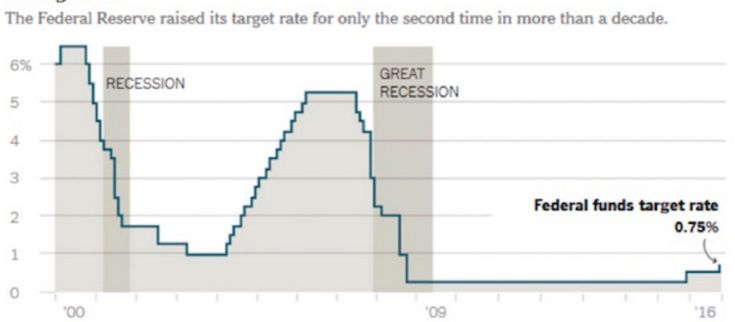
Today’s young Wall Street hotshots have never seen anything like that.
To them the jump from 0.5% to 0.75% must seem like a big deal.
It’s really not.
America’s growing strong dollar conundrum poses a threat to Mr Trump’s vows to slash the trade deficit
FT 13 December 2016
Repeat After me: “Bonds Don’t Necessarily Lose Value When Rates Rise”
Most people don’t apply the right maturity and/or duration to their portfolios
Cullen Roche
What is the Worst Case Scenario for Bonds?
Cullen Roche
November 2018 will mark the tenth anniversary of quantitative easing (QE)
— undoubtedly the boldest policy experiment in the modern history of central banking.
Stephen S. Roach 30 July 2018
The only thing comparable to QE was the US Federal Reserve’s anti-inflation campaign of 1979-1980, orchestrated by the Fed’s then-chair, Paul Volcker.
But that earlier effort entailed a major adjustment in interest rates via conventional monetary policy.
By contrast, the Fed’s QE balance-sheet adjustments were unconventional and, therefore, untested from the start.
Era of quantitative easing is drawing to a close
arguably the greatest monetary policy experiment since John Law began dabbling with fiat paper money in France
Robin Wigglesworth, FT 8 December 2016
Markets have already decided that 2016 is the year when the economic stimulus baton switches hands from central banks to governments.
The Mississippi Bubble of 1720 and the European Debt Crisis
Liberty Street Economics
internetional.se/shares.htm#tulip05
Interest rates follow very long-term cycles.
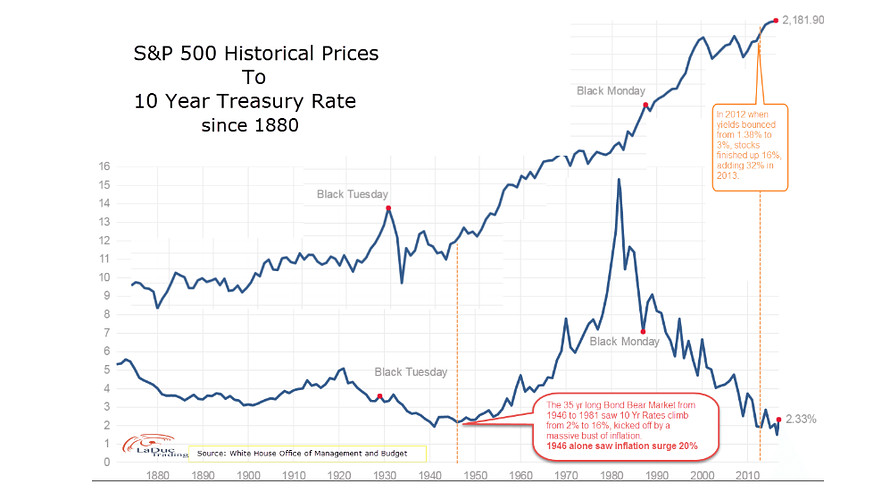
Now we need real demand and moderate inflation to grow us out of this predicament,
as we can’t rely on corporate investment (other than in stock buybacks, dividends and acquisitions)
or consumer spending (if consumers don’t have the money to spend).
US Treasuries sell-off continues as inflation fears mount
Dollar at 13-year high after economic data bolster case for rate rise
FT 23 November 2016
Reinforced the view that the multi-decade bond bull market has reached a turning point.
Global Bonds Suffer Biggest Crash In Over 25 Years
zerohedge 18 November 2016
Bond-market losses will be huge, and retirees are most vulnerable
"Investors unprepared for rising interest rates"
So says Ric Edelman, executive chairman of Edelman Financial Services a financial planning firm that manages $17 billion
MarketWatch 17 november 2016
Barron’s named the firm the nation’s No. 1 independent financial advisor in 2009, 2010, and 2012.
He is also author of the recently updated bestseller “Rescue Your Money.”
He is also author of the recently updated bestseller “Rescue Your Money.”
Investors unprepared for rising interest rates, top financial adviser Ric Edelman tells Howard GoldWhile people think they’re being prudent by avoiding stocks, they are actually taking on more risk piling into bonds.
Bond valuations are the Achilles heel of markets
Investors seem to have concluded that this is the beginning of the end of unconventional central bank monetary policy.
Investors can, of course, change their minds.
John Plender, 1 November 2016
The equity market is less obviously in bubble territory, though it remains remarkably buoyant on the back of poor corporate earnings. On a cyclically adjusted basis price earnings ratios look very expensive.
Yet the market is supported by a large volume of corporate buying through takeovers and buybacks.
Now, some strategists and investors think that the linkers
— inflation-linked government bonds — trade is back on
FT 20 October 2016
But
Excellent article by John Authers about Why bond yields are so low
FT 20 October 2016
How can anyone make sense of today’s markets?
Gillian Tett, FT 14 October 2016
By reducing the incomes of retirees and terrifying near-retirees,
the Fed successfully reduced economic activity.
John Mauldin 9 October 2016
Ray Dalio Warns A 1% Rise In Yields Would Lead To Trillions In Losses
zerohedge 8 October 2016
Dalio pointed out that thoughts which dared to question the economic orthodoxy, and which were once relegated to the fringe blogs,
have become the norm, pointing out that it is no longer controversial to say that:
…this isn’t a normal business cycle and we are likely in an environment of abnormally slow growth
…the current tools of monetary policy will be a lot less effective going forward
…the risks are asymmetric to the downside
…investment returns will be very low going forward, and
…the impatience with economic stagnation, especially among middle and lower income earners, is leading to dangerous populism and nationalism.
Globally, the stock market is about $69 trillion in size,
trading about $191 billion in shares per day.
The bond markets are well north of $140 trillion,
and trade about $700 billion in volume per day
zerohedge 4 October 2016
What should you do if Trump is right about a bond bubble?
Nigam Arora, MarketWatch Sept 29, 2016
In the first presidential debate, Donald Trump said,
"Now, look, we have the worst revival of an economy since the Great Depression.
And believe me: We're in a bubble right now. And the only thing that looks good is the stock market,
but if you raise interest rates even a little bit, that's going to come crashing down.
“We are in a big, fat, ugly bubble. And we better be awfully careful. And we have a Fed that's doing political things.
This Janet Yellen of the Fed. The Fed is doing political — by keeping the interest rates at this level.
And believe me: The day Obama goes off, and he leaves, and goes out to the golf course for the rest of his life to play golf,
when they raise interest rates, you're going to see some very bad things happen, because the Fed is not doing their job.
The Fed is being more political than Secretary Clinton."
Old Mutual Global Investors Ltd., which oversees the equivalent of about $436 billion,
says a policy change aimed at steepening the yield curve wouldn’t be surprising, even though it would come at the expense of bondholders.
“It would definitely see some pain,” said Mark Nash, head of global bonds at the London-based fund manager.
“Money flows across borders. It’s all linked.”
The claim that you can capitalize the stock market at an unusually high PE multiple owing to ultra-low interest rates,
therefore, implies that deep negative real rates are a permanent condition, and that governments will be able to destroy savers until the end of time.
The truth of the matter is that interest rates have nowhere to go in the longer-run except up
In his latest just released monthly letter, Bill Gross lays out the global economy as an analogy to Monopoly
where the narrative only works if everyone gets $200 in cash on every rotation around the board.
It’s the $200 of cash (which in the economic scheme of things represents new “credit”) that is responsible for the ongoing health of our finance-based economy.
Without new credit, economic growth moves in reverse and individual player “bankruptcies” become more probable.
And without banks creating new loans and injecting money into the broader economy, economic activity grinds to a halt.
Bill Gross $10tn negative-yield bonds a ‘supernova that will explode one day’
FT 10 June 2016
Trump, Englund och sedelpressarna
- People say I want to default on debt, You never have to default because you print the money
"If interest rates go up, we can buyback debt at a discount if we are liquid enough as a country.
Om man har en sedelpress går man inte i konkurs
Englund blog 10 May 2016
$17 Trillion Of Governments Yield Less Than 1%, Duration Risk Soaring
Investors face damaging losses if yields rise even a little
A half-percentage point increase would wipe out $1.6 trillion
Bloomberg Business 26 April 2016
Investors continuing to buy bonds even when they pay next to nothing suggests deep concern over the state of the global economy.
This month, the International Monetary Fund warned the threat of worldwide stagnation was rising because economic expansion has been so tepid for so long.
BlackRock chief Larry Fink
negative and low interest rates around the world are crushing savers, and
those policies are "going to become the biggest crisis globally."
Fink called on political leaders to step in and provide fiscal reform to complement monetary policy.
"We have become too dependent on central bankers" to boost the global economies, he said, stressing easy money policies were supposed to be a temporary healing.
"I don't call seven, eight years temporary. ... I don't see how that [still] has a positive impact."
Vi kan mycket väl bevittna världshistoriens största och kanske farligaste bubbla.
Räntorna är de lägsta på åtminstone 5 000 år.
Detta betyder att priset på obligationer är de högsta på 5 000 år.
Andreas Cervenka, SVD 27 januari 2016
Statspapper är själva fundamentet i det globala finansbygget.
Det totala värdet av alla världens statsobligationer uppgår till närmare 60 000 miljarder dollar enligt siffror från McKinsey.
Lägg till andra obligationer, där räntan direkt och indirekt påverkas av statslåneräntorna,
och siffran är runt 150 000 miljarder dollar.
I slutet av 2014 var värdet på alla världens aktiemarknader cirka 70 000 miljarder dollar.
Increasingly hysterical calls for negative interest rates, helicopter money and the like look premature
The era of zero interest rates has a lot longer to run yet.
Real rates of return, traditionally in the 2.5pc to 3pc range, are virtually impossible to come by
Jeremy Warner, 6 Feb 2016
Last month, the Fed lifted interest rates for the first time in nine years, and short-term bond yields have duly climbed higher.
But longer-term Treasury bonds have shrugged, with yields actually falling since the US central bank tightened monetary policy.
Robin Wigglesworth, Financial Times 7 January 2016
In all, the massive speculation unleashed in the equity markets since the March 2009 bottom
has caused more than $5 trillion of current cash flow and new debt to be allocated to corporate stock buybacks, M&A deals and LBOs.
The stock market is thus a creature of financial engineering, not a mechanism for efficiently allocating capital and accurately pricing prospective risk and return.
David Stockman, October 20, 2015
What I wish George Will, Bill Gross, and other free market advocates would consider is
the possibility that the Fed itself is not the source of the low rates, but simply is a follower of where market forces have pushed interest rates.
That is, the Great Recession and the prolonged slump that followed caused interest rates to be depressed and the Fed did its best to keep short-term interest rate near this low market-clearing level.
Economists view 20 October 2015
"We are at a sharp inflexion point," says Charles Goodhart, a professor at the London School of Economics and a former top official at the Bank of England.
As cheap labour dries up and savings fall, real interest rates will climb from sub-zero levels back to their historic norm of 2.75pc to 3pc, or even higher.
The implications are ominous for long-term US Treasuries, Gilts or Bunds. The whole structure of the global bond market is a based on false anthropology.
Ambrose Evans-Pritchard, 23 September 2015
The working age cohort was 685m in the developed world in 1990. China and eastern Europe added a further 820m, more than doubling the work pool of the globalised market in the blink of an eye.
"It was the biggest 'positive labour shock' the world has ever seen. It is what led to 25 years of wage stagnation," said Prof Goodhart, speaking at a forum held by Lombard Street Research.
The handling of the current financial crisis has reinforced too big to fail doctrine.
So how can one reduce moral hazard and reduce expectations of future bail-outs?
Living wills to curtail too-big-to-fail, perhaps even thereby allowing systemically important banks, such as Citigroup, Goldman Sachs or Barclays, to fail or, at least, to be unwound.
Charles Goodhart and Dirk Schoenmaker, FT August 9 2010
Throughout this extraordinary monetary experiment managers of listed companies have been reluctant to invest in fixed assets
despite enjoying the lowest borrowing costs in history.
By contrast financial institutions have been fearless in propelling markets ever higher.
John Plender, FT 6 august 2015
This dichotomy between subdued risk taking in the real economy and aggressive risk taking in financial markets has prompted Angel Gurría, secretary-general of the Organisation for Economic Cooperation and Dev-elopment, to remark that one or other of these views will be proved wrong.
The folk in Basel believe that low interest rates beget yet lower rates because they cause bubbles, followed by central bank bailouts.
Their worry is that we risk trapping ourselves in a cycle of financial imbalances and busts. .
Escaping from this once-in-5,000-year aberration may thus require Houdini-like skills.
The U.S. agency that monitors risks in the financial sector in the wake of the Great Recession
doesn’t yet understand why there have been an increasing number of sharp selloffs in U.S. and European bond markets,
the head of the organization said Monday.
MarketWatch 8 June 2015
The recent selloff wiped out about $1.2 trillion in value from the global bond market
And holders of debt globally are more exposed to the potential for big losses than at any time in history,
based on a metric known as duration.
Bloomberg 8 June 2015
After all, the potential for losses is now greater than at any time on record, based on duration levels for $50 trillion of debt tracked by Barclays Plc.
If yields on 10-year Treasuries rose to 3 percent by year-end, investors today would face losses of 3.6 percent.
Output is financially sustainable when spending patterns and the distribution of income are such that the fruit of economic activity can be absorbed without creating dangerous imbalances in the financial system.
It is unsustainable if generating enough demand to absorb the output of the economy requires too much borrowing, real rates of interest rates that are far below zero, or both.
Martin Wolf, FT 14 April 2015
Bonds beware as money catches fire in the US and Europe
The broad M3 money
"Forecasters ignore broad money at their peril," says Gabriel Stein, at Oxford Economics.
A dynamic measure of eurozone M3 known as Divisia - tracked by the Bruegel Institute in Brussels - is back to growth levels last seen in 2007.
Ambrose Evans-Pritchard, 15 Apr 2015
The developed world seems to be moving toward a long-term zero-interest-rate environment.
Though the United States, the United Kingdom, Japan, and the eurozone have kept central-bank policy rates at zero for several years already,
the perception that this was a temporary aberration meant that medium- to long-term rates remained substantial.
If debt can be rolled over forever at zero rates, it does not really matter – and nobody can be considered insolvent.
Daniel Gros, Project Syndicate 10 April 2015
In an environment of zero or near-zero interest rates, creditors have an incentive to “extend and pretend” – that is, roll over their maturing debt, so that they can keep their problems hidden for longer. Because the debt can be refinanced at such low rates, rollover risk is very low, allowing debtors who would be considered insolvent under normal circumstances to carry on much longer than they otherwise could.
After all, if debt can be rolled over forever at zero rates, it does not really matter – and nobody can be considered insolvent. The debt becomes de facto perpetual.
Governments do know how to stop a slide into another Great Depression. But, governments are haunted by fears of large fiscal deficits.
They have relied on monetary expansion, which is politically more acceptable, but also much weaker in its effect
Robert Skidelsky:, Project Syndicate 22 January 2015
Claudio Borio
Low inflation, bond yields and interest rates around the world will push the boundaries of economic and political stability to breaking point
if they continue on their downward trajectory, the Bank for International Settlements has warned.
Szu Ping Chan, Telegraph 18 Mar 2015
The Swiss-based "bank of central banks" said the "sinking trend" of global rates would push countries further into uncharted territory.
It highlighted that $2.4 trillion (£1.6 trillion) of long-term global sovereign debt was now trading at negative yields,
with an increasing number of investors willing to pay governments for the privilege of lending to them.
"As bond markets show us day after day, the boundaries of the unthinkable are exceptionally elastic," said Claudio Borio, head of the Monetary and Economic department at the BIS.
Why are interest rates so low? The best answer is that the advanced countries are still in a “managed depression”. This malady is deep. It will not end soon.
The fact that vigorous programmes of monetary stimulus have produced such meagre increases in output and inflation indicates just how weak economies now are.
The explosions in private credit seen before the crisis were how central banks sustained demand in a demand-deficient world. Without them, we would have seen something similar to today’s malaise sooner.
Martin Wolf, FT March 17, 2015
The Fed put
Federal Reserve uttered the single word “patience” and everything changed.
On Wednesday the stock market rose 2 per cent and on Thursday the Dow Jones Industrial index had its best day in three years.
The market dependence on Fed policy has never seemed greater
Financial Times December 19, 2014
Despite the fact that the Fed message also noted that rate increases could come as early next spring.
The game of chicken between the Fed and the markets is on once more.
Every time it seems that we are finally drawing to an end of easy money, something (or things) in the world go wrong and only Fed forbearance and patience can soothe the markets.
The flow of Opec petrodollars into global financial markets is set to dry up
as the collapse in the oil price delivers a $316bn hit to the cartel’s revenues.
The $316bn figure would be much higher if other big oil exporters including Russia,
Norway, Mexico, Kazakhstan and Oman are taken into account.
Financial Times, 3 December 2014
Gavyn Davies, The very long run equity bull market and
Lawrence Summers and Paul Krugman on secular stagnation
Gavyn Davies, FT blog, Nov 09 2014
Greenspan said that the Fed’s quantitative easing has failed in one of its goals, to spur demand.
Inflation is “dead in the water” because effective demand is “dead in the water,”
But quantitative easing has been a “terrific success” in getting the real rate of return on long-term assets down,
boosting all income-earning assets.
MarketWatch 29 October 2014
“It hasn’t been a success in the demand side,” he said, because banks are simply parking the reserves at the central bank.
“They just let it sit. Unless or until that happens, you don’t galvanize economic activity,” he said.
“When that starts, all things can happen - and not all of them are good,”
Strategin synes vara att det gäller att stabilisera, helst höja, villapriserna
så att konsumenterna främst i USA skall återgå till att konsumera med lånta pengar, dvs just det som ledde fram till katastrofen.
Detta kan inte vara klokt.
Det skrev jag på min blogg första gången den 5 december 2009.
Nu skriver jag det igen.
Rolf Englund blog 28 October 2014
Systems flooded with cash can sometimes freeze.
Having lots of money in the system does not guarantee that funding will flow freely
Gillian Tett, FT October 16, 2014
Since the 2008 crisis, western central banks have flooded the system with cash and expanded their balance sheets by – depending on how you calculate it – an eye-popping $7tn-$10tn.
But the problem with “liquidity” is that the word can mean several things; having lots of money in the system does not guarantee that funding will flow freely, or that traders can cut deals.
Forward-looking credit swaps already suggest that
Fed will not be able to raise interest rates next year, or the year after, or ever, one might say.
Put another way, it is possible that the world economy is so damaged that it needs permanent QE just to keep the show on the road.
Ambrose Evans-Pritchard, 15 October 2014
A rocky exit from low interest rates by the Federal Reserve risks
$3.8 trillion of losses to global bond portfolios,
IMF warned in its latest global financial stability report.
MarketWatch 8 October 2014
GLOBAL FINANCIAL STABILITY REPORT (GFSR)
Risk Taking, Liquidity, and Shadow Banking: Curbing Excess While Promoting Growth
October 2014
There is no bond market bubble
Using the Mankiw rule to predict US monetary policy 10-years ahead
The Market Monetarist/Krugman, 20 September 2014
I find it very hard to see why US bond yields should suddenly spike 200 or 300bp as some of doomsayers are claiming.
And finally I should stress that this is not investment advice and I am not making any recommendations to sell or buy US Treasury bonds and the market might go in whatever direction.
Don’t confuse brilliance with a bull market
I’ve noticed that many long-time bears are capitulating. If you look at market history, when bulls feel invincible and beaten-down bears give up, you have the makings of a market top.
When the Fed attempts to extricate itself from the market one day, that’s when the music stops, and the blame game begins.
MarketWatch, Michael Sincere 23 September 2014
Hindsight is a wonderful thing, especially when it comes to explaining market crashes.
The glaringly obvious guide to the next crash
James Mackintosh, FT September 21, 2014
International bond issuance, fuelled by ultra-low western interest rates, continues to swell:
Exotic issuers such as Pakistan, Zambia, Mongolia and Ecuador have successfully issued debt
Governments and companies in emerging markets have issued $796bn in debt this year,
compared with $734bn in 2013, according to Dealogic data.
FT 6 August 2014
Good recap of Argentina Passi Passu
Greenspan, 88:
How to unwind the huge increase in the size of Feds balance sheet with minimal impact.
It is not going to be easy, and it is not obvious exactly how to do it.
Interview with Alan Greenspan, MarketWatch 24 July 2014
Without asset-market surveillance, you do not have an integrated view of how the economy works.
How to respond to asset-price change is a legitimate issue. But not to monitor it, I think, is clearly a mistake.
Greenspan: I happen to agree that bubbles are primarily an issue to be addressed by regulation.
Low interest rates ‘ruining’ insurers
FT June 24, 2014
For decades, economic growth in America was driven by a powerful and sustainable force: increased consumption paid for by the rising incomes for middle-class and working-class Americans. But somewhere around 1980, that model broke down.
And now, with the economy only partially healed, it seems we’re going back to the lend-and-spend economy that failed us before.
Rex Nutting, MarketWatch 27 juni 2014
But somewhere around 1980, that model broke down. Wages flattened out, but consumption didn’t. Americans cut back on their savings, and took on more debt — mostly mortgage debt — to satisfy their needs and desires.
It’s not a sustainable model, but it did persist for nearly 30 years until the credit bubble burst in 2007. Millions of Americans lost their jobs, and millions lost their homes when the credit spigot was shut off, forcing average families to cut back on their consumption and live within their means once again.
And now, with the economy only partially healed, it seems we’re going back to the lend-and-spend economy that failed us before.
Full text"Battle raging between the world’s leading macroeconomists"
The European Central Bank has found itself caught in the crossfire
The Bank for International Settlements’ call last month has reignited the debate over how to explain – and tackle –
the financial and economic turmoil that has persisted over the past six years.
The debate is so fierce, the viewpoints so distinct, that two of the world’s leading multilateral organisations,
the BIS and the International Monetary Fund, have completely different ideas on what the ECB’s next step should be
FT Money Supply blog 14 July 2014
Ekonomerna mer oense än någonsin
Rolf Englund blog 2014-07-15
Infrastrukturinvesteringar har blivit det fikonlöv bakom vilket åtstramningens kolportörer
gömmer det faktum att nu även de vill stimulera ekonomin genom ökad efterfrågan.
Rolf Englund blog 15 juli 2014
På Gripenstedts tid var Sverige ett av Europas fattigaste länder, med hungersnöd år 1868.
Utan de stora statsfinansiella underskotten hade konungariket varit mindre skuldsatt, men utan järnvägar.
Carl-Johan Westholm, Liberal Debatt nr 3, publicerad på nätet den 19 maj 2014
For Prof Krugman, the BIS is another example of those who have been wrong about the crisis,
but refuse to acknowledge it and have to keep on inventing new bogey men to justify their point of view.
Except that as far as I can see it's precisely the reverse.
The BIS was one of the few international bodies to come anywhere close to predicting the crisis.
Jeremy Warner, 14 July 2014
If it sees the same mistakes being repeated again, then perhaps we should all sit up and take a bit of notice.
BIS's main point – that you cannot for ever rely on ever rising levels of debt as the main engine of growth – is surely correct.
Besides, any organisation that constantly attacks the policies of its owners, the world's major central banks, strikes me as entirely healthy in its own right, whether mistaken or not.
Liquidationism in the 21st Century
Paul Krugman JULY 12, 2014

BIS chief fears fresh Lehman from worldwide debt surge
Jaime Caruana says investors are ignoring prospect of higher interest rates in the hunt for returns
Ambrose Evans-Pritchard 13 July 2014
The world economy is just as vulnerable to a financial crisis as it was in 2007, with the added danger that debt ratios are now far higher and emerging markets have been drawn into the fire as well, the Bank for International Settlements has warned.
Jaime Caruana, head of the Swiss-based financial watchdog, said investors were ignoring the risk of monetary tightening in their voracious hunt for yield.
“Markets seem to be considering only a very narrow spectrum of potential outcomes. They have become convinced that monetary conditions will remain easy for a very long time, and may be taking more assurance than central banks wish to give,” he told The Telegraph.
The analytical underpinnings of the current phase of risk taking in financial markets are far from robust.
Less pleasant scenario – that of stagflation and greater financial instability.
Mohamed El-Erian, FT 14 July 2014
BIS Slams the Fed
"A Controlled Collapse?"
I propose Yellen is clueless. If she had any sense, she would have acted in advance to prevent an asset bubble
or at least stall the one Bernanke had started.
The Fed is not going to attempt a controlled collapse.
Yet, a collapse is coming. It will be anything but controlled.
Mike "Mish" Shedlock, 11 July 2014
An article on ZeroHedge entitled "Is The Fed Going To Attempt A Controlled Collapse?"
The question stems from lengthy (256 page PDF) from the BIS Annual Report
I will address the absurdity of that notion momentary, but first please consider some snips from the BIS report that caught my attention.
BIS
Investment by businesses is the key ingredient to cut our reliance on debt-fuelled current expenditure by consumers or the state
But there is a deeper issue to be tackled:
why does the economy have to be stimulated in artificial ways through the boosting of lending
Roger Bootle, Telegraph 6 July 2014
BIS warned that ultra-loose monetary policy risked causing another financial crisis.
It argued that interest rates should be raised, and indeed returned to normal, sooner rather than later.
BIS was one of the few institutions to warn of the coming financial crisis that shook the world in 2008.
Believe it or not, central banks, markets and the academic community had all lost sight of the fragility of the financial system and the importance of financial stability.
The BIS case was that ultra-loose monetary policy had engineered a false boost to demand by strengthening spending based on debt,
and by encouraging a regime in which credit risk was not properly assessed.
As a result, when a large shock arrived the system would shudder, if not collapse.
That is exactly what happened.
But there is a deeper issue to be tackled: why does the economy have to be stimulated in artificial ways through the boosting of lending to dodgy borrowers?
The main culprit is Germany. It is running a current account surplus of 7½pc of GDP.
Over the last 18 years, German consumer spending has grown by only 18pc, compared with a 53pc increase by UK consumers.
The second source of the world’s deflationary tendency is continued under-spending by two main groups of surplus countries: oil producers and the Asian emerging markets
There is now a gaping cavern between the interest rates available to retail savers and the rates of return sought by industrial and commercial companies when considering their investments.
As a retail saver you might be lucky to get 1pc or 2pc a year. Yet companies turn their noses up at projects which do not yield more than 10pc, sometimes 15 or even 20pc.
If spare capacity in the west were taken up by investment in productive plant, machinery and infrastructure, then demand would not need to be boosted by unsustainable mountains of debt.
Roger Bootle's latest book, “The Trouble with Europe”, has just been published.
Kommentar av Rolf Englund:
Javisst, men varför skulle företagen investera om de vet att konsumenterna skall dra ner på sina utgifter?
Grundbultsfrågan: Hur blir S = I ???
Savings and investment, being different activities carried on by different people
Man återkommer ständigt till Keynes och Hayek. Har den ekonomiska "vetenskapen" inte kommit längre?
Rolf Englund blog 8 juli 2014
Leonid Bershinksy weeps over the cruel world that for some reason isn’t listening to Jaime Caruana of the BIS,
who warns that we must raise interest rates now now now.
Why is this prophet so lonely? And where are the bond vigilantes?
Paul Krugman, JULY 5, 2014
Well, it might have something to do with the fact that three years ago Caruana and the BIS warned that
interest rates must rise to avert a surge of inflation.
I missed my chance to mark the anniversary, but it’s now five years plus since the WSJ warned that wildly inflationary monetary and fiscal policies were bringing on the bond vigilantes.
I admire the Bank for International Settlements.
It takes courage to accuse its owners – the world’s main central banks – of incompetence.
Yet this is what it has done, most recently in its latest annual report.
Martin Wolf, Financial Times 1 July 2014
It would be easy to dismiss this as the rantings of a prophet of doom. That would be a mistake.
Whether or not one agrees with its pre-1930s view of macroeconomic policy, the BIS raises big questions.
Contrariness adds value.
One can divide the BIS analysis into three parts:
what caused the crisis;
where we are now on the way out of it;
and what we should do.
On the first, the perspective is that of the “financial cycle”.
This analysis goes back to the work of the great Swedish economist Knut Wicksell
"All in all, the report is not good news"
BIS annual report suggests that “monetary policy is testing its outer limits,” and
that advanced economies, including the U.S., need “balance sheet repair and structural reform.”
Investors should take note, as the run-up in U.S. stocks has been driven by central bank accommodation using low interest rates.
MarketWatch 1 July 2014
Although near-zero rates are no longer effective in rallying the economy, they have sent investors into equities.
“Obviously,” the report concludes, “market participants are pricing in hardly any risks … a powerful and pervasive search for yield has gathered, and credit spreads have narrowed.”
All in all, the report is not good news
We must end this addiction to debt as the engine of growth
There has been no serious attempt to get to grips with the financial cycle,
which requires moving away from debt as the engine of growth
Jeremy Warner Telegraph 30 June 2014
In its annual report, Bank for International Settlements (BIS) spelled out
the risks of relying too heavily on monetary policy to stimulate the economy.
BIS warned that central banks including the Bank of England and US Federal Reserve could keep monetary policy loose for too long,
with potentially damaging consequences.
Szu Ping Chan, Telegraph 29 June 2014
BIS Annual Report, 2013/2014
29 June 2014
Jag tycker det är skriande uppenbart att räntan världen över är för låg och att
en större del av stimulanserna borde ske via finanspolitiken.
Rolf Englund, 5 december 2009
Conventional wisdom has it natural interest rates have fallen
With debt in the developed world standing at higher levels than before the financial crisis,
one of the more disturbing threats to financial stability is an unexpectedly sharp rise in global interest rates.
John Plender, Financial Times June 24, 2014
Policy rates. Over centuries these have been remarkably stable.The bank rate in the UK, for example, has averaged around five per cent since the Bank of England came into being in 1694.
The nearest I can find to a plausible case for a near-permanent downward bias to rates is a nightmarish one that comes from the economists at the Bank for International Settlements.
They have long argued that monetary policy making both in the US and elsewhere has been dangerously asymmetric.
Central bankers have failed to lean against booms, while easing aggressively during busts.
This has led to a downward bias in interest rates and an upward debt accumulation habit. Vicious circles result, because it becomes difficult to raise rates without damaging economic growth. At the same time the distortions in production and investment behaviour induced by persistently low rates prevent a return to more normal interest rate levels.
As Stephen Roach, former chairman of Morgan Stanley Asia, has pointed out, The US, is going back to the low saving, excess consumption growth model that prevailed before 2008.
Asset price bubbles and Central Bank Policy, Alan Greenspan
Bank for International Settlements
Fed’s easy money has disconnected markets from the real economy
Junk bond spreads near all-time lows and stocks at record highs
Is it time to sound the alarm over levels in the credit or equity markets?
Henny Sender, Financial Times 6 June 2014
Asset price bubbles and Central Bank Policy
Nils-Eric Sandberg, Stefan Ingves och mysteriet med den försvunna inflationen
Rolf Englund blog 23 mars 2014
but says it could begin scaling back later this year and ending it completely in 2014. BBC, June 20, 2013
In recent years an astonishing amount of money has quietly flooded into fixed income funds,
which buy corporate bonds, emerging markets bonds and mortgage debt.
And as the US looks more likely to raise interest rates, creating potential losses for bondholders,
the flows could reverse – creating destabilising shocks for regulators and investors alike.
Gillian Tett, 13 March 2014
A new paper from the Chicago Booth business school estimates that inflows to global fixed income funds have been almost $2tn since 2008, four times that of equity funds.
Seth Klarman, the publicity shy head of the $27bn Baupost Group
whose investment opinions have attracted a near cult-like following, said that investors were underplaying risk and were
not prepared for an end to central banks reversing a five-year experiment in ultra-loose money.
Financial Times, 10 march 2014
While noting that he could not predict exactly when a significant market correction would occur, Mr Klarman wrote in a private letter to clients:
“When the markets reverse, everything investors thought they knew will be turned upside down and inside out. ‘Buy the dips’ will be replaced with ‘what was I thinking?’?.?.?.?
Anyone who is poorly positioned and ill-prepared will find there’s a long way to fall. Few, if any, will escape unscathed.
Since central banks slashed interest rates to record lows and began a policy of buying up government bonds after the 2008 market crash, the S&P 500 has rallied by more than 150 per cent to new all-time highs.
While the mainstream media is loaded with flattering articles of the Fed’s brilliance in quantitative easing and its stimulus program,
the real beneficiaries of such a policy are the largest banks.
Here Seth Klarman notes they have placed the economy at great risk without achieving much reward.
Mark Melin, March 04, 2014, via John Mauldin
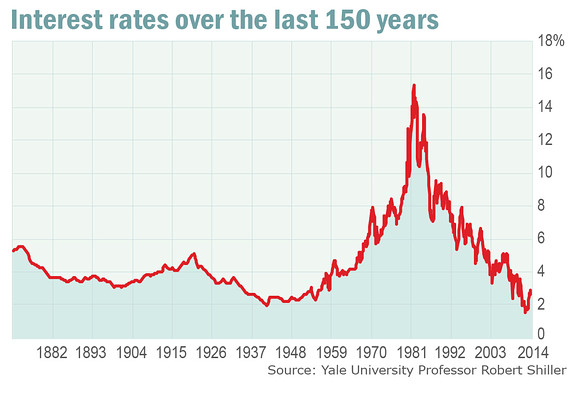
Bonds have been in a major bull market for nearly 33 years
— ever since the 30-year Treasury yield hit its all-time a high of 15.20% on Sept. 29, 1981.
MarketWatch, 25 February 2014
The 10-year’s yield record high came the next day, at 15.84%.
Today, in contrast, the 30-year yield is 3.7% and the 10-year’s is 2.74%.
Anyone whose investment careers began after 1981 has therefore never experienced a bond bear market. Assuming the typical investor doesn’t seriously start thinking about investing until he is 25 or 30 years old, especially about investing in bonds, that means that anyone today not in, or very close to, retirement has only known a bond bull market.
That’s an amazing historical and psychological fact, the significance of which cannot be overstated. It means that very few investors today have the long-term perspective with which to properly assess whether bonds are likely to suffer major declines in coming years.
The U.S. Treasury yield curve has lost its forecasting power
An ideal leading indicator would exclude components such as the yield curve that behave perversely during times of financial stress, said Morgan Stanley economist Ellen Zentner.
She suggested investors look at the Duncan Leading Indicator,
devised in 1977 by Wallace Duncan, then of the Federal Reserve Bank of Dallas.
Bloomberg, Simon Kennedy, Nov 27, 2013
Treasuries have turned anything but risk-free
The global financial system is hostage to a big rise in borrowing costs
when the retreat from QE puts an end to the current era of extraordinarily low interest rates.
John Plender, FT 22 October 2013
If any issue is going to cause surprises in the system in the coming years,
it is not necessarily going to be a credit risk at all;
interest rate risk could be more dangerous.
Gillian Tett, FT October 3, 2013
For the past few years, interest rates have been at rock bottom levels, and it is widely assumed this will continue.
But at some point the cycle will change, either because the central banks eventually tighten policy (in a good scenario), or markets panic (say, after a “technical” default).
And yet – oddly – the issue of interest rate risk gets far less focus in the new regulatory architecture than credit risk.
As Jens Weidmann, Bundesbank president, pointed out in a Financial Times editorial this week, this poses all manner of long-ignored dangers.
Worse still, there has been surprisingly little effort by the official sector to conduct public analysis of what surging interest rates might do to banks or asset managers
At a central bankers’ summit in Jackson Hole, Wyoming, a paper presented by Hélène Rey, economics professor at London Business School, identified a common global financial cycle
driven in part by Fed actions, with asset prices following investors’ risk appetites as measured by “fear gauges” such as Wall Street’s Vix index of expected stock market volatility.
If she is right, the recent turmoil in emerging markets could spread.
Financial Times, August 30, 2013
“If the reversing of easy monetary conditions is serious then, yes, I believe it will go across asset classes,” Ms Rey told the Financial Times. “But if the Fed acts slowly, it will be much easier for portfolios to adjust without major losses – it does depend on the speed.”
Some strategists are more cataclysmic. Not invited to Jackson Hole was Albert Edwards, Société Générale’s famously bearish global strategist,
who warned this week the crisis would not be confined to emerging market economies with yawning current account deficits.
“I see this as the beginning of a process where the most wobbly domino falls
and topples the whole, precarious, rotten, risk-loving edifice that our policy makers have built,” he wrote in a note.
Financial Times, August 30, 2013
Could it really have arrived? Are global stocks about to tank in an all consuming way?
Indeed, is this the moment Albert Edwards has been waiting for since 1996?
Of course, Edwards is perhaps London’s best-known doom-monger when it comes to stocks.
FT Alphaville Monday, March 5th, 2007
Holdings of Treasuries in China, the largest foreign lender to the U.S., fell in June
amid discussion by Federal Reserve officials about slowing the pace their bond purchases.
China’s stake dropped by $21.5 billion in June, to $1.276 trillion,
Bloomberg, August 15, 2013
Why Obama should not pick Summers for the Fed
Even worse, he has warned that policies such as quantitative easing and low interest rates
threaten to create malinvestment and new asset bubbles.
Scott Sumner, Financial Times, August 7, 2013
Professor Summers has argued that the Fed may not be able to control aggregate demand once interest rates hit zero, and therefore that we need to rely on fiscal stimulus.
Even worse, he has warned that policies such as quantitative easing and low interest rates threaten to create malinvestment and new asset bubbles.
Prof Summers is a brilliant economist and would probably display outstanding leadership skills in a banking crisis. But that is not what we need in a 21st century central banker.
The most important monetary trend of the past 30 years is the relentless decline in real yields on Treasury bonds, from 7 per cent to roughly zero. We can debate the causes of the decline, but there is no evidence that it will turn around soon. That means the US economy is likely to hit the zero bound in future recessions, again and again.
Some people seem to believe that large-scale asset purchases by central banks have created bubbles in many markets
and that stopping such purchases (let alone reversing them) must cause big falls in prices.
Others take the view that these central bank purchases are ineffective in stimulating demand in the wider economy.
I think the evidence for either of these positions is weak.
But some people believe both things – a position that I think is also contradictory as well as being profoundly pessimistic.
David Miles, external member of the Bank of England’s Monetary Policy Committee, FT 27 juni 2013
Three more years of zero interest rates
Whether it's in the long term interests of the economy is another matter.
Savers are again punished, and the profligate rewarded.
Jeremy Warner, August 7th, 2013
We know that the longer negative real interest rates persist, the more unbalanced and unsustainable the sort of growth they give rise to becomes.
BIS, which counts the world’s leading monetary authorities as members,
said cheap and plentiful central bank money had merely bought time,
warning that more bond buying would retard the global economy’s return to health.
Financial Times, June 23, 2013
It used its influential annual report to call on members to re-emphasise their focus on inflation and press governments to do more to spearhead a return to growth.
The BIS report comes on the back of last week’s markets turmoil, fuelled by Fed chairman Ben Bernanke’s comments that the central bank could slow its $85bn monthly bond-buying programme this year and end it by mid-2014.Unwinding the world’s biggest economic experiment
Gavyn Davies, FT June 21, 2013
The long retreat from easy monetary policy in the US has begun.
It is close to impossible to doubt that the three-decade bull market in bonds is over.
John Authers, Financial Times, June 21, 2013
The Federal Reserve, it is true, is still buying bonds at a rate of $85bn per month, and has not committed to a timetable for ending those purchases. But we now know that the Fed wants bond yields to rise. And indeed 10-year Treasury yields have risen more than a full percentage point since last July’s low, to 2.5 per cent. That is a tightening.
It is unclear whether the Fed really believes the US economy is strong, or fears that asset prices could be close to a bubble, but of its change in direction there can be no doubt.
Second, we can have faith in the immense latent power of central banks. The Fed has engineered this tightening, and removed air from asset markets throughout the world, just by jawboning. Indeed it continues to buy bonds at a fast rate.
Meanwhile, the ECB has created a persistent lull in the eurozone crisis by promising to do “whatever it takes” – and without, as yet, doing anything.
Third, and related to these, it is close to impossible to doubt that the three-decade bull market in bonds is over.
Opinions vary widely on what happened in Washington last night.
My take is that Fed has just tightened monetary policy.
Bernanke shifted the unemployment target from 6.5pc to 7pc, bringing the end of stimulus much closer.
Ambrose Evans-Pritchard, Telegraph, June 20th, 2013
The US Federal Reserve has refused to blink. The Chinese central bank has refused to blink.
The authorities in the world's two biggest economies appear determined to strike a blow against moral hazard and clear the froth in asset markets, at least until this exhibition of virtue blows up in their faces.
The term "Perfect Storm" is banned by the Telegraph as a lamentable cliché,
so let us just say that this is the moment we long been fearing or waiting for – depending on taste – when markets are no longer given what they want.
The Bernanke Put has become the Bernanke Call.
The Politburo Put has become the Politburo Call.
Rather than putting a floor under asset markets whenever there is trouble, they are instead putting a roof on asset price rises.
It’s hard to write a happy ending to ‘QE’ story
Have we finally witnessed the end of the great 32-year bull market in bonds?
John Plender, Financial Times, June 18, 2013
Yields on 10-year and 30-year US Treasuries up by half a percentage point since the start of May and emerging markets in a funk.
The eurozone still hangs like a dark cloud over the global economy, in recession with no comprehensive solution in sight to the problem of imbalances and a banking system that is undercapitalised and overloaded with sovereign debt.
As Stephen Lewis of Monument Securities remarks, the fear that the Fed will not taper, or indeed dare not taper, may be as significant a factor in the current malaise as anxiety that it will.
The market, he adds, has realised it is difficult to write a happy ending to this story.
UK and much of the eurozone appear determined to repeat the mistakes that inflicted stagnation on Japan
Basel III’s backstop leverage figure is just 3 per cent by 2019.
For a banking system to operate on the basis that a fall of a mere 3 per cent in the value of bank assets
will wipe out the banks is simply absurd
John Plender, Financial Times, June 21, 2013
Higher rates may trigger increases in bad loans, which would also create problems for banks, creating a financial crisis.
Financial markets are focusing on the potential exit from the expansionary fiscal and monetary measures,
low or zero interest rates and quantitative easing that policy makers have relied on to engineer a recovery.
Satyajit Das, Financial Times 17 June 2013
Central banks believe they will be able to exit when appropriate,
reminiscent of Ashly Lorenzana’s definition of addiction in her journal Sex, Drugs & Being an Escort:
“When you can give up something any time, as long as it’s next Tuesday.”
In reality, these policies may be hard, if not impossible, to reverse.
In the US, it now requires a government budget deficit of about $600bn,
augmented by injection of about $1tn in liquidity from the Federal Reserve,
to create about $300bn of growth.
Since 2008, the balance sheets of big central banks have expanded from about $5tn-$6tn to more than $18tn.
Zero interest rate and QE policies have increased financial risk.
Low rates allow overextended companies and nations to maintain or increase borrowings rather than reducing debt levels.
It becomes difficult for central banks to increase interest rates.
Levels of debt encouraged by low rates rapidly become unsustainable at higher rates.
Higher rates may trigger increases in bad loans, which would also create problems for banks, creating a financial crisis.
Satyajit Das is a former banker and author of
Traders, Guns and Money: Knowns and Unknowns in the Dazzling World of Derivatives, and
Extreme Money: The Masters of the Universe and the Cult of Risk
Amazon
– Om vi ser att de ekonomiska förbättringarna håller i sig kan centralbanken vara redo
att trappa ner på sina stimulansköp under de nästa mötena.
Ungefär så lät det från centralbankschefen Ben Bernanke den 22 maj
Enligt uppgifter från Bank of America Merrill Lynch har de globala börserna
förlorat 3000 miljarder dollar, cirka 20 000 miljarder kronor, i värde sedan den 22 maj.
Daniel Kedersted, SvD Wall Street blog 14 juni 2013
I dagsläget pumpar centralbanken in 85 miljarder dollar i det finansiella systemet varje månad.
Hittills har man satsat över 2000 miljarder dollar i konstgjord andning
Satsningarna är så pass tunga att marknaden i mannaminne aldrig varit så beroende av finanspolitiska stimulanser som idag.
Jag tycker det är skriande uppenbart att räntan världen över är för låg och att en större del av stimulanserna borde ske via finanspolitiken. Rolf Englund, 5 december 2009
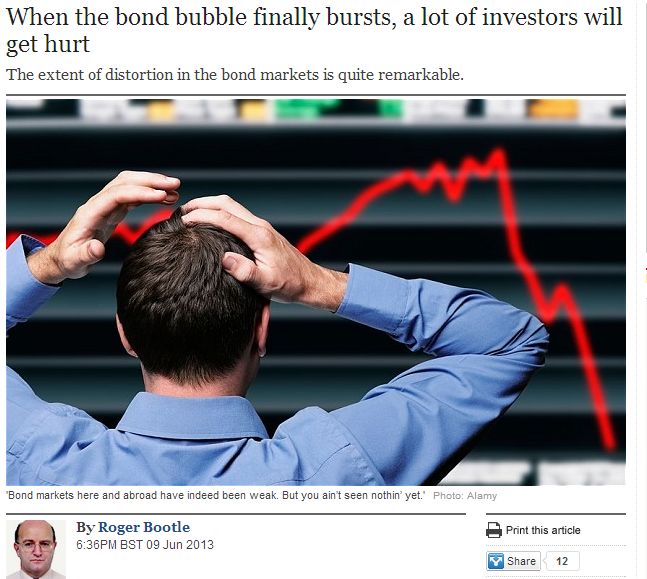
This isn’t a /Bond market/ bubble in the classic sense of markets holding unrealistic expectations
It arises as a result of the correct perception of official policy.
But the extent of the distortion this has caused in the bond markets is quite remarkable.
Roger Bootle, Telegraph 9 June 2013
Index-linked bonds currently present the most remarkable features.
For most of their history, such “linkers” have yielded between 2pc and 4pc after inflation, that is, in real terms.
Recently, however, real yields have been negative.
That’s right, investors have willingly held them at yields which are bound to lose money in real terms.
And investors even have to pay tax on the interest.
Roger Bootle, Telegraph 9 June 2013
So what is going to happen?
What the appropriate level of interest rates and bond yields should be when things have returned to normal will depend crucially upon inflation.
If inflation is expected to run at something like 2pc, then we can expect conventional long bonds to yield between 4pc and 6pc.
Realräntor - Real Interest Rates
Authorities would surely need to maintain very low short rates while simultaneously putting pressure on the banks, pension funds and insurance companies to maintain high ratios of bonds in their portfolios “for safety reasons”. This is exactly what happened in the UK and the US in the years immediately after the Second World War and it is already happening again now.
In other words, such a regime would involve sharply negative real interest rates and real yields.
That is a substantial underpinning for the value of all sorts of assets, including residential and commercial property and equities.
But, of course, the foundations for such resilience are distinctly dodgy, because eventually the bond bubble will have to burst.
Yes, yields on US conventional 10-year bonds are up about 40 basis points over the past month.
But they are still just over 2 per cent. This is hardly a bond market Armageddon.
If recovery takes hold, as we hope, yields will rise further.
Nobody can have supposed that nominal and real long-term interest rates would remain at basement levels forever.
Martin Wolf, 4 June 2013
Comment by Rolf Englund:
Martin Wolf is right, of course, when he writes that "nobody can have supposed that nominal and real long-term interest rates would remain at basement levels forever."
Just as nobody before the start of the financial crisis can have supposed that houseprices would rise for ever.
Comment at FT
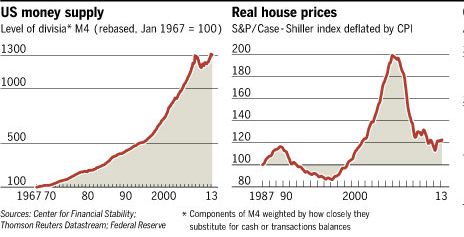
Many analysts believe that QE has caused a major bubble to appear in asset prices,
the full extent of which will be unveiled only when the central banks start to shrink their balance sheets.
Others reply that the rise in both bond and equity prices has been justified by economic fundamentals.
This is probably the most important debate in the financial markets today,
with enormous ramifications for both policy makers and investors.
Gavyn Davies, FT blog 26 May 2013
Is this the “big one” for global bonds?
The month just ended was the fourth worst month for government bond returns in the past two decades.
Gavyn Davies, FT blog June 2, 2013
Abrupt response to Ben Bernanke’s warning that the Fed might think about tapering QE
Fears that the great bull market in fixed income, which started in 1982, might now be threatened by a sharp reversal.
Can you hear the bears growling?
When bonds and equities were rallying globally until recently,
the bear argument was that central banks and regulators had created such worrying vulnerabilities
in the financial system that a plunge back to earth was only a matter of time.
That tipping point looks closer than we thought a month ago.
Financial Times 4 June 2013
In a topsy-turvy world in which good economic news is bad news – because it brings forward the day when QE stops – strong non-farm US payroll data on Friday could see further disruptive bond selling.
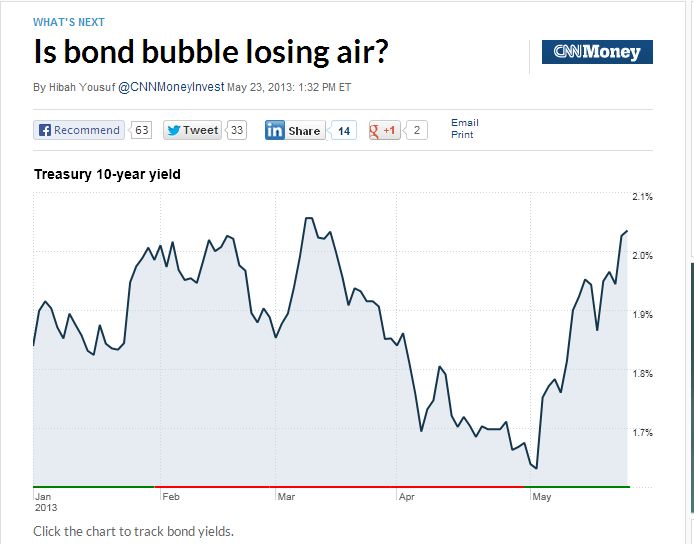
Bernanke is determined not to have a repeat of 1994 bond market sell-off
Investors Should Remember 1994
blogs.wsj.com/source/2010/12/29/
Last night's panic in Tokyo, where the Nikkei dropped a stomach churning 7 per cent, demonstrates just how difficult it's going to be for the world's central banks to exit their loose money policies.
You can do what Britain, and now Japan, are attempting, and inflate your way out of it.
Central bankers dream of getting back to "normal" – normal interest rates, a normal balance sheet, and so on.
But that point isn't going to come any time soon.
Jeremy Warner, Telegraph 23 May 2013
Why all the talk of a bond bubble?
What is a bubble, anyway? Surprisingly, there’s no standard definition.
But I’d define it as a situation in which asset prices appear to be based on implausible or inconsistent views about the future.
Dot-com prices in 1999 ... housing prices in 2006
Is there anything comparable going on in today’s bond market?
Paul Krugman, New York Times 9 May 2013
Dot-com prices in 1999 made sense only if you believed that many companies would all turn out to be a Microsoft;
housing prices in 2006 only made sense if you believed that home prices could keep rising much faster than buyers’ incomes for years to come.
You don’t want to buy a 10-year bond at less than 2 percent, the current going rate, if you believe that the Fed will be raising short-term rates to 4 percent or 5 percent in the not-too-distant future.
But why, exactly, should you believe any such thing?
The Fed normally cuts rates when unemployment is high and inflation is low — which is the situation today.
True, it can’t cut rates any further because they’re already near zero and can’t go lower. (Otherwise investors would just sit on cash.)
But it’s hard to see why the Fed should raise rates until unemployment falls a lot and/or inflation surges,
and there’s no hint in the data that anything like that is going to happen for years to come.
There isn’t any case for believing that we face any broad bubble problem,
let alone that worrying about hypothetical bubbles should take precedence over the task of getting Americans back to work.
Asset price bubbles and Central Bank Policy
Are the markets going mad?
That is a question many investors might have asked in recent weeks,
as stocks in the UK, eurozone and US have soared – even as bond spreads decline.
Phoney QE peace masks rising risk of instability
Gillian Tett, Financial Times 16 May 2013
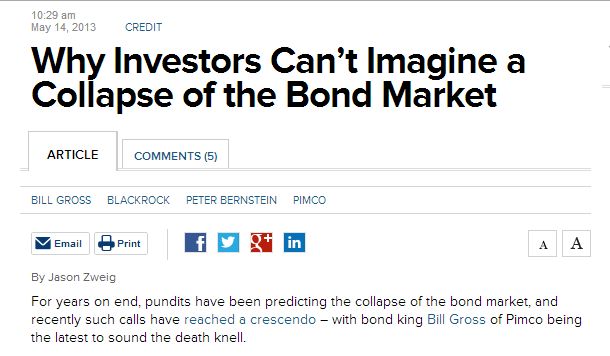
For years on end, pundits have been predicting the collapse of the bond market,
and recently such calls have reached a crescendo
– with bond king Bill Gross of Pimco being the latest to sound the death knell.
Wall Street Journal, 10:29 am May 14, 2013
As the late investment strategist Peter Bernstein liked to say, markets have memory banks.
What investors expect is shaped by what they experience.
Today’s bond investors have lived through more than three decades in which bonds almost never went down.
So, even though everyone talks about the coming bear market in bonds, most people can’t imagine how painful it could be, warns David Allison, a partner at Allison Investment Management in Wrightsville Beach, N.C.
That’s true not just for individual investors but for professionals as well:
The average age of a portfolio manager, according to the CFA Institute, is 43
– meaning that the last bear market in bonds ended when the typical portfolio manager was around 10 years old.
- Knowing when to quit separates winners from losers.
Those who spend years pursuing lost causes can waste their lives,
läser jag i Financial Times i dag.
Det är kanske något jag borde tänka på?
Rolf Englund på Facebook, 14 May 07.00 svensk tid
Jag har länge tjatat om Den Stora Kraschen. Men aktierna bara stiger...
Men vänta bara när räntan stiger igen och de amerikanska statsobligationerna förlorar stort.
Inte har jag fel, tror jag. Men jag har svårt för timingen.
Jag dömde t ex ut Wernerplanen, eurons föregångare i en bok
"Vår framtid i Europa" (MUF, 1971) av Jan Brännström, Rolf Englund och Claes-Henric Siven.
Det gäller att ha tålamod. Eller ge upp.
The bond markets will crash once global central banks stop buying debt,
triggering a financial crisis much worse than the one seen in 2008,
strategist David Roche told CNBC 8 May 2013
Roche, who has previously warned that "safe haven" government bonds are the most dangerous place for investors to be in, said Wednesday: "Yes it [a financial crisis] will happen and yes, it will be bigger [than the credit crisis].
Once you re-price the burden of the world's debt... the ugly truth will be revealed."
Yields on U.S. 10-year Treasurys have fallen more than 200 basis points over the past five years and are now around 1.8 percent. Meanwhile, U.K. 10-year and German 10-year were also trading near record lows at 1.8 percent and 1.29 percent, respectively.
"As long as the central bankers print money, the only way to have to distribute it is [for governments] to buy 70 percent of new bond issuance in these safe haven bond markets. As long as they go on doing that, the yields won't go up, and the day they stop, the yields will go up by so much we will have a financial crisis on our hands," he said.
Roche said the impact of a crash in the "safe haven" bond markets will be catastrophic for financial markets worldwide.
The bond market is an accident waiting to happen
When the bond market finally does crack, it is going to be one epic nightmare
that is going to make 2008 and 2009 seem like a picnic.
Bill Fleckenstein, 21 April 2013
It will be a different kind of a crisis; but it will be an enormous crisis.
These people that are bullish about stocks and bonds and the bond market, they do not understand anything.
We will hit a moment in time where there will be a rapid acceleration of the perception that people are being cheated via inflation by these money-printing policies. Why Americans seem to think there is no inflation just because the CPI says so, when their checkbooks every day ought to tell them there is
The U.S. economy is in a bubble inflated by “phony money” from the Federal Reserve and will burst within a few years,
warned David Stockman, who was budget director for President Ronald Reagan.
Bloomberg, April 1, 2013
Waiting for the bond bubble to pop
Junk bond yields have never been this low
CNN 3 May 2013
Leon Black, the chairman and CEO of private equity firm Apollo Group, said investors have completely forgotten lessons learned from the financial crisis, when many of those loans imploded.
"There is no institutional memory,"
Citing the infamous quote of former Citigroup CEO Chuck Prince ahead of the financial crisis, Sri-Kumar warned "The music will stop, and not everyone will have a seat."
It's not clear how much longer the credit bubble can keep expanding, but the higher the market moves, warns Sri-Kumar, the sharper the drop-off, because the economy simply can't sustain its anemic growth rate without the unprecedented level of intervention by the Federal Reserve.
"It's pretty clear that the markets are being artificially inflated by Fed stimulus or the steroids they've put into the system," noted Justin Slatky, a senior portfolio manager at high-yield hedge fund Shenkman Capital Management.
The Fed will have to stop the music at some point and start increasing interest rates. But until then, banks, companies, and hedge funds seem more than willing to keep dancing.
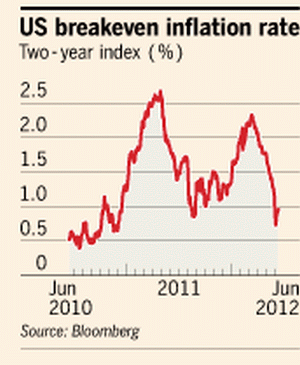
Some of the developed world’s biggest central banks are trying deliberately to raise inflation.
John Authers, FT, 1 March 2013
No one fully understands why rates have fallen so far so fast,
and therefore no one can be sure for how long their current low level will be sustained.
Economists simply have little idea how long it will be until rates begin to rise.
Kenneth Rogoff and Carmen Reinhart, Financial Times May 1, 2013
If one accepts that maybe, just maybe, a significant rise in interest rates in the next decade might be a possibility, then plans for an unlimited open-ended surge in debt should give one pause.
In the fixed interest sector something irrational is undoubtedly going on
Despite the oft-heard central bankers’ refrain that bubbles are impossible to identify until after they have been pricked,
historical comparisons leave little doubt that this is a bubble
John Plender, FT January 29, 2013
Despite the oft-heard central bankers’ refrain that bubbles are impossible to identify until after they have been pricked, historical comparisons leave little doubt that this is a bubble – one, moreover, to which central banks have contributed their fair share of hot air.
It is rare indeed for investors to pay a multiple of more than 50 times for the income stream on a 10-year Treasury bond.
In higher yielding parts of the market prices are out of touch with default risk.
The impossibility, as with all bubbles, lies in predicting when investors will run out of puff.
What we do know is that when the fixed interest prick happens, it will be potentially very nasty because the excessive exposure of banks to government debt markets creates serious systemic risk.
Certainly, it is quite hard to believe bond yields could sink any lower. But here’s a question.
If everyone thinks government bonds are a bubble riding for a fall, how come it’s not already happened?
Jeremy Warner, Telegraph, 2 Jan 2013
So to bet on a significant rotation is also to bet on the return of growth.
Well, everyone hopes for the best, but beyond the bounce in equity markets, which may be more driven by hunt for yield than faith in rip-roaring earnings growth, evidence for it is pretty thin on the ground.
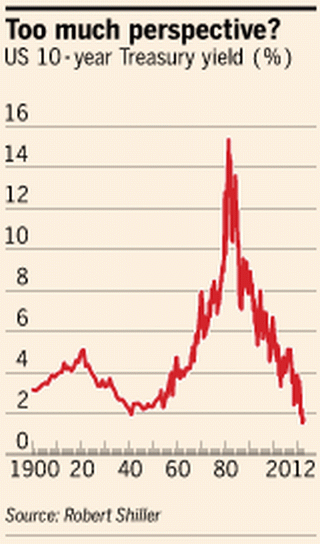
US Bonds
The bull market started back in 1982, when the Federal Reserve under Paul Volcker convinced the market that it could control inflation.
The downward march in yields is unstopped since then.
John Authers, Financial Times December 28, 2012
It would be wise to start taking evasive measures. Such anomalies tend to correct themselves violently. As many holders regard treasuries as truly risk-free, and have no memory of a time when their prices were not rising, this anomaly looks particularly dangerous. And treasury bonds are so central to global markets and the economy that even a steady rise in yields, rather than a rout, would be hazardous.
Are the bond markets going mad?
We have entered the world of disaster economics
Gillian Tett, Financial Times 23 July 2012
Economists at Fulcrum Asset Management, (including Gavyn Davies in an FT blog post) blames
a psychological-cum-generational shift among investors around the concept of “disaster”.
During most of the past few decades, Fulcrum argues, investors and economists did not much discuss “disaster” – namely at least a 10 per cent decline in national gross domestic product per capita.
Only two occurred between 1950 and 2000; most modern investors built their careers in a world without disaster risk.
As Mr Barro’s work shows, this low-disaster period may have been an exception to the norm.
The investment question of our time
is whether US Treasury bonds are in a bubble, offering what author Jim Grant dubbed “return-free risk”,
not the risk-free return investors seek.
James Mackintosh, FT 17 April 2012
It did not happen in 2011
Rolf Englund blog 24 november 2009
What will the 10-year Treasury be yielding a decade from now?
If you’re like virtually everyone else of whom I ask this question, you believe its yield will be higher then than its current 1.88% — and perhaps much higher.
That, in turn, means you believe the 10-year Treasury will produce a loss over the next decade
MarketWatch 11 May 2012
But if you are like the vast majority of investors, you also have a significant portfolio allocation to bonds, especially in your 401(k)s. How is that consistent with your belief that Treasurys will produce losses over the next decade?
The answer, of course, is that you are confident that you will be able to identify when the bond market finally hits it top, getting out before the next decade’s losses are produced.
Far from understanding that confidence, I call it a triumph of hope over experience.
This perception of wealth has its true basis in nothing but the famous "greater fool theory";
that is, in the expectation that there will be a greater fool to buy the acquired house later at a higher price.
Deluded by this wealth chimera, private households have run down their savings and piled up astronomic debts to be repaid with future earned income.
Kurt Richebächer, 25 June 2005
Cologne-based financial strategist Philip Vorndran says inflation is the only way out of the European debt crisis.
DW: You recently published a book entitled "The Debt Avalanche" - referring, of course, to the debt crisis in Europe.
I believe a political consensus has been reached - to ensure there is no threat to social peace
Deutsche Welle 24 July 2012
In theory, you can reduce debt in four different ways.
The Greeks have shown us the easiest way, debt restructuring. But that is unrealistic, we won't see that in the large economies because the central banks will balk at the concept.
The second option is the "Swabian housewife" model: austerity. Here, unfortunately, we are all 15 years too late. If we all started saving now and putting the brakes on spending, we would quickly reach a state of economic Armageddon, comparable to the situation in the 1930s. That is something politicians certainly do not want, and it would also be a massive challenge to apeaceful social coexistence.
The third theoretical option is growth - nominal growth, which is greater than the increase in debt. That is not a realistic scenario within the Western World, we have too many demographic challenges.
That leaves higher inflation. If you have a look at how widely the central banks have already opened their purse strings then it is, as former ECB chief economist Jürgen Stark put it, just a matter of time.
Peter Schiff:
Market-Crushing Treasury Collapse To Hit Around 2013
expects the coming crisis to blow the 2008-9 financial crisis out of the water
Forbes 27 ;March 2012
Peter Schiff, the divisive investor and commentator that predicted the subprime/real-estate bubble, is forecasting a U.S. dollar and bond crisis over the next couple of years.
Schiff blames intervened bond markets, where rates are artificially and excessively low, and expects the coming crisis to blow the 2008-9 financial crisis out of the water.
USA
To be able to borrow money at -2.0%/year real and invest it in useful things is a very, very good business to be in
Brad DeLong, 11 March 2012
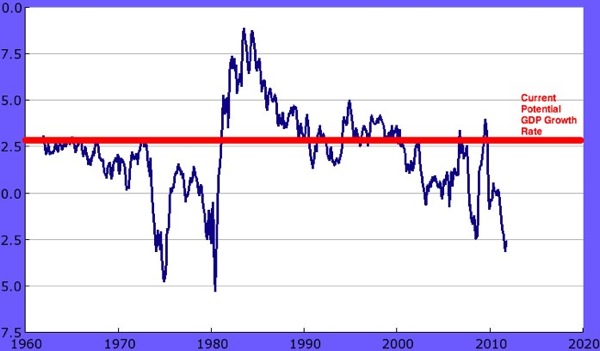
It is true that in a sense the U.S. is simply the tallest midget - the least uncertain place to put your money in a world rife with uncertainty. But given that U.S. Treasury debt is regarded as the safe asset in the world economy, it is very difficult to look at this graph and not conclude that for quite a while - since 2000, at least - a dominant feature of the world economy is that there are not enough safe financial assets (or, rather, financial assets generally perceived as safe) in the world economy, and that each time the U.S. government creates another Treasury bond it adds value to the world economy.
"I think the greatest bubble that is about to burst is the 10-year and longer Treasury,
because the idea that inflation is gone forever and for all time, and therefore these artificially low rates can last, is silly,"
the president of W.H. Ross & Co. said in an interview
Jeff Cox CNBC.com Senior Writer 21 March 2012
Long-term government debt, which has provided some of the best market returns for decades, now poses the greatest threat to portfolios, investor Wilbur H. Ross told CNBC.
Ross added his voice to the warnings regarding Treasurys at the far end of the yield curve, cautioning that the inflation specter is about to creep up and hammer the value of fixed-income government securities.
The reason that markets haven’t jumped yet is that the last great inflation and correction happened
in the late 1970s and early 1980s, just long enough ago that most adults in the financial markets don’t remember it
Amity Shlaes, Bloomberg 15 March 2012
Graham Secker from Morgan Stanley said it is rare for global stocks, oil prices and government bonds to rise in lockstep, and such exuberance becomes a "very reliable sell signal for stocks" once speculators join the party.
Equity long positions on NASDAQ have reached 1.5 standard deviations and long bets on oil are at an extreme of 1.9
This is occurring at a time when yields on 10-year US Treasuries are still at 1.96pc, signalling depression, deflation, or both.
Ambrose 8 March 2012
The historical relationship between bonds and equities has completely broken down over the past six months.
"You can't have a sustained period where equities are going up, while bond yields are flat or trending down," said Mr Secker.
One or the other must give, and bears have no doubt which it will be.
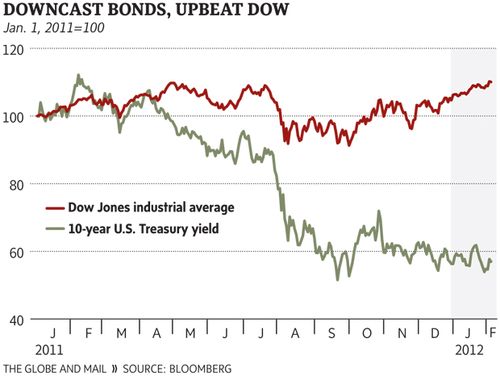
Suddenly, a growing number of commentators are suggesting that the worst is behind us
Aside from the fact that, historically at least, bursting bubbles have generally been followed by drawn-out and messy overshoots to the downside I have one question:
Why are share prices approaching intermediate term highs at the same time that bonds yields are hovering near record lows?
SeekingAlpha, 6 February 2012
How the west cut its debts
The crucial issue is that during that period, the state engineered a situation where the yields on government bonds were kept slightly below the prevailing rate of inflation for many years.
Gillian Tett, FT, December 22, 2011
US government debt is a safe haven the way Pearl Harbor was a safe haven in 1941.
Niall Ferguson, FT February 10 2010
Despite a reputation for being a slow-growing alternative to stocks for the risk-averse,
bonds just passed stocks' long-term performance over the past 30 years.
CNBC, 5 Jan 2012
Gunnar Eliasson och Nils Karlsson räknar med sju procents realränta.
"Ett årligt sparande /till ett medborgarkonto/ på 23 000 kr eller drygt 1 900 kr per månad
är tillräckligt för att vid sju procents real ränta spara ihop till en miljon kronor på 20 år. ...
(Kom ihåg, att värdestegringen för aktier de senaste 25 åren varit högre än sju procent realt per år.)"
DN-Debatt 1997-11-19
For the US government, according to Bank of England data,
the price of borrowing for ten years is now at its lowest level for two centuries
- and for the British government, the implicit interest rate it has to pay to borrow is lower than it has been since the end of the Victorian era.
Robert Peston, BBC Business editor, 19 August 2011
---
Chart showing “long term” government bond yields since 1800
For the record, the 30-year yield is pretty low.
But even though it might feel like the world is falling apart, we’re still not as low as back in 1941,
when the world, really was falling apart.
Wall Street Journal 18 August 2011
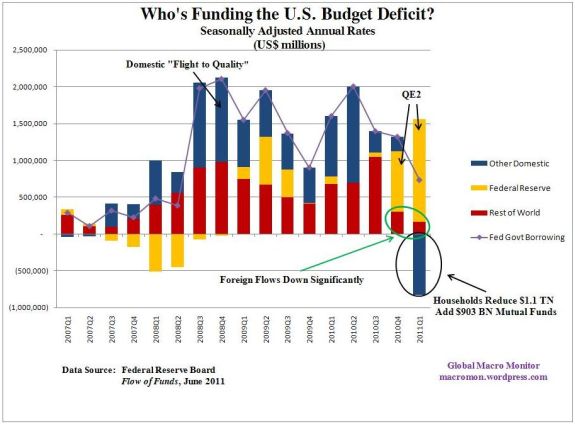
Who’s Been Buying Treasuries?
Tim Iacono 10 June 2011

Yields on 10-year 2.36% lowest level since January 2009
CNN 12 october 2010 with nice chart
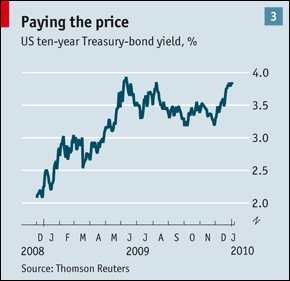
No country defaults on its domestic bonds if it retains the right to set the printing presses in motion.
US Treasuries were never risk free in the common sense understanding of the term.
John Plender, Financial Times, August 16 2011
It seems counter-intuitive that bond markets, with their traditional fear of inflation, should punish a country for not being able to debase its currency. The demise of this conventional market wisdom is one of the achievements, for want of a better word, of European Monetary Union.
In effect, southern Europe (of which Ireland is an honorary member) is going through the equivalent of an International Monetary Fund austerity programme, but without the benefit of devaluation.
The Weimar Republic would presumably have been entitled to a triple A rating since it was perfectly capable of repaying its debts, even though the hyper-inflated money used for the task would have been close to worthless.
Finance academics, with their distinction between risk, which is measurable, and uncertainty, which is not, have used language in a way that can confuse mere mortals.
And the obsession with quantifying risk by reference to standard deviations or techniques such as value at risk are not always helpful.
US Treasuries were never risk free in the common sense understanding of the term. And if the ECB is ultimately empowered to issue euro bonds that are backed by the full power of the printing press, those bonds will never be risk free in common sense terms either.
Om man har en sedelpress går man inte i konkurs
Rolf Englund blog 4 november 2011
Many ask whether high-income countries are at risk of a “double dip” recession. My answer is: no,
because the first one did not end. The question is, rather, how much deeper and longer this recession or “contraction” might become.
Martin Wolf, Financial Times, 30 August 2011
Bill Gross, manager of the world’s largest bond fund for Pimco, has admitted that
it was a mistake to bet so heavily against the price of US government debt.
CNBC 30 August 2011
Mr Gross emptied his $244 billion Total Return Fund of US government-related securities earlier this year in a high-profile call that has backfired as the bond market has rallied. As of Monday, Pimco’s flagship fund ranked 501th out of 589 bond funds in its category.
“Do I wish I had more Treasurys? Yeah, that’s pretty obvious,” Mr Gross told the Financial Times last week, adding:
“I get that it was my/our mistake in thinking that the US economy can chug along at 2 percent real growth rates. It doesn’t look like it can.”
What is the “stall speed” of an economy?
Unemployment tends to rise when GDP growth falls below about 2.5-3 per cent
Gavyn Davies blog June 15, 2011
U.S. government bond yields are poised to converge with Japan’s for the first time in almost two decades,
sparking the biggest returns for investors in Treasuries since 2008
while raising concern that America may be stuck in a prolonged period of below-par economic growth.
Bill Gross, Bloomberg Aug 15, 2011
“We are beginning to resemble Japan from an interest rate policy standpoint as well as potentially an economic growth standpoint,” Bill Gross, who runs the world’s biggest bond fund at Pacific Investment Management Co., said in a telephone interview Aug. 10.
Investors are “fearful of low growth and are fleeing to high-quality sovereign paper at whatever yield.”
Credit rating agencies should never be taken too seriously, but for Standard & Poor's to put the United States on "negative outlook" is none the less something of event
Jeremy Warner, Daily Telegraph, 18 April 2011
Federal Reserve Bank of Dallas President Richard W. Fisher said he sees “extraordinary speculative activity” in the U.S.
after the central bank pumped record amounts of stimulus into the economy.
Bloomberg 23/3 2011
“There is an enormous amount of liquidity sloshing around,” the regional bank chief, who votes on monetary policy this year, said in a speech today in Berlin. “There is abundant liquidity in the machine we know as the United States economy.”
Fisher reiterated his view that no further monetary stimulus will be needed after the Fed finishes its planned $600 billion of Treasury purchases through June.
Federal Reserve policy is keeping Treasury yields too
low to provide reasonable returns for most investors
Pimco's Bill Gross told CNBC 5 Apr 2011
The yield on the benchmark 10-year Treasury note would have to rise to 4.50 to 5 percent to be at what Gross terms a "normalized" level.
Who will buy Treasuries when the Fed doesn’t?
Treasury yields are perhaps 150 basis points or 1½% too low
when viewed on a historical context and
when compared with expected nominal GDP growth of 5%.
Bill Gross, March 2011
By eliminating QE II, the Fed would be ripping a Band-Aid off a partially healed scab. Ouch!
Pimco has dumped all of its US Treasury bond exposure in its flagship Total Return Fund.
The move makes sense given Pimco chief Bill Gross's public statements that Treasurys are over-valued.
CNBC 9/3 2011
/Pimco's/ bearish call on Treasuries will not have been made lightly.
Given the record of Mr Gross, one cannot ignore the decision.
Since the total return fund began in 1987, it has generated an average annual return of 8.42 per cent
FT 11 March 2011
With a Treasury, you do not run the risk of losing your principal.
Judging by the strong investor demand for new long-term Treasury debt this week and last month, few seem to share Mr Gross’s concern that inflation and the end of QE2 will send bond yields sharply higher.
"I don't know who's buying 30-year fixed debt.
I don't understand TIPS (Treasury Inflation Protected Securities)
that are projecting 30 years of benign inflation,"
Ray Dalio, founder & CIO of the hedge fund Bridgewater Associates, 3 Mar 2011
Bridgewater Associates is the world's largest hedge fund, with $8.9 billion under management.
The Congressional Budget Office recently announced that this year’s US budget deficit will be $1,500bn – a grim figure that is dominating the attention of policymakers.
Frequently overlooked, however, are our long-term structural deficits and debts; these are the biggest threat to our economic future.
Peter Peterson, FT, February 28 2011
Furthermore, policymakers tend to think of public debt problems in purely national terms, but US debt is not growing in isolation. It is part of an international debt bubble being inflated simultaneously and unsustainably by fundamental demographic changes and vast unfunded promises in virtually every advanced economy. Bubbles eventually pop – and ignoring this one could be calamitous.
With memories of last May's "Flash Crash" still fresh in investors' minds,
now comes warning of a market meltdown that could extend beyond stocks
— a possible "Splash Crash" that also would affect currencies, commodities and bonds.
The interconnectedness of high-speed trading platforms is making such an event increasingly possible, says John Bates
CNBC 3 Feb 2011
Wellcome Trust, which has amassed a £14.5 billion investment fortune,
said that it had sold its last bond in April as it positioned itself for a rise in inflation.
the country is facing its biggest inflationary threat for 20 years
The Times 16/12 2010
US Treasuries last week suffered their biggest two-day sell-off
since the collapse of Lehman Brothers in September 2008.
Daily Telegraph 11 Dec 2010
The big financial economy and markets event of the past few days has been
a sharp fall in the price of US government debt,
whose corollary is a rise in the implicit interest rate
Robert Peston 13 December 2010
There is no little debate about what all this means.
And what's particularly unhelpful is that
the competing explanations are the difference between economic heaven and hell
The fashionable explanation is that the rise in yields should be seen as good news, because it shows that investors are becoming more confident in the US economic recovery
The competing explanation may appear to be based on an almost diametrically opposite view of the prospects for the US. It is that the tax cut shows a US administration utterly incapable of getting to grips with public-sector deficit
The problem is that, even after more than two years of near-zero official rates and huge amounts of stimulus spending, economies such as the US have failed to grow as strongly as hoped.
The hangover effect of the debt-fuelled house-buying and consumption binge that started to unravel three years ago.
People are no longer able to borrow unless they have a good credit history.
In any event, many people do not want to borrow.
They are focused instead on reducing the debts they have taken on – a process called deleveraging – either by choice or because they cannot roll over debts with new loans.
FT October 31 2010
On the one hand, interest rates have plunged to historic lows, allowing companies, countries and some individuals to borrow at a cost lower than ever.
On the other hand, households and the wider economy still struggle in the wake of a credit bust.
The interplay between these two forces – the stimulating effect on economic activity of low borrowing costs and the damping effect of a debt squeeze – has severe implications for investors around the world, from individual savers to the world’s biggest insurance companies.
“Is there a bond bubble in Japan? Because if there is, it has somehow lasted for 20 years. If you don’t get legitimate economic growth, then there isn’t a bond bubble.”
Ten-year Treasury yields fell this month to their lowest levels since the dark days of January 2009.
TIPS are at similarly historical levels, lowest since the government started selling them in 1997.
A low yield means demand is high for TIPS, which offer investors additional annual returns to make up for the rate of inflation.
The gap, or breakeven, between the two yields implies what investors expect inflation to be.
WSJ 25/10 2010
Ben Bernanke declared war today - not on China, but on the possibility of deflation.
He knows that a vicious cycle of slow growth, stagnant or falling prices and high unemployment poses a much greater threat to America's way of life than China's silly exchange rate.
But like it or not, the exchange rate will be caught up in the Fed's response.
Stephanie Flanders, BBC 15 October 2010
Stephanie Flanders is the BBC's economics editor.
In the 1930s, the deflationary trap was the gold standard. Britain left it first, and was vilified for doing so - but it was also the first major economy to recover.
The verdict of economic historians has been that it would have been better for the world if other countries had followed Britain sooner.
Now we have no gold standard (though the euro might be playing a similar role for the eurozone). But we do have a collection of countries, most of them Asian, who have created a modern version of it, by pegging their currencies to the dollar.
America can't abandon its own currency. But it can make things as uncomfortable as possible for those that choose to stick with it. Ben Bernanke may not have planned it that way, but that is exactly what the Fed's policy will do.
Let me say something about what that policy will actually be.
Federal Reserve Chairman Ben S. Bernanke said additional monetary stimulus may be warranted
because inflation is too low and unemployment is too high.
Blooomberg Oct 15, 2010 2:43 PM GMT+0200
Bernanke and his central bank colleagues are considering ways they can stimulate the economy as the unemployment rate holds near 10 percent and inflation falls short of their goals.
After lowering interest rates almost to zero and purchasing $1.7 trillion of securities, policy makers are discussing expanding the Fed’s balance sheet by purchasing Treasuries and strategies for raising inflation expectations, according to the minutes of the Federal Open Market Committee’s Sept. 21 meeting.
...
En vanlig prognos på marknaden är att Fed fram till årsskiftet kommer att spendera 500 miljarder dollar (nästan 3 300 miljarder kronor) på att trycka ned räntorna med obligationsköp och därmed få fart på tillväxten.
Dollarn föll två öre mot kronan efter Bernankes uttalande, ned till 6:53 kronor per dollar.
Det är den lägsta nivån sedan september 2008.
The deliberate attempt by the Federal Reserve to create more inflation is beginning
to have a big impact on financial markets.
Yesterday the dollar came under selling, and commodity prices increased.
The dollar fell to a 15-year low (nominal that is!) against the yen, and an eight-month low against the euro
Copper reached a two year year, and gold rose further to $1387, an all time nominal high.
Eurointelligence 15/41 2010
...
Dålig affär av Riksbanken att sälja guldet
Därmed har den svenska centralbanken gått miste om intäkter på 594 miljoner kr
Tidigare har även finansmannen Tomas Fischer kritiserat Riksbanken för utförsäljningen av guldreserven.
DI 2009-01-07
30-Year Mortgage Rate Hits Decades-Low of 4.19 %
CNBC 14 Oct 2010
The average rate on 15-year fixed loans fell to 3.62 percent, the lowest on records dating back to 1991.
Warren Buffett hints at bond bubble
Investors buying bonds at the prevailing high prices are 'making a mistake,'
Fortune October 5, 2010
He added that he "can't imagine" the rationale for adding bonds to your portfolio at current prices.
Chinese purchases of our bonds don’t help us — they hurt us.
The Japanese understand that. Why don’t we?
Paul Krugman NYT September 12, 2010
American policy figures have repeatedly balked at doing anything about Chinese currency manipulation, at least in part out of fear that the Chinese would stop buying our bonds.
But this fear is completely misplaced: in a world awash with excess savings, we don’t need China’s money — especially because the Federal Reserve could and should buy up any bonds the Chinese sell.
It’s true that the dollar would fall if China decided to dump some American holdings. But this would actually help the U.S. economy, making our exports more competitive. Ask the Japanese, who want China to stop buying their bonds because those purchases are driving up the yen.
Ask Not Whether Governments Will Default, but How
The sovereign debt crisis is not European: it is global. And it is not over.
Arnuad Mares at John Mauldin 20/9 2010
Faber advises investors "stay away from Treasurys as they’ve been rallying since 1981
- equivalent to a 19-year bull run," - when the 10-year bottomed out on Sep. 21, 1981.
Faber says Dec. 18, 2008 was the peak of the bond bubble with yield of 2.08% and 2.53% on 10-year and 30-year respectively.
(See 10-year chart)
August 25, 2010
Is there a government bond bubble?
Probably not, but approach low-probability risks carefully
The Economist invitation August 2010
Full text of several economists
The public are focused on countries' official debts, rather than their fiscal gaps, to gauge the need to print money.
But this emperor's new clothes continue to draw lots of attention.
Laurence Kotlikoff our guest wrote on Aug 20th 2010
Almost two years into the bond flight, about $550 billion has poured into U.S. bond mutual funds
Using inflation-adjusted figures, investors had put $499 billion at this same stage of the Internet bubble.
Colas selected December 1996, the month of Alan Greenspan’s “irrational exuberance” speech, as the estimated start of the bubble in equities.
For bonds, he uses the collapse of Bear Stearns in March 2008.
CNBC 31 Aug 2010
Yankee bonds
– dollar-denominated bonds sold by non-American companies into the US
So far this year, 773 have been issued, raising $412.9bn
– beating the $378.1bn raised up to this point last year
The attraction of the US market is lower funding costs.
Banks are the biggest issuers.
Eurointelligence 24/8 2010
We've been living in a veritable bubble bath the past 10 years what with two stock bubbles, a real estate bubble and a derivatives bubble. And now, with so much money flooding into Treasury securities and interest rates so low,
many people are wondering whether the next pop! we'll hear will be the bursting of a bond bubble.
CNN Money Magazine: Ask the Expert, 19/8 2010
But while bond prices are relatively high and interest rates inordinately low, to a large extent that simply reflects the outlook for continued sluggish economic growth and restrained inflation in the near future. Or, as the Federal Reserve Open Market Committee put it in its August 10th statement, "with substantial resource slack continuing to restrain cost pressures and longer-term inflation expectations stable, inflation is likely to be subdued for some time."
The BIGGEST Financial Weapon of Mass Destruction
Treasury Bonds with maturities of 10 years or more
Aubie Baltin January 15, 2010
America and the World are now sitting on the world's biggest ticking financial time bomb, largely because we've pursued some of the most reckless financial policies in history. This toxic asset is U.S. Treasury Bonds… specifically Treasury Bonds with maturities of 10 years or more. They're the world's most popular investment by far… and now they're about to turn out to be the world's most dangerous!
INTEREST RATES HAVE ONLY ONE WAY TO GO, WHICH MEANS THAT LONG TERM BONDS ALSO HAVE ONLY ONE WAY TO GO AND THAT IS DOWN
The real interest rate on 5-year inflation-protected securities is now negative.
In other words, prospects for other investments are so poor that some investors prefer a safe asset that doesn’t quite keep up with inflation.
The invisible bond vigilantes continue their invisible attack: nominal 10-year bonds at 2.71%.
Paul Krugman 11 August 2010
Since the beginning of April, when optimism about the economic recovery was at its peak, 2-year bond yields have fallen by 0.63 per cent as the market has realised that the Fed would not tighten monetary policy until at least the end of 2011.
More remakarbly, the 5-year yield has dropped by 1.20 per cent, and the 10-year yield has tumbled 1.14 per cent, presumably reflecting a belief that abnormally low short rates will persist for many years to come.
The decline in bond yields has flown directly in the face of expectations that bond yields would rise because of fears about excessive government deficits, in a pattern which is disturbingly similar to what happened when Japan headed towards deflation a decade ago.
Gavyn Davies, FT 9 august 2010 with nice charts
Wednesday 10-year Treasury note yield below 3 percent
2010-07-07
up to date rates here
On Monday, the yield on 10-year government bonds was 1.1 per cent in Japan, 2.6 per cent in Germany, 3 per cent in the US and 3.3 per cent in the UK.
Based on yields on index-linked securities, real interest rates on borrowing by these governments are very low (1.2 per cent, or less, in the US, Germany and UK).
Investors are saying that they view the risk of depression and deflation as greater than that of default and inflation.
Martin Wolf, July 6 2010
Former Federal Reserve Chairman Alan Greenspan said the recent rise in Treasury yields represents a “canary in the mine” that may signal further gains in interest rates. Bloomberg March 26 2010
“I’m very much concerned about the fiscal situation,” said Greenspan, 84, who headed the central bank from 1987 to 2006. An increase in long-term interest rates “will make the housing recovery very difficult to implement and put a dampening on capital investment as well.”
Once again, cheap money is driving up asset prices
"commercial banks are causing a bubble to develop in government-bond markets"
The Economist print Jan 7th 2010
It is hard to imagine any circumstances in which the authorities will have the foresight (or the courage) to prick a bubble.
It cannot be done when the economy is weak.
And when the economy is strong, as it was in the late 1990s, central banks argue that higher asset prices are justified (back then, by the productivity improvements brought by the internet).
The gap between short-term interest rates and long-term bond yields is extraordinarily high. That allows banks, in particular, to borrow at low rates from the central banks and invest the proceeds in government debt; the same trick was used to rebuild bank profits in the early 1990s.
Russell Napier, a market historian and an analyst at CLSA, a broker, thinks that purchases by a combination of Asian central banks and developed-world commercial banks are causing a bubble to develop in government-bond markets.
How to solve the financial crisis?
Let me tell you a little secret, folks.
Play for time. A few years of nice profits will help offset the big losses from past blunders
Allan Sloan et al
The gap between yields on Treasuries and so-called TIPS due in 10 years closed above 2.25 percentage points last week, the longest stretch since August 2008.
That’s the low end of the range in the five years before Lehman Brothers collapsed,
and shows traders expect inflation, not deflation in coming months
Bloomberg Dec. 21 2009
The United States government is financing its more than trillion-dollar-a-year borrowing with i.o.u.’s on terms that seem too good to be true. But that happy situation, aided by ultralow interest rates, may not last much longer.
An additional $500 billion a year in interest expense would total more than the combined federal budgets this year for education, energy, homeland security and the wars in Iraq and Afghanistan.
Edmund L. Andrews New York Times 23 Nov 2009
With the national debt now topping $12 trillion, the White House estimates that the government’s tab for servicing the debt will exceed $700 billion a year in 2019, up from $202 billion
The potential for rapidly escalating interest payouts is just one of the wrenching challenges facing the United States after decades of living beyond its means.
Watch out for tail risks hanging over the $14,300bn US Treasuries market
Risky to fund long-term holdings with short-term debt.
Gillian Tett, Financial Times, 19 May 2011
Those 10-year bond rates are still laughably low, meaning financing costs are cheap. But if sentiment ever swings violently, there could be a nasty wake-up call.
Could sovereign debt be the new subprime?
Gillian Tett, FT November 22 2009
These days, there is a near-unanimous belief among western regulators that one way to prevent a repeat of the 2007-08 crisis is to stop banks taking crazy risks with subprime mortgage bonds or complex instruments such as collateralised debt obligations (CDOs). Instead, banks are being urged to hold a higher proportion of their assets in the form of “safe” instruments, most notably sovereign or quasi-sovereign debt. G20 regulators are holding regular meetings in Basel to draw up rules on how banks should do this, as part of a wider reform of financial regulation
That does not necessarily mean an outright default looms any time soon; indeed, default seems highly unlikely. However, it is easy to imagine that some countries will end up eroding the value of their bonds by debasing their currencies in the coming years, printing money and stoking inflation.
It is even easier to anticipate a sharp rise in bond yields – and a corresponding sharp fall in bond prices – particularly when central banks stop their quantitative easing programmes. Some smart hedge funds are betting on just that.
Investors should shun U.S. government bonds
former Bank of England policy maker Willem Buiter said.
Bloomberg Nov. 10 2009
“Rates will have to start rising, probably later in 2010, as inflation expectations medium and long term show up in higher long rates,” Buiter said in an interview on Bloomberg Radio today.
When asked if people should be buying Treasuries, he said: “I wouldn’t, but then I’m a leading indicator of capital losses on a range of assets.”
Ten-year Treasuries rose for a third day after a report showing German investor confidence declined.
The yield on the note, which moves inversely to prices, fell 3 basis points to 3.46 percent
The Fed did not see the crisis coming
The list of dogs that did not bark is a long and distinguished one.
Maverecon: Willem Buiter, FT, July 17, 2009
As the US, UK and Japan will be trying to borrow the same buck in international markets, bond yields will rise when QE stops and there is an even modest recovery in credit demand from the private sector.
That alone is enough to prevent the development of a new credit bubble similar to those that have been economic drivers for nearly two decades.
David Roche, FT October 26 2009
All credit bubbles rely on underpriced capital being in oversupply relative to the fundamental needs of an economy. Given the huge demand for capital by increasingly insolvent governments, those conditions won’t exist.
China’s central bank warned that its counterparts in developed nations face difficult choices
as monetary easing threatens to cause “severe” inflation and exchange-rate volatility.
“Failure to manage the degree of easing may lead to concerns about mid- and long-term inflation and exchange-rate stability,”
the People’s Bank of China said in a quarterly monetary policy report, posted on its Web site today.
Bloomberg August 5 2009
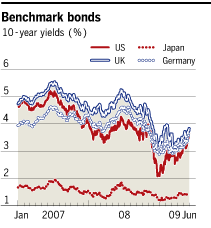
Are recent jumps in government bond rates proof that investors are worried about fiscal prospects?
Martin Wolf, Financial Times June 2 2009
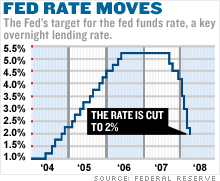
Investors are kicking themselves for failing to spot the twin bubbles in the stock and housing markets
when the laws of economic gravity for both became spectacularly unhinged.
Now, America should be on red alert for another bubble that's destined to pop
-- outrageously overpriced government bonds, the flipside being outrageously low interest rates.
Fortune Shawn Tully, editor at large June 19, 2009
Allan Meltzer, the distinguished monetarist from Carnegie Mellon, fears that the disaster scenario is far more likely. "We'll see tremendous pressure not to raise rates from Congress, the administration, businesses and the unions because of high unemployment," he told Fortune. "As the economy picks up, the Fed will need to scale back on money-supply growth, and in a replay of the 1970s, they will not do it."
The yield on the 30-year Treasurys touched a low of 2.51 percent last year in December
but now it is back up at 3.77 percent
Marc Faber, editor and publisher of The Gloom, Boom & Doom Report, CNBC 17 Mar 2009
"Yields have already backed up pretty substantially and I tell you, I think the US government bond market is a disaster waiting to happen for the simple reason that the requirements of the government to cover its fiscal deficit will be very, very high," Faber said.
"At every market peak.. you have excess liquidity.
At the present time a very significant part of what people call excess liquidity comes actually from the American current account deficit".
That 800 billion dollars flows around the world and boosts economic activity.
Marc Faber at Michael Shedlock 1/3 2007
The most striking thing about financial markets at the start of 2009 is neither the level nor the valuation of stockmarkets.
Nor is it oil prices.
What is remarkable is the level of nominal government-bond yields.
The Economist print January 8th 2009
Two-year Treasury bonds yield less than 1%.
The 30-year bond was, as recently as January 2nd, yielding less than 3%.
James Montier of Société Générale cites figures showing that ten-year Treasury yields have averaged just over 4.5% since 1798.
Today they offer just 2.5%.
“Global bond yields are sure to be much higher in five years than they are today, but this does not imply that the market currently is in a bubble,” says Martin Barnes of Bank Credit Analyst, a research group. “The economic backdrop will remain bond-friendly for at least the next six months.”
RE: Då är det gott om tid och ingen fara (OBS Ironi).
Investors must be wary of government bond 'bubble'
But is it possible to have a bubble in the most boring form of IOU?
John Plender, Financial Times, January 7 2009
With US Treasury bills yielding little or nothing and government bond yields plunging everywhere as central banks creep towards a Japanese-style zero interest rate policy (Zirp), there is talk of a government bond bubble. But is it possible to have a bubble in the most boring form of IOU?
When it comes to aerated finance the best authority is Charles Kindleberger, the economic historian who devoted much of his life to studying manias, panics and crashes. His basic definition of a bubble was "an upward price movement over an extended range that then implodes". Speculation was an essential part of a story in which investors were buying not for income and capital gain, but with a view to re-selling on a short-term basis to someone else at a higher price - a phenomenon sometimes known as the "Greater Fool Theory".
I share the view of Michael Lewitt, of Harch Capital Management, who argues that the last thing investors are thinking when they buy zero per cent Treasuries is reselling them at a profit. In most cases, they expect to resell at a loss. Rather, he argues, their priority is absolute safety and the knowledge that there will always be buyers for securities backed by the US government. Such behaviour, then, is a perfectly rational response to extreme uncertainty and the fear of deflation.
The risk, as I suggested here before Christmas, is that the upwards yield adjustment could be savage when Humpty Dumpty is put back on the wall and normal private sector financial service resumes. Given the enormous funding pressure that will exist in the early days of the Obama administration, and the potential shift of investment focus from deflation to inflation, Treasuries will at some point become an outcast asset category.
The tricky question is, "when?".
It is suddenly fashionable to suggest we are in the throes of a fresh investment bubble - this time in government bonds.
Gilts have been bid up to dizzy levels as investors buy into the notion that deflation is coming and is here to stay.
Why else buy assets yielding only 1 or 2 per cent unless you believe that Britain is heading into a Japanese-style lost decade of ultra-low interest rates and relentlessly falling prices?
David Wighton, Business Editor, The Times January 7, 2009
John Redwood, the former Welsh Secretary, who these days supplements his backbench stipend as a City money manager, joined the sceptics yesterday, saying that only the greater fool theory explained the enthusiasm for the asset class.
“You still have a massive paranoia in the marketplace and you’ve got that safety-at-any-cost mentality,” .
“People are not buying Treasury bills because they think the yields are attractive.
They are buying them because they are afraid to put money anywhere else.”
Bloomberg Dec. 15 2008
Instead of shunning the U.S., where losses on subprime mortgages in 2007 triggered a global seizure in credit markets that led to the downfall of securities firms Bear Stearns Cos. and Lehman Brothers Holdings Inc., investors can’t get enough Treasuries. Even as estimates of Obama’s stimulus package and the budget deficit rise to a record $1 trillion, demand continues to increase as investors flee risky assets around the world and put their cash into U.S. bonds paying, in some cases, nothing in yield just to ensure the return of their principal.
Purchases accelerated even as the yield on the benchmark two-year Treasury note tumbled to 0.76 percent last week.
Rates on three-month bills turned negative on Dec. 9 for the first time.
The same day, the U.S. sold $30 billion of four-week bills at a zero percent rate.
Yields on two-, 10- and 30-year Treasuries last week all fell to lowest since the U.S. began regular sales of those securities.
Realräntor - Real Interest Rates
Conventional wisdom is that in the long term, shares always outperform bonds, whose value and income tend to be destroyed by inflation. Shares are inherently more risky, but they compensate by delivering higher returns. In fact this may not even be true in the long term, as statistical analysis tends to focus on stock markets that survive economic implosions and ignores those completely wiped out by them.
Jeremy Warner, The Independent, 26 June 2008
The key question for stock markets is whether the cycle is ending in an inflationary or a deflationary nemesis.
Though much has been written and said about the possibility of a return to the stagflation of the 1970s, the bigger long-term threat to share prices would be the deflationary outcome.
Experience from the 1930s and Japan from 1990 onwards shows that deflationary influences are profoundly more destructive of equity values than inflationary ones.
High-Grade Bond Yields Rise to Highest Since 2002
June 12 2008 (Bloomberg)
Average yields on the securities rose 14 basis points yesterday to 6.32 percent, the highest since July 2002
Yields on the benchmark 10-year Treasury note rose to 4.10 percent yesterday, the highest this year. Yields on two-year Treasuries posted their biggest back-to-back increase in at least 20 years, surging 55 basis points to 2.93 percent.
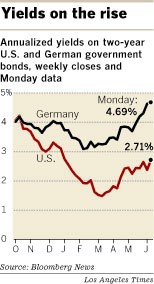
Bernanke sparks a bond sell-off with new inflation warning
Bernanke triggered a jump in government bond yields in Asia early Tuesday morning by declaring in a speech that "the risk that the economy has entered a substantial downturn appears to have diminished over the past month or so."
Los Angeles Times June 9, 2008
In Japanese trading early Tuesday the yield on the two-year U.S. Treasury note rocketed to 2.93% from 2.71% at the end of U.S. trading Monday.
As market yields jump, remember, the value of older bonds drops.
Bernanke believes that the danger of a “substantial downturn” in the US economy has abated over the past month,
but that inflation risks are increasing.
FT June 10 2008
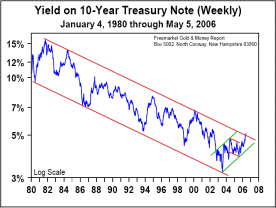
Jim Grant of Grant's Interest Rate Observer on Bloomberg
Treasuries are about as compelling a value as the kind of stuff you find in your hotel mini-bar.
Ten-year securities yielding 3.5 percent, much less than the year-over-year depreciation of the purchasing power of the dollar.
"Treasuries at these great interest rates constitute a return free risk".
March 26, 2008
Next Bubble Is Forming: U.S. Government Bonds
The Business Ledger, February 12, 2008
Bubbles are defined as markets that trade in high volumes at prices that are considerably higher than their intrinsic value.
The fundamental problems that created the current economic mess we are in today were simply a far too easy monetary and fiscal policy that encouraged leverage, consumption and risk. Borrowing as much as you could and investing it in an asset that never went down in value was the formula for success.
In studying past financial bubbles — there are some great books written on the subject), the common ingredients in the bubble recipe are a low interest rate environment that encourages extreme leverage strategies and a psychological belief by investors that the asset that is being bought and leveraged can never go down.
A stock market bubble exists when the value of stocks has more impact on the economy than the economy has on the value of stocks.
John H. Makin, AEI, Economic Outlook, November, 2000-11-09
A repeat of the Great Depression is unlikely
Deflation is the ultimate economic calamity. This is also known as the liquidity trap.
yields may well shoot up to 6 or 7 per cent. So the “price” for avoiding deflation may be a bond market meltdown.
Wolfgang Munchau, FT February 11 2008
The Rising Risk of a Systemic Financial Meltdown:
The Twelve Steps to Financial Disaster
by Nouriel Roubini, February 11, 2008
at John Mauldin