Finanskrisen
The Great Recession
Solution II:
Government-owned preference shares
The shadow banking system of hedge funds and CDOs, CLOs, PIPES, etc.
Bill Gross

Financial Crisis
Home - Index - News on this page - US Dollar - Houseprices
Doom
Historical precedents make everyone very nervous whenever Austria and banks are mentioned together in the same sentence
Sue Chang, MarketWatch Feb 8, 2016
Petros Christodoulou
Click
Frozen withdrawals in 2007 and 2015
Rolf Englund blog 2015-12-12

zc
Can the world's central banks rescue the slowing global economy even if they try?
Ambrose Evans-Pritchard 7 April 2019
The End of the Global Housing Boom
After a years-long surge in global capitals, property prices are starting to head lower.
From Sydney to Toronto, here’s a look at what’s ahead.
Bloomberg 31 July 2018
The recurring theme: policymakers are in uncharted waters.
"I don't want to scare the public, but we've never had QE," Dimon said.
"We've never had the reversal. Regulations are different. Monetary transmission is different.
Governments have borrowed too much debt, and people can panic when things change."
Jamie Dimon is chairman and chief executive officer of J.P. Morgan Chase.
Ten years after the financial crisis
Central banks brought a global economic heart attack to an end by performing emergency surgery.
But the patient has gone back to his old habits of smoking, heavy drinking and gorging on fatty foods.
He may be looking healthy now. But the next attack could be even more severe and the medical techniques that worked a decade ago may not be successful a second time.
– Marknaden för nyproducerade bostadsrätter har imploderat.
Det är en bubbla som håller på att spricka, men effekterna blir nog väldigt partiella.
Höjs räntan med 0,5 procent istället för de väntade 0,25 procent så kan det hända grejer, säger Malmqvist.
Han uppskattar att den rådande högkonjunkturen åtminstone borde hålla i sig i 12 till 18 månader.
Peter Malmqvist SvD 3/8 2018
GAM blocks fund redemptions
It is highly unusual for asset managers to block investors from redeeming their money.
FT 2 August 2018
If the western world has seen populism jump when economic times are good,
what on earth will happen when the next recession hits?
Gillian Tett FT 1 August 2018
‘The internet is now disrupting politics ... and voters are responding with a squeal of anti-establishment anger’
Italy turmoil shows banking ‘doom loop’ still a powerful force
FT 5 June 2018
The Fed can't legally save the world financial system in another 'Lehman' crisis
Ambrose Evans-Pritchard 14 February 2018
There is a time to be in stocks… and a time to be out of them.
Without knowing the future, you can still know when something is not normal.
And when something is not normal… it is just biding its time until it becomes normal again.
Bill Bonner February 2018
Even though they told us, and most of us believe, that QE was responsible for the inflation of asset prices across the board,
somehow quantitative tightening (QT) is not supposed to have the opposite effect.
John Mauldin, 3 February 2018
No hedge fund that wishes to survive is going to sit patiently on their repo silos at 95% leverage
To the contrary they are likely to not only begin selling with malice aforethought,
but also to actually pivot to the other side.
David Stockman, Friday, February 2nd, 2018
US bond market sell-off deepens
10-year Treasury yield rises to fresh four-year high at just under 2.8%
FT 2 February 2018
The next global economic downturn – probably in 2019 – will be traumatic for everybody,
given that we have already used up our monetary and fiscal powder, and exhausted popular consent for globalisation.
Ambrose Evans-Pritchard 31 January 2018
Wells Fargo's head of interest rate strategy is detecting a major trouble spot in the bond market.
Michael Schumacher's chief concern right now: Who's going to buy all those extra Treasury notes?
CNBC, 25 Jan 2018
As the US Treasury gets set to issue upwards of $1.2 trillion of new bonds in the fiscal year (2019) starting in October
and the Fed ramps its bond dumping rate to $600 billion per year, the question recurs:
Who is going to buy $1.8 trillion of bonds within a 12-month period at current rates (2.65%).
David Stockman 26 January 2018
The political economist Benjamin Friedman once compared modern Western society to a stable bicycle whose wheels are kept spinning by economic growth.
Should that forward-propelling motion slow or cease, the pillars that define our society – democracy, individual liberties, social tolerance and more – would begin to teeter.
our world would become an increasingly ugly place, one defined by a scramble over limited resources and a rejection of anyone outside of our immediate group.
Should we find no way to get the wheels back in motion, we’d eventually face total societal collapse.
BBC 18 April 2017
Why do societies collapse?
Jared DiamondatTED2003
I think all of us have been interested, at one time or another, in the romantic mysteries of all those societies that collapsed, such as the classic Maya in the Yucatan, the Easter Islanders, the Anasazi, Fertile Crescent society, Angor Wat, Great Zimbabwe and so on.
End of an era for irrational complacency in markets
Alberto Gallo FT 6 December 2017
Republican tax package will definitively put an end to 36-year upswing for Treasuries
With hindsight, we can identify the inflection point as July 5 this year when 10-year Treasuries closed at a rock bottom yield of 1.37 per cent.
John Plender 5 December 2017
Skräckscenariot: Sverige handfallet vid nästa kris
Bostadspriser i fritt fall och skenande arbetslöshet.
Kritikerna menar att det kan bli följden vid en global kris.
Johan Carlström, SvD 15 december 2017
Skärpningen av amorteringskravet undantar nyproduktion
Patricia Hedelius SvD 11 december 2017
Professor på KTH efterlyser bostadskrasch
- Det vore bra om vi så snabbt som möjligt kan komma ner till långsiktigt vettiga priser
vilket är en halvering av den nivå vi ser nu, säger Hans Lind.
Patricia Hedelius, SvD 30 November 2017
The world is set up for the unwinding of three mega-trends:
unconventional monetary policy, the real economy’s dependence on assets,
and a potentially destabilizing global saving arbitrage.
At risk are the very fundamentals that underpin current optimism.
One or more of these pillars of complacency will, I suspect, crumble in 2018.
Stephen S. Roach, Projet Syndicate 14 December 2017
IMF Global Financial Stability Report
With market and credit risk premiums at decade-low levels, asset valuations are vulnerable to a “decompression” of risk premiums — in blunter words, a crash.
We cannot tell people they must remain stuck in a deflationary economy because it is the only way to stop the financial system from exploding.
Martin Wolf, about IMF Global Financial Stability Report, FT 24 October 2017
Oscar Properties
Flera småsparare har hört av sig till SvD och beskriver hur de blivit rekommenderade att investera i obligationen
som ger en avkastning på 5,5 procent plus den så kallade Stiborräntan.
Investeringen i Oscar Properties uppges ha beskrivits som ”säker” av banken.
Den beskrivning vänder sig Claes Hemberg emot.
SvD Näringsliv 25 oktober 2017
Bland annat hjälpte Swedbank Oscar Properties att ta upp ett lån på sammanlagt nära en halv miljard genom en så kallad obligation.
– Det vi pratar om är en icke säkerställd obligation där långivarna hamnar längst bak i kön,
efter bankerna, av fordringsägarna om ett bolag får problem med sina betalningar
Only at the peak of those two bubbles /“roaring 20s” and the dotcom mania of the late 1990s/
has America’s S&P 500 been higher as a multiple of earnings measured over a ten-year cycle.
The Economist 7 October 2017
Stockholm och andra svenska storstäder kan bli det Nya Norrland, fast i en ond spiral av utflyttning och bristande affärsunderlag.
När bostäderna stiger i värde konsumerar hushållen ungefär 25 procent av värdestegringen.
Den konsumtionen försvinner om bostadspriserna inte längre stiger.
Mattias Svensson, Fastighetstidningen 3 oktober 2017
Plötsligt händer det – det som alla talat om i åratal. Luften har börjat pysa ur den heta bostadsmarknaden.
Det finns all anledning för i synnerhet köpare som tittar på nyproducerat att se upp i kommande affärer.
Patricia Hedelius, SvD Näringsliv 10 sep, 2017 (uppdaterad 2/10)
Efter börsens stängning en onsdagskväll i slutet på augusti vräkte det norska bolaget Obos, tillika en av Nordens största fastighetsutvecklare, ut aktier för drygt en miljard i bostadsbyggaren JM
Våg av borätter till salu – allt fler sänker priserna
Marknaden nästan svämmar över av bostadsrätter. 25 procent fler objekt var till salu i september jämfört med samma månad tidigare år.
Det har blivit vanligare med prissänkningar.
Johan Hellekant, SvD Näringsliv 1 oktober 2017
The world's population is accelerating toward collapse and nobody cares
Elon Musk, CNBC 7 July 2017
Hedge funds that built up bullish long-end Treasury wagers to the highest outright level since 2008 are
rushing for the exit as a government bond rout that started in Europe following a weak French debt auction
is spreading to the U.S. market.
Bloomberg 6 July 2017
The global economy is caught in a permanent trap of boom-bust financial cycles.
This deformed structure is becoming ever more corrosive and dangerous as debt ratios rise to vertiginous levels, BIS has warned.
Ambrose Evans-Pritchard, 25 June 2017
The Bank for International Settlements said the rot in the global monetary system has not been cut out since the Lehman crisis in 2008.
“The end may come to resemble more closely a financial boom gone wrong, just as the latest recession showed, with a vengeance,” said Claudio Borio, the BIS’s chief economist.
A decade of ultra-loose money has kept the lid on debt service costs and masked risk.
The key point is this:
with so much growth already baked into financiers’ forecasts a sudden recession would create a nasty shock.
Gillian Tett, FT 18 May 2017
Sveriges Riksbank, Konjunkturinstitutet, Finansinspektionen, Boverket, Internationella Valutafonden, OECD, EU-kommissionen, European Systemic Risk Board,
Moody’s, UBS, Nobelpristagare som Robert Shiller och Paul Krugman, svenska ekonomer som Lars Jonung med flera, förre finansministern Anders Borg, förre Riksbankschefen Lars Heikensten…
Om de haft rätt hade ju förstås landets folkvalda för flera år sedan vidtagit en lång rad åtgärder i syfte att undanröja faran.
Andreas Cervenka, SvD 27 mars 2017
A popular options-market gauge of so-called black swan, or difficult to predict, events
is drawing the attention of some bears on Wall Street as it trades at record levels.
MarketWatch 21 March 2017
This is the most dangerous and overvalued stock market on record
— worse than 2007, worse than 2000, even worse than 1929.
Or so warns Wall Street soothsayer John Hussman in his scariest jeremiad yet.
MarketWatch 14 March 2017
Eight Years Of Bull Ends Tomorrow
David Stockman. Posted On Tuesday, March 14th, 2017
Why Robert Shiller Is Worried About the Trump Rally
Still about 30 percent below its high in 2000, stocks are almost as expensive now as they were on the eve of the 1929 crash.
Bloomberg 14 March 2017
The cyclically adjusted p/e (CAPE), a measure created by economist Robert Shiller,
“now stands over 27 and has been exceeded only in the 1929 mania,
the 2000 tech mania, and the 2007 housing and stock bubble,”
says Alan Newman in his Stock Market Crosscurrent letter (source: CNBC).
MarketWatch 20 December 2016
It is possible that asset prices will come down gradually,
implying a slowdown rather than a collapse of spending and economic activity.
US households now own $21 trillion of equities, so a 35% decline in equity prices to their historic average
would involve a loss of more than $7.5 trillion.
Martin Feldstein, Project Syndicate 26 October 2016
Det är en del, företrädesvis fastighetsmäklare och bankekonomer, som försöker intala sig själva och oss andra att bostadspriserna kan plana ut.
Men bostadsbubblor, liksom andra bubblor, har en mycket karaktäristisk form. Det brukar, alltid, se ut så här.
Englund blog 25 mars 2012
Ray Dalio Warns A 1% Rise In Yields Would Lead To Trillions In Losses
zerohedge 8 October 2016
Irrational exuberance begins to surface in US stock market
The multiple of 18 times next year’s projected earnings at which the S&P 500 currently trades...
is at its highest since 2002
John Authers, FT 17 August 2016
Trump, Englund och sedelpressarna
- People say I want to default on debt, You never have to default because you print the money
"If interest rates go up, we can buyback debt at a discount if we are liquid enough as a country.
Om man har en sedelpress går man inte i konkurs
Englund blog 10 May 2016
For the first time since the Great Depression, the world is in a global liquidity trap.
FT 6 April 2016
World economy stands on the cusp of another crash,
warns Lord Mervyn King. Telegraph 26 Febr 2016
The crisis was not a failure of individual policymakers or bankers Lord King argues but of “a system, and the ideas that underpinned it...
There was a general misunderstanding of how the world economy worked”.
Since the crisis, low interest rates have fuelled asset prices and a desperate search for yield,
leaving central banks trapped “in a prisoner’s dilemma” unable to raise rates for fear of slowing growth and causing another downturn.
However, short-term measures to maintain market confidence in the aftermath of the crisis has only perpetuated the underlying disequilibrium, Lord King argues..
The global financial system has become dangerously unstable and faces an avalanche of bankruptcies that will test social and political stability, a leading monetary theorist has warned.
"The situation is worse than it was in 2007. Our macroeconomic ammunition to fight downturns is essentially all used up,"
said William White, the Swiss-based chairman of the OECD's review committee and former chief economist of the Bank for International Settlements (BIS).
Ambrose Evans-Pritchard, in Davos 19 Jan 2016
The bear market in stocks has finally arrived
Michael Sincere, MarketWatch Jan 20, 2016
Soon Comes The Deluge
David Stockman • January 19, 2016
The global and US economies are heading into an extended deflationary recession;
S&P earnings peaked at $106 per share more than a year ago and are already at $90, heading much lower;
and the central banks of the world are out of dry powder after a 20-year binge of balance sheet expansion.
The broad market has now gone sideways for nearly 700 days.
The BTFD /Buy The Fucking Dip/ meme is loosing its mojo because it only worked so long as the Fed-following herd could point to more printing press cash flowing into the market
or promises of “accommodation” that were credible. But that will soon be ancient history.
Wall Street’s Keynesian chorus cannot grasp the fact that there is such a thing as a collective balance sheet and that it can get used up. Moreover, when that happens there is no more effective “stimulus” to be had—-it just results in central banks pushing on a string.
“Fangs” — Facebook, Amazon, Netflix and Google
As with the first Shanghai Surprise, the stark reaction to this week’s Chinese events reveals deep lack of confidence in the health of the western corporate sector.
Even if the situation now stabilises — as it did for several months back in 2007 —
the message of concern, in both west and east, is clear.
John Authers, FT 8 January 2016
One of the (many) fascinating things about this latest global financial crisis is that there’s no single catalyst.
Unlike 2008 when the carnage could be traced back to US subprime housing, or 2000 when tech stocks crashed and pulled down everything else,
this time around a whole bunch of seemingly-unrelated things are unraveling all at once.
zerohedge 7 January 2016
Today Will Be a Watershed Moment for Financial Markets
We are in uncharted waters after nearly 20 years of madcap money printing by the Fed and other central banks.
Everything has been wildly inflated — stocks, bonds, real estate — and also the entire real economy as measured by global GDP.
That includes trade volumes, capital spending, commodity prices, energy and mining capacity, manufacturing investment, bulk carriers and containerships.
Also, warehouse and distribution facilities, brick and mortar retail space and much, much more.
David Stockman • December 15, 2015
Carry trade
How the Rising Dollar Could Trigger the Next Global Financial Crisis
John Mauldin's Outside the Box on 12-11-2014
A rocky exit from low interest rates by the Federal Reserve risks
$3.8 trillion of losses to global bond portfolios,
IMF warned in its latest global financial stability report.
MarketWatch 8 October 2014
Fund manager and prominent bear John Hussman is warning investors once again of the potential for a big market plunge
In the note, Hussman acknowledges that he’s proven “fallible” since 2009
MarketWatch 29 September 2014
International bond issuance, fuelled by ultra-low western interest rates, continues to swell:
Exotic issuers such as Pakistan, Zambia, Mongolia and Ecuador have successfully issued debt
Governments and companies in emerging markets have issued $796bn in debt this year,
compared with $734bn in 2013, according to Dealogic data.
FT 6 August 2014
The Coming Liquidity Crisis
What was the cause of the last crisis? Everybody points to subprime debt, but that was really just a trigger.
What happened was that everybody in the financial world became distrustful of everybody else’s balance sheet
Dylan Grice and John Mauldin 7 July 2014
Seth Klarman, the publicity shy head of the $27bn Baupost Group
whose investment opinions have attracted a near cult-like following, said that investors were underplaying risk and were
not prepared for an end to central banks reversing a five-year experiment in ultra-loose money.
Financial Times, 10 march 2014

ABOUT THE WORLD'S BIGGEST RISKS - (EMU, Bird Flu, Hard Landing in China)
With the world becoming more interconnected, it’s getting harder to anticipate and manage global risks.
We take a look at some of the biggest risks and ways to mitigate them.
CNBC Special Report February 2014
The government’s list of the greatest threats facing the country.
Antibiotics have transformed human health and saved millions of lives.
Now, as a result of overuse, they are no longer working.
The golden age of medicine has come to an end
Daily Telegraph 2014
Crash Course: Stocks and other investments are wildly overvalued
The mispricing of assets across world markets has reached epidemic proportions.
Satyajit Das, MarketWatch Feb 25, 2016
U.S. stock buybacks have reached 2007 levels and are running at around $500 billion annually. When dividends are included, companies are returning around $1 trillion annually to shareholders, close to 90% of earnings.
Additional factors affecting share prices are mergers and acquisitions activity and also activist hedge funds, which have forced returns of capital or corporate restructures.
The major driver of stock prices is liquidity, in the form of zero interest rates and quantitative easing.
Satyajit Das is a former banker and author of The Age of Stagnation (Prometheus Books)
The next global financial crisis could start with U.S. stocks.
Satyajit Das, MarketWatch 2 March 2016
A future crisis is likely to unfold as follows.
New institutional arrangements and banking regulations have altered market structures in ways likely to amplify shocks in a future financial crisis.
Designed to address problems exposed by the global financial crisis and to reduce instability, new initiatives may have done the reverse.
Satyajit Das, FT October 29, 2014
Rating downgrades or deteriorating credit quality of a sovereign result in falls in the value of government bonds held by banks, triggering losses.
Where the securities are used as surety for funding or derivatives, banks face calls for additional collateral, draining liquidity from markets.
The deterioration in a sovereign’s credit quality will affect the CVA calculation for derivative transactions, not only with the sovereign but entities in that jurisdiction....
Investors assume that the global financial crisis is now ancient history and normality has returned.
But while financial markets are buoyant, the real economy remains moribund, stuck in a “secular stagnation” of low, volatile growth,
high and rising debt, slow investment, overcapacity, high unemployment, low income growth and negative real interest rates.
Satyajit Das, MarketWatch, Dec. 12, 2013
Despite talk of recoveries and reforms, little has actually changed.
CAPE
Robert Shiller has been out there talking about a stock-market bubble again.
“The boom in the U.S. stock market makes me most worried. Also, because our economy is still weak and vulnerable.”
Shiller has some clout among investors because he called a bubble in the U.S. housing market
via his book “Irrational Exhuberance” just as everyone thought prices had nowhere to go but up.
MarketWatch, December 2, 2013
If bubbles are out there these 10 sages will warn us
Views on asset imbalances from Buffett to Yellen to Faber
MarketWatch 23 November 2013
"A bravura performance"
Lawrence Summers has poured gallons of icy water on any remaining optimists.
Speaking on a panel at the International Monetary Fund’s annual research conference,
the former US Treasury secretary suggested that there could be no easy return to pre-crisis normality in high-income economies.
Instead, he sketched out a disturbing future of chronically weak demand and slow economic growth.
Martin Wolf, November 19, 2013
Larry Summers, Paul Krugman, Gavyn Davies
Utan bubblor kollapsar ekonomin
Andreas Cervenka, SvD Näringsliv 19 november 2013
And here’s the worrisome thing:
what if it turns out that we need ever-growing debt to stay out of a liquidity trap?
Paul Krugman, New York Times blog, September 25, 2013
Higher rates may trigger increases in bad loans, which would also create problems for banks, creating a financial crisis.
Financial markets are focusing on the potential exit from the expansionary fiscal and monetary measures,
low or zero interest rates and quantitative easing that policy makers have relied on to engineer a recovery.
Satyajit Das, Financial Times 17 June 2013
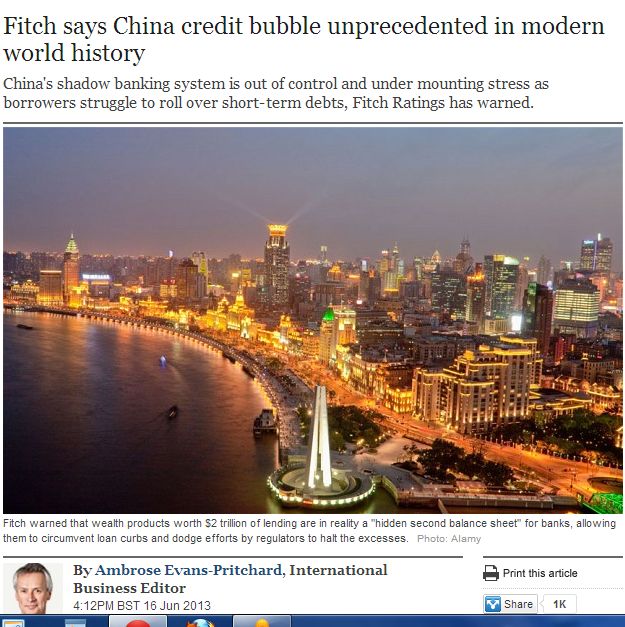
Fitch says China credit bubble unprecedented in modern world history
Ambrose Evans-Pritchard, 16 June 2013
Universa's view that a crash is coming is not widely held, making crash protection cheap
Universa buys this protection in the form of options that generate huge returns when the stock market falls by more than 20%.
Universa's adviser, economist and former derivative trader Nassim Taleb calls it 'black swan' hedging.
That's apropos considering Taleb coined the phrase 'black swan,' described as an unforeseen event that has an extreme impact, such as the 2008 financial crisis or Japan's 2011 nuclear disaster.
CNNMoney 24 May 2013
Universa president and chief investment officer Mark Spitznagel says he's pretty confident that the market will crash, or fall by more than 20%, in the next six months -- a year max.
Related: Is bond bubble losing air?
Are the markets going mad?
That is a question many investors might have asked in recent weeks,
as stocks in the UK, eurozone and US have soared – even as bond spreads decline.
Phoney QE peace masks rising risk of instability
Gillian Tett, Financial Times 16 May 2013
Profound tensions lurk beneath surface calm
It is easy to identify the reason for this: as this data has gone haywire in the past couple of years,
western central banks have been unleashing an estimated $7tn worth of quantitative easing.
This has lowered interest rates on government bonds, forcing investors to search elsewhere for yield.
But what has intensified the crunch is that, while central banks have been gobbling up bonds, the supply of assets has declined.
However the crucial question now is just how much longer these bizarre conditions can continue.
Right now the betting among most analysts I have recently spoken with in London and New York is that these distorted conditions will remain in place far longer than most people expect.
Take a look at a report recently compiled by Matt King, an analyst at Citigroup
Mind the gap; investing in repressed markets
Next Bubble Is Forming: U.S. Government Bonds
The U.S. economy is in a bubble inflated by “phony money” from the Federal Reserve and will burst within a few years,
warned David Stockman, who was budget director for President Ronald Reagan.
Bloomberg, April 1, 2013
In an essay published yesterday in the New York Times (NYT),
Stockman wrote that the Fed’s quantitative easing policies following the credit crisis
have flooded stock markets with cash even while the “Main Street economy” remains weak.
The combination, he wrote, is “unsustainable.”
Stockman, 66, is the author of “The Great Deformation: The Corruption of Capitalism in America,” which will be published tomorrow.
He rose to prominence during the early 1980s in the Reagan administration while pushing supply-side economics, which held that income tax cuts would boost economic growth and raise more revenue for the government.
Stockman quickly turned on supply-side economics. He said the benefits would only “trickle down” to the non-wealthy and that the tax plan “was always a Trojan horse” for accomplishing the primary goal. That objective was bringing down the top income-tax rate to 50 percent from 70 percent.
He resigned as budget director in 1985 and published a book criticizing the Reagan administration.
US government debt is a safe haven the way Pearl Harbor was a safe haven in 1941.
This is no recovery. And this is no "down cycle" that will soon be followed by a reliable "up cycle."
This is a big, multi-bubble pop and it’s far from over.
Book; Aftershock
In the fixed interest sector something irrational is undoubtedly going on
Despite the oft-heard central bankers’ refrain that bubbles are impossible to identify until after they have been pricked,
historical comparisons leave little doubt that this is a bubble
John Plender, FT January 29, 2013
Att varna för en förestånde finanskrasch har vissa likheter med att slå larm om en kommande jordbävning i San Fransisco-trakten.
Till och med en jagsvag nybörjarprofet kan vara helt säker på att få rätt.
Men lika gärna som det kan smälla imorgon kan det dröja femtio år innan det blir dags att låta ett
”vad var det jag sa!” eka över de kaliforniska kullarna.
Andreas Cervenka, e24, 2011-02-27
Even Marc Faber isn’t perfect.
His best prediction of all time, he says, was also the worst investment call he’s ever made.
“That was the prediction that the tech bubble would burst,” which he made in 1998.
“But it came two years too early.”
CNBC 1 Apr 2011
The long shadow of the 1930s
Could things go bad again?
I mean really bad – Great Depression bad, world war bad?
The kind of cataclysmic event my generation has learned to think belongs only in the history books.
Gideon Rachman, Financial Times, November 28, 2011
The Federal Reserve told the 31 largest U.S. banks to test their loan portfolios and trading books against a deep recession and a European market shock
to ensure they have enough capital to withstand losses.
The most severe test scenarios outlined by the Fed today include an unemployment rate of as much as 13 percent,
an 8 percent drop in gross domestic product and a 21 percent plunge in home prices.
Bloomberg Nov 23, 2011
The Fed said it would publish the results of the market shock scenario of the six institutions: Bank of America Corp., Citigroup Inc., Goldman Sachs Group, Inc., JPMorgan Chase & Co., Morgan Stanley and Wells Fargo & Company.
When EU regulators ran stress-tests on European banks in July,
Dexia, the Franco-Belgian lender, not only passed the exercise, it emerged as one of the safest banks in Europe.
FT October 5, 2011
The world is facing the worst financial crisis since at least the 1930s “if not ever”
the Governor of the Bank of England said last night
DT 6 Oct 2011
Jeremy Warner
Bank of England hits the panic button
Bank of England Governor Mervyn King has attacked the 'absurd' level of risk taken on by banks
He called the banks' reliance on short-term debt to meet funding needs in 2008 an "accident waiting to happen".
He said that, in future, banks must be forced to rely much more on equity to finance their risky activities.
BBC 26/10 2010
We are now in the stage of the crisis where people get truly desperate.
The latest crazy idea, which is being pursued by officials, is to turn the eurozone’s rescue fund into an insurance company,
or worse, a collateralised debt obligation, the financial instrument of choice during the credit bubble.
This is the equivalent of putting explosives into a can, before kicking it down the road.
Wolfgang Münchau, FT 2 October 2011
Once the crisis hit Italy, followed by an absolutely inadequate policy response of the Italian government, the crisis has reached a point of No return.
Italy is too big to save with the current set of instruments, including ECB bond purchases, and in the absence of a credible programme of eurobonds,
he concludes that a breakup of the eurozone must now be considered as a probable scenario.
The question is now whether and how the EU can survive such a cataclysmic event.
Wolfgang Münchau in his column in FT Deutschland, ref. by Eurointelligence 21 September 2011
Our economic predicament is not a temporary or traditional condition.
The economic model that drove the long boom from the 1980s to 2008, has broken down.
The 2008/09 financial crisis has bequeathed a once-in-a-generation crisis of capitalism
George Magnus, FT 12 September 2011
“Rates can be lower than you’d imagine for longer than you’d think,” said Kit Juckes, currency analyst at Société Générale.
“But you wouldn’t expect the kind of things we’ve seen in [European] rates unless you’re thinking something terrible will happen.”
FT 9 September 2011
The market can stay irrational longer than you can stay solvent.
John Maynard Keynes, (attributed)
Unless there is a dramatic and simultaneous shift in the politics of Italy, Germany and the European Central Bank,
the collapse of the eurozone is all but certain.
Neither Italy, Spain, Portugal, Ireland nor Greece will be able to maintain their membership in the eurozone,
and maintain sustainability of their sovereign debt at current interest rate spreads.
Wolfgang Munchau, Eurointelligence 9 September 2011
We are in a worse situation than we were in 2008.
The world’s developed economies are trapped at the “stall speed” of low growth and
need to have greater fiscal stimulus and less austerity to kick-start growh,
leading economist Nouriel Roubini told CNBC Friday.
CNBC Friday 2 Septemberb 2011
“We are in a worse situation than we were in 2008. This time around we have fiscal austerity and banks that are being cautious.”
Stephen Cecchetti and his team at BIS have written the definitive paper
Debt becomes poisonous once it reaches 80pc to 100pc of GDP for governments, 90pc of GDP for companies, and 85pc of GDP for households.
“The debt problems facing advanced economies are even worse than we thought.”
Ambrose Evans-Pritchard, 31 August 2011
The real effects of debt
by Stephen G Cecchetti, M S Mohanty and Fabrizio Zampolli
This paper was prepared for the "Achieving Maximum Long-Run Growth" symposium
sponsored by the Federal Reserve Bank of Kansas City, Jackson Hole, Wyoming, 25-27 August 2011
Many ask whether high-income countries are at risk of a “double dip” recession. My answer is: no,
because the first one did not end.
The question is, rather, how much deeper and longer this recession or “contraction” might become.
Martin Wolf, Financial Times, 30 August 2011
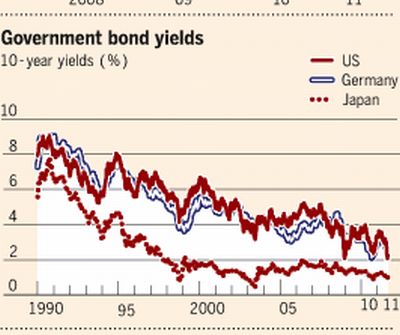
What has the market turmoil of August been telling us? The answer, I suggest, is three big things:
first, the debt-encumbered economies of the high-income countries remain extremely fragile;
second, investors have next to no confidence in the ability of policymakers to resolve the difficulties; and,
third, in a time of high anxiety, investors prefer what are seen as the least risky assets, namely,
the bonds of the most highly rated governments, regardless of their defects, together with gold.
Those who fear deflation buy bonds; those who fear inflation buy gold; those who cannot decide buy both.
But few investors or corporate managers wish to take on any longer-term investment risks
Welcome, then, to what Carmen Reinhart, senior fellow at the Peterson Institute for International Economics in Washington,
and Harvard’s Kenneth Rogoff call “the second great contraction” (the Great Depression of the 1930s being the first).
Those less apocalyptic might call it the “Japanese disease”.
Next Bubble Is Forming: U.S. Government Bonds
In the normally quiet month of August we have seen these difficulties escalate so rapidly that
little now stands between Europe and a decade of low growth, high unemployment, industrial decline and popular discontent, the nearest modern economic parallel for which is the 1930s.
It is an already lethal cocktail that becomes more deadly when mixed inside the euro, a currency created without the resilience to withstand difficult times and which has no structure for effective decision-making.
Gordon Brown, Britain’s prime minister from 2007 to 2010 and chancellor of the Exchequer from 1997 to 2007,
New York Times 18 August 2011
Det börjar likna Cataclysm, banne mig
Rolf Englund blog 4 augusti 2011
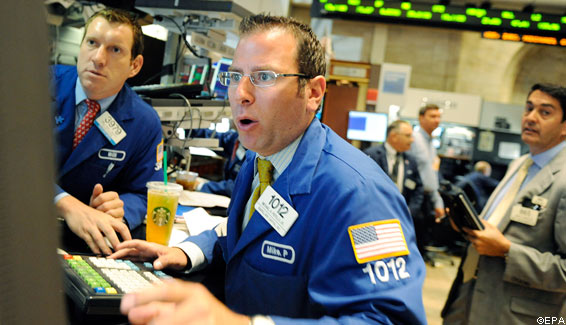
The Wilshire 5000 Total Market Index, the broadest index of U.S. stocks, lost 891.93 points, or just over 7%, Monday.
This represents a paper loss for the day of approximately $1.0 trillion.
CNN August 8, 2011
Hundreds of municipal downgrades are next. But don't panic
Hibah Yousuf, CNN August 8, 2011
The crisis that started in the US real estate sector in 2007
has devastated state finances on both sides of the Atlantic and is threatening to wreck the euro and trigger a second global downturn.
Der Spiegel 8 August 2011
Britain's Economist magazine is warning of a double-dip recession in the US, a second downturn just three years after the last one. Many economists have been pointing out that last week's panic resembled the fear that swept financial markets after the collapse of US investment bank Lehman Brothers in September 2008.
Then as now, banks stopped lending each money. Then as now, banks' cash deposits at the central bank doubled within days.
Angel Gurria, secretary general of OECD
dicusses whether there is a way out of the cycle of high debt and low growth that the developed world finds itself in.
Hard Talk BBC, 6 July 2011
Highly Recommended
Deleveraging
Both households and financial institutions have reduced their leverage,
but they still have a long way to go to reach their previous trend relationship to GDP.
A. Gary Shilling, Bloomberg, 5 March 2014
A year ago, Dr. Gary Shilling published the influential book The Age of Deleveraging,
which followed his earlier work, Deflation (1998); and in today’s Outside the Box he updates us on his thinking
Of course, there is that slim, remote, inconsequential, trivial probability that our forecast of global deleveraging, of continuing global economic weakness and of recession is dead wrong,
and that all the government stimuli and other forces will revive economies enough to justify current investor enthusiasm. We doubt it, however.
via John Mauldin, 11 February 2013
2013 Investment Themes (excerpted from the January 2013 edition of A. Gary Shilling's Insight)
Why Deleveraging Still Rules Markets in 2013
I foresee about five more years of deleveraging
A. Gary Shilling, Bloomberg 28 January 2013
Gary Shilling is looking for a brand new cyclical recession beginning in 2012
The economy, he says, is like a four-cylinder engine, and a recovery usually requires all four to be firing.
They are consumer spending, employment, housing and the reversal of the inventory cycle.
Howard Gold, MarketWatch 24 June 2011
Many Americans will be forgiven if they can’t see the difference between that and the recovery we’ve been experiencing. That’s Shilling’s point. Usually, deep recessions like the one we just lived through are followed by strong snapbacks, like a growth slingshot.
This time, however, the recovery has been “distinctly subpar,” in his words.
Translation: More than three years after the peak, we’re still not back to where we were.
The economy, he says, is like a four-cylinder engine, and a recovery usually requires all four to be firing. They are consumer spending, employment, housing and the reversal of the inventory cycle.
Shilling thinks only the last is really recovering — i.e., companies that brutally liquidated inventories during the recession have had to rebuild them through boosting production and some additional hiring as demand bounced off its lows.
Friedman and Keynes
Many economists agree that the drastic measures taken probably prevented a repeat of the Great Depression. But...
Howard Gold, MarketWatch 1 July 2011
The Coming Collapse in Housing
By Gary Shilling at John Mauldin 17/11 2006
In a new book “The Age of Deleveraging: Investment Strategies for a Decade of Slow Growth and Deflation”*,
Gary Shilling, an economist, argues for the deflationary outcome.
He expects American GDP growth to average only 2% over the next decade as the economy struggles to deal with the debt burden.
Buttonwood, The Economist print Jan 6, 2011
Nouriel Roubini:
Världsekonomin hotas av en ”perfekt storm” bestående av usla amerikanska statsfinanser,
omstrukturering av skulder i EMU, stagnation i Japan och inbromsning i Kina
DI 2011-06-13
I en intervju med nyhetsbyrån Bloomberg säger han att sannolikheten är en på tre att faktorerna ovan senast om två år kommer att sätta käppar i hjulet för den globala ekonomin.
---
Roubini Says ‘Perfect Storm’ May Threaten Global Economy
Bloomberg 13 June, 2011
Roubini is among analysts who predicted the global financial crisis of 2007-2009 that was triggered by a collapse in the value of U.S. mortgage securities.
In Europe, officials need to restructure the debt of Greece, Ireland and Portugal, and waiting too long may result in a “more disorderly” process, Roubini also said.
European officials are racing to find a plan to stem Greece’s debt crisis by June 24 while sharing the cost of a new rescue with bondholders
Robert Shiller, co-creator of the S&P/Case-Shiller Home Price Indices
Claiming that he wasn't making any predictions, he predicted that home prices could fall another 25 percent.
"Statisticians deal with things that repeat themselves. This housing boom and bust is so historic and unprecedented, you can't forecast the future because you have no comparison."
Diana Olick, CNBC Real Estate Reporter, 10June 2011
Not just that the global economy remains severely unbalanced or that it is business as usual in an unreformed financial sector.
It is not even that the euro area could trigger the sort of mayhem last seen in the autumn of 2008
It is that oil prices have been rocketing and greenhouse gas emissions increased by a record amount last year.
There is the potential there for not just one crisis but three: a situation where the ATMs freeze up, the planet warms up, and the lights go out
Larry Elliott, Guardian, 31 May 2011
Unravelling the reason for higher oil prices is tricky, but whether it has been stronger demand from the fast-growing emerging economies, the long-anticipated arrival of peak oil, speculation from hedge funds or a combination of all three, the era of easily available cheap crude is over for good.
Hence the attempts to get oil out of dangerous deepwater fields or from the Canadian tar sands. In the long term, however, countries will have to find ways of making fossil fuels cleaner, going nuclear, or investing heavily in renewables. All are expensive and potentially controversial, as Germany will find with its decision to abandon nuclear altogether.
It's not pretty but there are at least four possible choices. Choice one: do nothing because modern financial capitalism is robust and self-correcting, there is more oil in the ground than we think, and global warming is a fantasy.
Possible, but given that it was the same mindset as prevailed in financial markets pre-2007, fraught with risk.
The Economic Consequences of the Peak
IMF: Svenska huspriser för höga
Sveriges exit från den globala krisen har varit unikt lyckad vid jämförelse med andra länder inom EU.
”Bostadspriserna förefaller övervärderade och ett utdraget prisfall verkar sannolikt”
Dagens Industri 2011-06-01
"We estimate that house prices have peaked, and we believe that interest rates are set to continue to rise.
Therefore house prices will probably continue to fall," said Peter Doyle at the IMF said
The IMF warned in its annual assessment of the Swedish economy, that Swedish house prices are in line for a fall even if the eurozone debt crisis does not impact on growth.
thelocal.se, 1 June 2011
Bundesbank President och Grekland – “the central bank equivalent of nuclear deterrence:
defy us and we will blow up the world”
Rolf Englund blog 25 maj 2011
Watch out for tail risks hanging over the $14,300bn US Treasuries market
Risky to fund long-term holdings with short-term debt.
Gillian Tett, Financial Times, 19 May 2011
How long before a new financial crisis?
If the core ingredients of a financial crisis are boundless optimism, excessive leverage and overpriced assets,
then we are already in dangerous territory less than three years after the collapse of Lehman Brothers
John Plender, Financial Times, 17 May 2011
It's as if 2008 never happened.
Once again the world's investors are pumping up bubbles that will probably explode in their faces.
Bloomberg Businessweek's Economics editor Peter Coy, April 14, 2011
Global junk-bond issuance hit a record in the first three months of the year.
And Yale's Robert Shiller calculates that the Standard & Poor's 500-stock index is trading at 23 times earnings normalized over the past 10 years, compared with a historical average of 16.
*
The advanced countries are in no sense back to normality:
fiscal deficits remain exceptional; monetary policy is hugely accommodative; the financial sector is fragile, particularly in the eurozone; credit growth has been remarkably slow in the US and eurozone; households of several countries, including the US and UK, remain highly indebted; and there exists the possibility of sovereign defaults, bank failures or both within the eurozone.
Moreover, despite the scale of the monetary and fiscal stimuli applied, the recovery in these countries is still expected to be anaemic
Martin Wolf, FT April 19 2011
Credit rating agencies should never be taken too seriously, but for Standard & Poor's to put the United States on "negative outlook" is none the less something of event
Jeremy Warner, Daily Telegraph, 18 April 2011
If nothing else, S&P's bombshell highlights the hopeless mess the world's largest economy has managed to get itself into.
Coming on top of renewed escalation in the eurozone crisis, it feeds into a sea of worry about the sustainability of the economic recovery and the increasingly parlous fiscal position of many advanced economies.
Full textNext Bubble Is Forming: U.S. Government Bonds
Oljan har tagit miljoner år att bildas. Och på dryga 100 år har vi förbrukat hälften av jordens oljetillgångar...
På mindre än tjugo år skall vi konsumera vad som återstår...
Hur har det kunnat bli så?
Gunnar Lindstedt i boken "Olja - Jakten på det svarta guldet när världens oljekällor sinar", 2005
Peak Oil and the Second Great Depression (2010-2030):
A Survival Guide for Investors and Savers After Peak Oi
Kenneth D Worth 2011
Att varna för en förestånde finanskrasch har vissa likheter med att slå larm om en kommande jordbävning i San Fransisco-trakten. Till och med en jagsvag nybörjarprofet kan vara helt säker på att få rätt.
Men lika gärna som det kan smälla imorgon kan det dröja femtio år innan det blir dags att låta ett
”vad var det jag sa!” eka över de kaliforniska kullarna.
Andreas Cervenka, e24, 2011-02-27
På samma sätt kan den besserwisser som 1999 bosatte sig i en husvagn i Birkastan för att liverapportera från den Stora Bostadskraschen se tillbaka på ett minst sagt segt decennium.
Tajming är helt enkelt allt i finansvärlden.
Finansiella luftballonger brukade vara något som dök upp en gång per generation eller så.
Bara sedan 1999 har vi upplevt tre större hausseperioder; dotcomfesten (1999–2000), kredityran (2003–2007) och stimulanspartyt (2009–2010).
Det går att argumentera för att vi befunnit oss i något slags tillstånd av sinnesförändring under nio av de senaste tolv åren.
Bubblor tycks alltså inte längre vara spektakulära parenteser i finanshistorien utan smågrå inslag i vardagslunken
Tidigare krascher, observera 1974-1975
Based on one measure of volatility, stocks haven't risen this much amid price swings this narrow since 1971
Don't get complacent.
CNBC 17/2 2011
Economics is not a science. There are no laws or cast iron relationships – as there are in "pure sciences", such as physics or chemistry. Throughout recent history, though, there have been a handful of economic variables between which the links have been pretty solid.
Ever since the early 1970s, every single time oil prices have spiked sharply (rising by 80pc or more),
regular as clockwork the US has entered recession.
Given America's massive influence on worldwide economic sentiment,
the past five global recessions have all come in the wake of sharp jumps in the price of crude.
Liam Halligan, Daily Telegraph, 26 Feb 2011
Governments in Jakarta, Manila and New Delhi are grappling with their own subprime crisis of sorts.
This one reflects a toxic mix of suboptimal food stocks, exploding demand, wacky weather and zero interest rates around the globe.
Nouriel Roubini, the New York University economist who predicted the U.S. financial crisis, says surging food and energy costs are stoking emerging-market inflation that’s
serious enough to topple governments. Hosni Mubarak over in Egypt can attest to that.
William Pesek Bloomberg Feb 13, 2011
Unlike the food-price spike of 2008, this one may be more secular than cyclical. Asia alone, for example, will have another 140 million mouths to feed over the next four years. Add that to almost 3 billion people in the fast-growing region and you have a recipe for booming demand.
China’s size and scope means it will be buying up evergrowing chunks of the world’s food supply. As the yuan rises, so will China’s ability to outbid everyone else. Increased trade tensions are inevitable and it will show the futility of food subsidies. Prices will rise as long as consumption does, so it’s really a matter of pouring money down the drain.
7 Billion,
National Geographic Magazine
Rolf Englund blog 2/2 2011
Former British Prime Minister Gordon Brown has said he
fears the euro will face a "high noon" moment of reckoning early in the New Year.
BBC 8 December 2010
"I sense that in the first few months of 2011 we [will] have a major crisis in the euro area," he told BBC business editor Robert Peston.
He said the euro's problems were bigger than just its governments' debts.
Europe must also solve the euro's structural rigidities and the enormous debts of its banks, he warned.
Det finns egentligen inte någon Eurokris.
Tvärtom tvingar euron fram reformer som sedan länge varit nödvändiga,
vilket alltid har varit ett av de starkaste argumenten för en gemensam valuta.
Stefan Fölster, Magasinet Neo 2010-06-15
Gordon Brown:
'We have a major crisis in the euro area'
The enormous liabilities of the eurozone's banks are
a serious and substantial accident waiting to happen.
BBC, 8 December 2010
Gordon Brown says that the eurozone will not solve its current financial crisis unless it opts for a comprehensive and substantial rescue package, that would involve putting tens of billions of pounds of new capital into the eurozone's banks.
The former British prime minister said, in an interview I've just done with him, that the enormous liabilities of the eurozone's banks are a serious and substantial accident waiting to happen.
The central theme of his new book, Beyond the Crash, is that the US and Europe will be condemned to years of low growth unless and until the world's biggest economies co-ordinate their economic policies and their approaches to financial regulation
Beyond the Crash: Overcoming the First Crisis of Globalisation
Amazon
Probably one of the best pieces of analytical commentary we have yet read on the eurozone situation
Once the dust finally settles Europe will either be a unified country
with fiscal sovereignty firmly established in Berlin or Brussels,
or it will be fragmented with little chance of reunion.
Michael Petis via Rolf Englund blog 24/11 2010
Europe heads back into the storm
Ireland’s basic problem is that it now has to choose between its own sovereign solvency and the solvency of its banks.
Other European countries – in and out of the eurozone – may soon face the same choice.
In such a world, keeping banks afloat with public capital risks sinking the sovereign
– and with it, the whole banking system.
Financial Times editorial November 17 2010
The World Bank is set to join a German money market fund and Austrian life insurers in
facing losses as Austria prepares to write down the value of Hypo Alpe-Adria-Bank International AG’s junior debt.
Bloomberg 16 July 2014
The lender, whose goals are to fight poverty and help developing countries, is in talks with Austrian authorities about 150 million euros ($203 million) of Hypo Alpe junior bonds it holds, according to a World Bank spokesman, Derek Warren. The securities are part of 890 million euros in subordinated debt that will be wiped out once a law on Hypo Alpe’s wind-down, passed by Parliament’s lower house in Vienna last week, gets final approval.
The Austrian savings banks are on their own as government withdraws support for the banking system
My latest at Forbes looks at the implications of Moody's downgrade of Oesterreichische Volksbanken AG
Coppola Comment 5 AUGUST 2014
The Austrian government’s recent decision to overturn the guarantee provided by the State of Carinthia to holders of Hype Alpe Adria’s subordinated debt has come back to haunt it.
Erste, Austria’s largest bank by assets, swings to € 1 bn loss after Romania writedown
FT, 31 July 2014
It’s not quite Creditanstalt,
the Austrian banking collapse that marked the beginning of the Great Depression, but...
It is important not to get this latest flare-up in Europe’s financial crisis out of proportion;
the historical precedents make everyone very nervous whenever Austria and banks are mentioned together in the same sentence
Jeremy Warner, Telegraph 7 July 2014
The profit warning last week from Austria’s Erste Bank, together with the accompanying share price crash,
provides a timely reminder that Europe’s banking travails are by no means over.
Both these banks – Hypo and Erste – are big lenders into the emerging market economies of eastern Europe,
some of which are experiencing quite similar boom and bust cycles to those of the eurozone periphery. Bulgaria, for instance, is not yet a member of the euro but it might as well be, for it is irredeemably joined at the hip to the single currency through a Currency Board and has, therefore, found itself part of the same dynamic that has afflicted Greece and Ireland, only a bit later.
ECB is to flood the banking system anew with more liquidity support
– “Targeted Long Term Refinancing Operations (TLTROs).
Thus does the ECB hope to answer both solvency and liquidity concerns. Can it hope to succeed?
This is what Americans sometimes call a “non trivial question”
Shares in Erste Group plunged 15 per cent on Friday after the Austrian lender said that problems in Hungary and Romania would drag it to a net loss of up to €1.6bn this year.
The announcement sent a shiver through central European markets, which brought western European companies large profits in the years before the financial crisis, but have since been far more volatile.
FT 4 July 2014
Austrian banks have lent a total of $300bn to clients in the region (Eastern Europe),
equivalent to 68 per cent of Austrian gross domestic product, according to (BIS).
If Bank Austria, which is owned by Italy’s Unicredit, were included, the figure would rise to about 100 per cent
Financial Times February 25 2009
In 1931, Austria was attempting to deliver the kind of austerity now being witnessed in parts of southern Europe.
The crisis culminated in the failure of Creditanstalt, a major Viennese bank – the 1931 equivalent of Lehman Brothers.
A handful of years later, Hitler was welcomed by cheering crowds in Vienna.
Stephen King, HSBC Group’s chief economist, Financial Times, 9 May 2012
Under the Gold Standard, the only option to regain competitiveness was to force domestic prices and wages lower.
Interndevalvering
In May 1931, a Viennese bank named Credit-Anstalt failed.
Founded by the famous Rothschild banking family in 1855, Credit-Anstalt was one of the most important financial institutions of the Austro-Hungarian Empire,
and its failure came as a shock because it was considered impregnable.
Bloomberg Businessweek's Economics editor Peter Coy, April 20, 2011
The bank not only made loans; it acquired ownership stakes in all kinds of companies throughout the sprawling empire, from sugar producers to the new automobile makers. Its headquarters city, Vienna, was a place of wealth and splendor, famous for its opera, balls, chocolate, psychoanalysis, and the extravagant architecture of the Ringstrasse. The fall of Credit-Anstalt—and the dominoes it helped topple across Continental Europe and the confidence it shredded as far away as the U.S.—wasn't just the failure of a bank: It was a failure of civilization.
When the Austro-Hungarian Empire broke up after World War I, the bank continued to do business throughout the old empire without recognizing that the world had changed. Suddenly, more knowledgeable local lenders were getting the best deals, leaving Credit-Anstalt with the loans no one else would touch, says Aurel Schubert, an Austrian economist who wrote a 1991 book on the episode called The Credit-Anstalt Crisis of 1931. (There's a modern analogy in Greek banks' unwise loans in Bulgaria, Romania, and Serbia.)
The scariest thing about the Credit-Anstalt default is that it occurred in a small, peripheral country, just as today's worst problems are concentrated so far in Greece, Ireland, and Portugal, which combined make up just 5 percent of the 27-nation European Union's gross domestic product. "Austria is a tiny, tiny little place, and you wouldn't imagine it could set off a chain of domino reactions. But it did. I do see exactly that potential now," says James.
Harold James, a British historian at Princeton University, described what happened next in his 2001 book The End of Globalization: Lessons from the Great Depression.
Europe stumbles blindly towards its 1931 moment
Unless the ECB takes fast and dramatic action, it risks destroying the currency it is paid to manage, and allowing a political catastrophe to unfold in Europe.
Ambrose Evans-Pritchard 14 Nov 2010
If mishandled, Ireland could all too easily become a sovereign version of Credit Anstalt - the Austrian bank that brought down the central European financial system in 1931, sent tremors through London and New York, and set off the second deeper phase of the Great Depression, the phase when politics turned ugly.
The eurozone’s fiscal fund (European Financial Stability Facility) is fatally flawed.
Like Alpinistas roped together, an ever-reduced core of solvent states are supposed to carry the weight on an ever-widening group of insolvent states dangling beneath them.
This lacks political credibility and may be tested to destruction if – as seems likely – Ireland is forced to ask for help.
At which moment the chain-reaction begins in earnest, starting with Iberia.
*
Svenskt Näringslivs chefekonom Stefan Fölster:
I Neos nummer på detta tema återfinns denna snedsyn framförallt i Erik Lakomaas artikel om Euron och Grekland.
Den som skrapar på ytan upptäcker något helt annat: Det finns egentligen inte någon Eurokris.
Tvärtom tvingar euron fram reformer som sedan länge varit nödvändiga, vilket alltid har varit ett av de starkaste argumenten för en gemensam valuta.
Det är ett vanligt missförstånd att Euron skulle tvinga medlemsländer att rädda den som inte sköter sina statsfinanser.
De globala ekonomiska obalanserna fortsätter att växa och med dem skuldsättningen hos de redan hårt skuldsatta och ansamlingen av allt osäkrare fordringar hos kreditorerna.
Risknivån i den globala balansräkningen ser alltmer ohälsosam och ohållbar ut.
Den växande valutaoron är ett tydligt tecken på att spänningarna börjar närma sig bristningsgränsen.
Per Lindvall e24 2010-11-15
Men det är också något sjukt och ohållbart med denna utveckling. För samtidigt som de ekonomiskt mogna länderna i Västvärlden som helhet, med USA i spetsen, lånar till sin privata och numera framför allt offentliga konsumtion så kanaliserar de betydande delar av sitt sparande till dessa i de flesta fall rejält överhettade och kapitalexporterande BRIC-länder.
Det är svårt att se att detta är en optimal kapitalallokering, utan snarare bidrar det till överinvesteringar och överhettning i de så kallade tillväxtekonomierna och ett förvärrande av de strukturella bekymren på hemmaplan.
Top of pageEuropas stabilitet är inte längre given
Om boken Peer Steinbrück, tidigare Tysklands finansminister, Unterm Strich
Rolf Gustavsson, SvD 6 november 2010
If you think we are gloomy, you should listened to Mervyn King, /chef för Bank of England/
who yesterday predicted a 1930s style global meltdown, unless policy makers can agree a common approach
to managing currencies (something we they will never do, even if faced with a trade war).
Eurointelligence 20/10 2010
King called for a "grand bargain" at the G20, that would include rules for capital flows and a rules to realign domestic demand to put the global economy on a surer footing, Reuters reports from London.
"The need to act in the collective interest has yet to be recognised,” according to King.
Unless it is, the result would be a 1930s style collapse of global trade.
Most of the peripheral countries have completed most of the borrowing they had to accomplish this year.
No governments have yet fallen, and no sovereign debt has yet been repudiated.
The key word is "yet."
Irwin Stelzer, director of economic-policy studies at the Hudson Institute
Wall Street Journal 25/10 2010
A group of influential hedge fund managers with assets of about $100 billion
has launched a stinging attack on central banks and regulators for bailing out stricken financial institutions.
The Times October 18 2010
The group lay out their argument in the book The Gathering Storm.
The authors have placed investment bets based on their convictions and will be donating the proceeds of the book to charity.
The hedge funds argue that banks, including the nationalised lender Northern Rock, should have been allowed to collapse or been forced to repair their balance sheets rather than being propped up by the state.
The group is led by Lee Robinson, a former credit derivatives banker who co-founded the London hedge fund Trafalgar Asset Managers.
He writes: “I ask the question: has the increase in credit, and hence leverage in the system caused by repeated bailouts by central banks, actually made crises more likely to occur?”
See also: The Gathering Storm, by Sir Winston Churchill
Se även:
Den annalkande stormen, av Rolf Englund
1987-10-26 För Svensk Tidskrift nr 9/1987
Borrowed time
Inflated: How Money and Debt Built the American Dream. By Christopher Whalen.
The Economist print Dec 16th 2010
Wiley; 393 pages; $34.95 and £23.99. Buy from Amazon.com, Amazon.co.uk
By the late 1970s housing had begun to replace defence as America’s engine of growth.
Before long, the myth that you could never have enough of the stuff had taken hold.
Mr Whalen is not alone in wondering how the American economy will cope without a buoyant property market.
We live in an amazing world. Everybody has big budget deficits and big easy money
but somehow the world as a whole cannot fully employ itself,”
said former Fed chair Paul Volcker in
Chris Whalen’s new book Inflated: How Money and Debt Built the American Dream.
Ambrose Evans-Pritchard, 26 Sep 2010
RE: Very Important Article
Anders Åslund och den svenska fastighetsbubblan Rolf Englund blog 22/12 2010
Är friheten hotad i USA?
Rolf Englund blog 4/12 2010
Så kan det bli ny världsdepression
Jag är personligen något skeptisk till Roubinis förutsägelser.
Han hade naturligtvis rätt i att peka på det fallande bostadsbyggandet som en allvarlig risk för en kraftig konjunkturnedgång.
Men när han gjorde detta i september 2006 hade de snabbt uppdrivna bostadsinvesteringarna redan fallit under mer än ett års tid (diagr).
Att han då sågs som en Kassandra säger nog mera om det socialpsykologiska klimatet bland politiker och ekonomer i USA än om Roubinis yrkesskicklighet.
Danne Nordling 16 oktober 2010
All western governments face severe difficulties in the years ahead
House prices have fallen and interest rates are low, but in Britain a mortgage of three times earnings will not buy a home on the edge of
a provincial city for even a relatively high-income family on say, £60,000 a year.
Max Hastings, FT October 15 2010
All western governments face severe difficulties in the years ahead as societies’ virtuous bourgeois, as we might describe them with only mild irony, face pressure on their lifestyles for which there are no panaceas.
Earnings are flat, and likely to remain so in real terms, while cost inflation is steep especially for healthcare, energy and insurance.
The gulf between top and median earners is wider than at any time since 1929.
In 1980, 8 per cent of US earners received 16 per cent of national income. That same proportion now falls into the hands of the top 1 per cent, while the top 20 per cent take over half. There is a similar concentration of wealth in the UK.
Politicians have good reason to fear a new western world in which a small minority continues to prosper and spend prodigiously, while the living standards of middle earners decline.
Top of pageAt the current rate of job creation, the nation would need nine more years to recapture the jobs lost during the recession.
And that doesn’t even account for five million or six million jobs needed in that time to keep pace with an expanding population.
Median house prices have dropped 20 percent since 2005. Given an inflation rate of about 2 percent it would take 13 years for housing prices to climb back to their peak.
Commercial vacancies are soaring, and it could take a decade to absorb the excess in many of the largest cities.
New York Times 13 Oct 2010
The vacancy rate, as of the end of June, stands at 21.4 percent in Phoenix, 19.7 percent in Las Vegas, 18.3 in Dallas/Fort Worth and 17.3 percent in Atlanta, in each case higher than last year, according to the data firm CoStar Group.
"USA har ryckt åt sig ett stort försprång och har världens mest framgångsrika ekonomi"
Klas Eklund på SvD:s ledarsida 2000-08-11
If you strip away the political correctness,
Chapter Three of the IMF's World Economic Outlook more or less condemns Southern Europe to death by slow suffocation
and leaves little doubt that fiscal tightening will trap North Europe, Britain and America in slump for a long time.
Ambrose Evans-Pritchard 03 Oct 2010
The IMF report – "Will It Hurt? Macroeconomic Effects of Fiscal Consolidation"
– implicitly argues that austerity will do more damage than so far admitted.
http://www.imf.org/external/pubs/ft/weo/2010/02/pdf/c3.pdf
"Not all countries can reduce the value of their currency and increase net exports at the same time," it said. Nobel economist Joe Stiglitz goes further, warning that damn may break altogether in parts of Europe, setting off a "death spiral".
The Fund said damage also doubles for states that cannot cut rates or devalue – think Spain, Portugal, Ireland, Greece, and Italy, all trapped in EMU at overvalued exchange rates.
"A fall in the value of the currency plays a key role in softening the impact. The result is consistent with standard Mundell-Fleming theory that fiscal multipliers are larger in economies with fixed exchange rate regimes."
Exactly.
It is fallacious to cite the austerity cures of Canada, and Scandinavia in the 1990s – as the European Central Bank does – as evidence that budget cuts pave the way for recovery. These countries were able export to a booming world. They could lower interest rates, and were small enough to carry out `beggar-thy-neighbour' devaluations without attracting much notice. We were not then in our New World Order of "currency wars".
Joseph Stiglitz sees bleak future for euro as New Malaise takes hold
Exclusive extract: In an updated edition of his critically acclaimed book, Freefall, Joseph Stiglitz analyses the response to the financial crisis and finds new threats stalking the global economy
http://www.telegraph.co.uk/finance/financetopics/financialcrisis/8041909/Joseph-Stiglitz-sees-bleak-future-for-euro-as-New-Malaise-takes-hold.html
Freefall: America, Free Markets, and the Sinking of the World Economy
Amazon
Den 6 maj 2010 föll Dow Jones med 1000 punkter.
De amerikanska börserna var som mest nere med 8 procent innan de återhämtade sig.
Händelsen har blivit känd som the flash crash eller blixtkraschen.
Affärsvärlden 3 Oktober 2011
I en holländsk dokumentär som sändes på SVT i går kallad ”Snabba klipp” framförs en teori om vad det var som faktiskt orsakade raset.
Enligt amerikanska finansinspektionen SEC/CFTC:s rapport som utredde blixtkraschen orsakades raset av att en enskild handlare sålde 75 000 e-mini-kontrakt för 4,1 miljarder dollar.
I rapporten nämns dock inget om att det var en enskild händelse på 50-100 millisekunder som orsakade kraschen.
The activity of high frequency traders and the algorithms they used one year ago today when a ‘flash crash’ rattled the markets worldwide
should cause the Securities and Exchange Commission to “thoroughly” examine their role,
said agency chief Mary Schapiro, CNBC 6 May 2011
“In 2010, the high frequency traders who are today’s liquidity providers represented well more than 50% of market volume and were net aggressive sellers during the broad index price decline," Schapiro told a gathering of mutual fund managers
Fear of 'Catastrophic' Crash Rising Despite Bull Market
the Flash Crash Advisory Commission that met on Friday has a long way to go
CNBC 18 Feb 2011
This means the Flash Crash Advisory Commission that met on Friday has a long way to go in restoring confidence
In an unprecedented move, the number of investors fearing a catastrophic stock market crash is rising even with the stock market at 2 ½ year highs.
The unusual dislocation comes from two distinct reasons: a lack of trust in the U.S. financial markets
following the so-called Flash Crash last May and the collapse of Lehman Brothers in 2007.
What caused the Flash Crash?
You won't find it in this report. It's really a series of recommendations
Here's a few highlights.
Bob Pisani, CNBC 18 Feb 2011
They recommend changes to the present system-wide circuit breakers: reducing the initial trading halts to a shorter period of time, allowing the halt to be triggered as late as 3:30 PM, and using the S&P 500 as the triggering mechanism rather than the Dow.
With memories of last May's "Flash Crash" still fresh in investors' minds,
now comes warning of a market meltdown that could extend beyond stocks
— a possible "Splash Crash" that also would affect currencies, commodities and bonds.
The interconnectedness of high-speed trading platforms is making such an event increasingly possible, says John Bates
CNBC 3 Feb 2011
Bates believes should a similar event happen in the future, be it caused by further disturbances in the Middle East or something else that releases market jitters and a shock to the algorithmic programs that drive high-frequency trading, the effects will be more widespread.
The flash crash of May 6 was sparked by a rapidly executed $4.1bn sale of stock index futures by a single institutional investor
who was hedging against the risk of a market downturn, a report by leading US regulators said on Friday.
The order was completed so quickly That it triggered wild automated selling by computer traders,
which wiped out nearly $1,000bn off the value of US shares for a period of several minutes.
FT October 1 2010
We live in an amazing world. Everybody has big budget deficits and big easy money
but somehow the world as a whole cannot fully employ itself,”
said former Fed chair Paul Volcker in
Chris Whalen’s new book Inflated: How Money and Debt Built the American Dream.
Ambrose Evans-Pritchard, 26 Sep 2010
RE: Very Important Article
“It is a serious question. We are no longer talking about a single country having a big depression but the entire world.”
The exception is Germany, which protects its surplus ($179bn, or 5.2pc of GDP) by means of an undervalued exchange rate within EMU.
The global game of pass the unemployment parcel has to end somewhere. It ends in Greece, Portugal, Spain, Ireland, parts of Eastern Europe, and will end in France and Italy too, at least until their democracies object.
The three pillars of global demand at the height of the credit bubble in 2007 were – by deficits – the US ($793bn), Spain ($126bn), UK ($87bn).
If China continues to hold down its currency, the country will import excess US liquidity, overheat, and lose wage competitiveness. This is the default cure if all else fails, and I believe it is well under way.
Chris Whalen Inflated: How Money and Debt Built the American Dream
Amazon
Ask Not Whether Governments Will Default, but How
The sovereign debt crisis is not European: it is global. And it is not over.
Arnuad Mares at John Mauldin 20/9 2010
Financial oppression as an alternative to outright default. Outright default is not the only way to impose losses on creditors. Financial oppression – the fact of imposing on creditors real rates of return that are negative or artificially low – can take other forms: repaying debt in devalued money (e.g., through unanticipated inflation), taxation or regulatory incentives on institutions to purchase government debt at uneconomic prices, for instance (see also “Default or Inflate or…”, The Global Monetary Analyst, February 24, 2010). Repaying debt in devalued money is particularly effective when the initial stock of debt is high – as it is now. Distorting prices in the government’s favour is particularly effective when the financing requirement is high – also a situation we face now and for years to come.
Next Bubble Is Forming: U.S. Government Bonds
Top of pageFed is running the risk of replaying the disaster movie that led to the credit crisis
by keeping monetary policy loose for too long
This is not the time for an aggressive Fed tightening, but...
Stephen Roach, CNBC 24 Aug 2010
Even though Roach thinks that U.S. monetary policy is too loose, he also said the economy is still spluttering and describes himself as being in the "double-dip camp."
"This is not the time for an aggressive Fed tightening, but it is the time for the Fed to stand back (and be more strategic),"
Top of pageIs the crisis coming back?
After the downgrading of Ireland by S&P, Irish sovereign bond spreads rose from 318bp to 344bp to level higher than before May, and even Greece spreads are now back at close to 10%, the level before the agreement on the EFSF. This means that the European rescue package have failed to calm down the market stress that triggered on those package in the first place.
There was further bad news from the US, where existing home sales declined by a record amount for July, giving rise to expectations of another decline in US house prices.
As ever, Calculated Risk has the best coverage of this.
The Wall Street Journal says in a comment that even a downturn to annualised growth rates of under 2% will feel like a recession.
In a 2% economy, there won’t be any job creation, or wage increases.
Eurointelligence 25/8 2010
In a 2% economy, there won’t be any job creation
Housing led the U.S. out of seven of the last eight recessions.
This time, it may kill the recovery.
Bloomberg Aug 23, 2010
I know it’s over the top, but here it is anyway:
the policy elite — central bankers, finance ministers, politicians who pose as defenders of fiscal virtue
are acting like the priests of some ancient cult,
demanding that we engage in human sacrifices to appease the anger of invisible gods.
Paul Krugman, New York Times 19/8 2010
Late last year the conventional wisdom on economic policy took a hard right turn. Even though the world’s major economies had barely begun to recover, even though unemployment remained disastrously high across much of America and Europe, creating jobs was no longer on the agenda. Instead, we were told, governments had to turn all their attention to reducing budget deficits.
But the apostles of austerity — sometimes referred to as “austerians” — Look at Greece, they said.
The skeptics countered that Greece is a special case, trapped by its use of the euro, which condemns it to years of deflation and stagnation whatever it does. The interest rates paid by major nations with their own currencies — not just the United States, but also Britain and Japan — showed no sign that the bond vigilantes were about to attack, or even that they existed.
Just you wait, said the austerians: the bond vigilantes may be invisible, but they must be feared all the same.
The invisible bond vigilantes continue their invisible attack:nominal 10-year bonds at 2.71%
Paul Krugman 11 August 2010
http://mayas.mrdonn.org/priests.html
Det som händer nu är att marknaderna slutligen har upptäckt att pessimisterna hade rätt
"en tillväxt på bara en eller två procent, innebär ökad arbetslöshet och stora påfrestningar på samhället
Paul Krugman, Ekot 20/8 2010
Det behöver inte nödvändigtvis innebära en krympande bruttonationalprodukt, men det spelar ingen roll.
Med en tillväxt på bara en eller två procent, kommer det att innebära ökad arbetslöshet och stora påfrestningar på samhället.
En längre intervju med Paul Krugman sänds i Godmorgon, världen nu på söndag 22/8 i P1.
...
Englund's Q
How come that unemployment is rising when the recession is over?
It is the productivity, Stupid
For employment to rise GDP must increase more than Productivity (P), of course
Rolf Englund 4/12 2009
...
The optimists will be right until they are wrong.
Wolfgang Munchau, FT 11/12 2006
Top of page
"a loss of confidence – not merely in the idea that the future will be a brighter place, but also, most crucially, about whether anybody is able to predict that future at all."
So what on earth is going on? Optimists like to blame it on a summer lull, or temporary jitters about US unemployment or the eurozone. They may be right. But personally, I suspect that there is something more fundamental going on too.
Gillian Tett, FT August 5 2010
Lawrence Summers, chief economic adviser to President Barack Obama, described the world’s leading economies as “in or near liquidity trap conditions”
With the shock of 2008 fading into memory, the moment of reckoning for the global economy has arrived.
Will the bounce back from the nadir become established as a return to sustainable expansion – or will initial relief mutate into the despair of a renewed slowdown?
Chris Giles, FT July 27 2010
So what could cause a global double dip?
There are four big risks:
a general slide in confidence,
the unwinding of temporary boosts to growth,
a sudden financial implosion, and
a bad reaction to fiscal austerity.
The longer Europe muddles along without a new crisis, the more remote the risk of a sudden implosion becomes. According to Mr Buiter, “the disaster scenario of sovereign defaults is no longer on the table except as a tail risk”.
Top of pageIn extraordinary times, the economy may be close to non-linear phenomena such as a rapid deterioration of confidence among broad constituencies of households, enterprises, savers and investors.
My understanding is that an overwhelming majority of industrial countries are now in those uncharted waters, where confidence is potentially at stake
Jean-Claude Trichet, FT July 22 2010
The stress tests may ultimately lead to catastrophic real-life stresses on banks vital to the prosperity of Europe.
Robert Preston, the BBC's business editor, 21 July 2010
If banks hold government bonds, such as Greek government bonds, in their "banking" books - and thus intend to hold those bonds till they mature or come up for repayment - then those banks would not have to recognise even one cent of potential loss on their bond holdings.
I morgon släpps resultaten av de stresstest som ska avslöja hälsoläget hos Europas 91 största banker. Värst vore om alla klarade provet galant.
Ett väl godkänt betyg skulle sänka förtroendet helt för ett test som redan mötts av skepsis och ifrågasättanden. Nästa fråga skulle då bli: vad är det myndigheterna försöker dölja? Ungefär så paranoid är finansmarknaden.
Andreas Cervenka SvD Näringsliv 22/7 2010
Allt bygger på att testet är trovärdigt. En bil som klarar sig oskadd från en kollision i fem kilometer i timmen imponerar knappast på en säkerhetsmedveten köpare. Lagom många banker i trubbel är bäst - det skapar en känsla av att alla problem dras fram i ljuset.
Full textIMF calls for more ‘stress-test’ openness
FT July 21 2010
Europe must ensure its stress tests are transparent to guarantee their credibility, according to staff at the International Monetary Fund.
But it reported resistance from eurozone authorities to the idea of more transparency.
“Supervisors felt that disclosure of individual bank results could prove too market-sensitive and some national authorities noted legal impediments to publication,” the fund said.
On Wednesday the IMF said that those views were out of date and that the executive directors on the fund’s board – whose opinion is separate from that of the staff – “welcomed the eurozone authorities’ intention to use transparent stress tests.”
Domedagen II
“If HRE is the only German bank that fails, that completely discredits the tests – not just for Germany but for the whole of Europe”.
Rolf Englund blog 2010-07-21
Eurointelligence skriver i dag stresstesterna, det som gör att, som jag skrev i går, domedagen blir på fredag.
Part 5B. What Happens If Things Go Really Badly?
More Things Can Go Badly:
Credit Default Swaps, Interest Swaps and Options, Foreign Exchange
at CalculatedRisk on 7/24/2010
In today’s post, we look at the effects of sovereign default on credit default swaps, interest rate swaps and options, and currency exchange contracts.
Full text and links to earlier
If you want to be really, really pessimistic...
...then Calculated Risk is the place to this morning.
What Happens If Things Go Really Badly? $15 Trillion of Sovereign Debt in Default
CalculatedRisk on 7/18/2010
CR Note: This series is from reader "some investor guy".
Out of the multitude of potential scenarios, I have settled upon one which is really bad, but doesn’t involve asteroids, mass extinctions, or apes taking over. It is consistent with prior bad episodes of sovereign debt default.
Here is the Really Bad scenario. It’s not a worst possible scenario. It is more like the Long Depression or the Great Depression reoccurring under 2010 conditions.
The Fed minutes warned of "significant downside risks" and a possible slide into deflation, an admission that zero interest rates, $1.75 trillion of QE, and a fiscal deficit above 10pc of GDP have so far failed to lift the economy out of a structural slump.
"The Committee would need to consider whether further policy stimulus might become appropriate if the outlook were to worsen appreciably," it said. The economy might not regain its "longer-run path" until 2016.
"The Fed is throwing in the towel," said Gabriel Stein, of Lombard Street Research. "They are preparing to start QE again. This was predictable because the M3 broad money supply has been contracting for months."
Ambrose Evans-Pritchard, 15 July 2010
The world is at risk of another financial crash following a steep rise in asset prices,
according to Raghuram Rajan, governor of the Reserve Bank of India
– and one of the few people to have warned of the last financial crisis.
FT 7 August 2014
“Financial sector crises are not as predictable [as those of economic growth]. The risks build up until, wham, it hits you.”
Don’t let another politician run the IMF
The fund is designed to push tough policies to straighten out countries that have mismanaged finances,
not win a popularity contest
Raghuram Rajan, professor at the University of Chicago Booth School and former IMF chief economist
Financial Times 19 May 2011
As Raghuram Rajan of the University of Chicago Booth School of Business and former chief economist of the International Monetary Fund notes in a thought-provoking new book, the underlying “fault lines” are still with us.
Martin Wolf, 13 July 2010
His voice is worth listening to: in 2005, he presented a controversial, yet now acclaimed, paper at the annual Jackson Hole monetary conference entitled “Has Financial Development Made the World Riskier?”
His answer? Yes.
The crisis has revealed deep faults within western economies and the global economy as a whole. We may be unable to avoid further earthquakes.
In his book, Prof Rajan points to domestic political stresses within the US.
President Barack Obama – a pragmatic centrist – is vilified. On the right, the call is to overthrow the modern government in an effort to return to the 18th century. This, then, is a crisis of government itself.
The problem is that the countries that used to provide the demand – the US, at world level, or Spain, in the eurozone – have over-indebted private sectors. So we see a zero-sum battle over shares of structurally deficient global demand.
This is a threat to survival of the eurozone and even the open world economy.
We can see two huge threats in front of us.
The first is the failure to recognise the strength of the deflationary pressures (see chart).
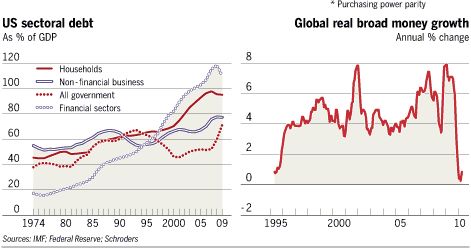
The west is not the power it was; its debt-fuelled consumers are not the source of demand they were...
Fault Lines, Princeton, 2010
Amazon
Raghuram Rajan, one of the few economists to see the financial crisis coming,
wins the Financial Times and Goldman Sachs Business Book of the Year award
FT 28/10/2010
The rebellion against the 1930s fiscal and monetary policies of the Euro-complex is gathering pace.
Il Sole has published a letter by 100 Italian economists warning that the austerity strategy imposed by Brussels/Frankfurt risks tipping Europe into a self-feeding downward spiral.
Ambrose Evans-Pritchard, June 16th, 2010
Premature retrenchment threatens recession and even deflation, as I argued last week.
Having barely survived the biggest financial meltdown in history, we need to appreciate that these downside risks are serious.
Cutting public spending will not automatically raise private spending.
Martin Wolf June 15 2010
Some argue that the economy is always in equilibrium – that, in the words of Voltaire’s Dr Pangloss, everything is for the best in the best of all possible worlds.
Others argue, with Andrew Mellon, US secretary of the Treasury under Herbert Hoover, that, after a big credit boom, we should “liquidate labour, liquidate stocks, liquidate farmers, liquidate real estate . . . it will purge the rottenness out of the system.”
I am not addressing inhabitants of either of these caves. I am addressing those who recognise that past mistakes have put the world economy into a deep hole and want to escape as quickly as possible.
Yet sensible people believe that the biggest danger now is delaying fiscal tightening. They do so for four reasons.
First, they fear that the financial markets, having turned on Greece, Portugal and Spain, will soon turn on the UK and even the US;
second, they believe that deficits crowd out the private spending needed for recovery;
third, they argue that high deficits must lead to inflation; and,
finally, they believe fiscal deficits fail to support demand.
We must recognise the danger here: cutting public spending will not automatically raise private spending.
This is walking and chewing gum at the same time. Why should that be so hard?
A decision to turn the eurozone into a huge Germany would – and should – be seen as an act of mercantilist warfare upon the US.
How long would the latter put up with the hypocrisy of surplus countries that blame borrowers for the deficits their own surpluses make inevitable? Not much longer, would be my guess, at least now that the US government has become the world’s borrower of last resort.
---
What if they find that it tips economies into recession, or even deflation?
Martin Wolf, 8 June 2010
The largest financial crisis in history is morphing from private entities (the banking sector and the household sector) to sovereign entities.
At best, fiscal cuts will hit the European recovery; the collapsing euro will subtract from growth in key trading partners—the U.S., UK, Japan and China.
At worst, the financial system may come unhinged if the euro disintegrates or sovereign(s) default disorderly, precipitating a double-dip recession.
Nouriel Roubini FT June 2010
Hoppet är ute för EMU - Euron kollapsar i Spanien
Rolf Englund blog 2010-05-31
"We've seen a crisis start in a country — Greece — become regional, impact the whole of the Euro zone and is on the verge of truly going global,"
El-Erian, CEO of the world's biggest bond fund, CNBC 6/5 2010
So what is to be done?
Martin Wolf April 27 2010
Halting the financial doomsday machine
The combination of state insurance (which protects creditors)
with limited liability (which protects shareholders) creates a financial doomsday machine.
Martin Wolf, FT April 21 2010
Andrew Haldane of the Bank of England, author of several brilliant papers on the crisis
The financial sector has become bigger and riskier. The UK case is dramatic, with banking assets jumping from 50 per cent of GDP to more than 550 per cent over the past four decades
The combination of state insurance (which protects creditors) with limited liability (which protects shareholders) creates a financial doomsday machine. What happens is best thought of as "rational carelessness". Its most dangerous effect comes via the extremes of the credit cycle.
Most perilous of all is the compulsion upon the authorities to blow another set of credit bubbles, to forestall the devastating impact of the implosion of the last ones.
In the end, what happens to finance is not what matters most but what finance does to the wider economy.
So what is to be done?
One idea, popular in US Republican circles, is: "just say no" to bail-outs. This is a delusion.
Another idea, popular among US liberals, is that the chief issue is "too big to fail".
A third notion is that the big issue is regulatory completeness. It is argued that if only oversight had been effectively imposed, the pattern of overleveraging and default could have been halted. This, too, is unlikely.
Policymakers are desperate to unwind the “unconventional support”, to activate “exit strategies” and begin the long march back to normality.
But there is still little sign of the sustained private-sector recovery required to take up the slack.
Jeremy Warner Daily telegraph 5 Mar 2010
Rewind a year, and the world economy stood on the brink of outright catastrophe.
A year on, and the roof plainly hasn’t fallen in.
Yet there is a continued air of unreality about the whole thing.
Everywhere in the West, and even in China, the “recovery” – such as it is – floats on a sea of public support, with the hoped-for rebound in underlying private-sector activity as elusive as ever.
I am aware of the commitment of Europe’s elite to the success of the European project.
But the crisis is profound – for the eurozone, the European Union and the world.
As Wolfgang Münchau has pointed out, last week’s European Council was not a solution but a fudge.
Martin Wolf FT March 30 2010
The immediate challenge is Greece. On this, the heads of government decided that “as part of a package involving substantial International Monetary Fund financing and a majority of European financing, euro area member states are ready to contribute to co-ordinated bilateral loans”.
But, it continued: “Any disbursement ... would be decided by the euro member states by unanimity subject to strong conditionality and based on an assessment by the European Commission and the European Central Bank ...
The objective of this mechanism will not be to provide financing at average euro area interest rates, but to set incentives to return to market financing as soon as possible.”
The outcome looks unworkable.
The fiscal tightening agreed by Greece, of 10 per cent of gross domestic product over three years, looks impossible, given the absence of monetary policy or exchange rate flexibility. Maybe no programme would succeed given the unfavourable initial conditions.
“The effort to bind states together may lead, instead, to a huge increase in frictions among them.
If so, the event would meet the classical definition of tragedy: hubris (arrogance); Ate (folly); nemesis (destruction).”
Thus, in December 1991, did I conclude an article on the rush to monetary union.
China and Germany unite to impose global deflation
Germany is in a supposedly irrevocable currency union with some of its principal customers. It now wants them to deflate their way to prosperity in a world of chronically weak aggregate demand.
I am beginning to wonder whether the open global economy is going to survive this crisis.
The eurozone may also be in some danger.
Martin Wolf, FT March 16 2010
Let me introduce you to Chermany, a composite of the world’s biggest net exporters:
China, with a forecast current account surplus of $291bn this year and
Germany, with a forecast surplus of $187bn
The core of Mr Schäuble’s argumentwas not about the mooted European Monetary Fund
Suddenly, the eurozone is not so irrevocable: Germany has said so.
I explained the first point last week. If Germany gets what it wants, the world’s second-largest economy would play an altogether negative role in the search for a way out from the global slump in aggregate demand.
Germany is in a supposedly irrevocable currency union with some of its principal customers. It now wants them to deflate their way to prosperity in a world of chronically weak aggregate demand.
If I understand China’s declared position correctly, it wants the US to deflate itself into competitiveness, instead, via fiscal and monetary contraction and, presumably, falling domestic prices. That would be dreadful for the US. But it would be dreadful for China and the rest of the world, too. It is also not going to happen. China surely knows that.
Due to the length of a typical lifetime and the number of those years that individuals are productive, it’s reasonable to think that someone in their mid-60s could retire today and look back at the last 40 years only to conclude that what they just experienced was normal.
But, what if the last 40 years were anything but normal?
What if, in the world of finance and economics, it was all just a big bubble?
Tim Iacono, 24 March 2010
Fed chairman Paul Volcker induced two debilitating recessions during Reagan’s first few years, breaking the back of wage-driven inflation that came before the waves of cheap foreign imports
and the removal of actual costs of homeownership (replaced with the nefarious “owners’ equivalent rent”) in the consumer price index that would forever distort the government’s measure of inflation.
In a system of money and credit where there is virtually no limit on how much of the stuff can be created, there was a natural remedy for the economic downturn that followed the bursting of the internet bubble and the attacks that are now forever referred to as simply 9/11.
It’s no coincidence that the almost non-stop sequence of financial bubbles over the last forty years followed the abandonment of anything resembling a system of sound money.
Anybody who looks carefully at the world economy will recognise that
a degree of monetary and fiscal stimulus
unprecedented in peacetime is all that is prodding it along
The conventional wisdom is that it will also be possible to manage a smooth exit.
Nothing seems less likely. So let us consider the endgame, instead.
Martin Wolf, FT February 23 2010
The doomsday cycle
Over the last 30 years, the US financial system has grown to proportions threatening the global economic order.
This column suggests a ‘doomsday cycle’ has infiltrated the economic system and could lead to disaster after the next financial crisis.
Peter Boone, Simon Johnson, 22 February 2010
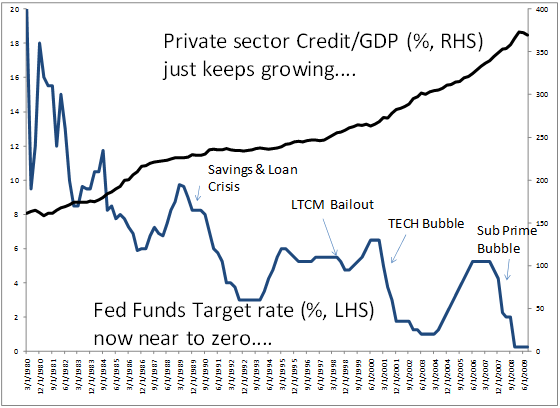
Peter Boone, Research Associate, Centre for Economic Performance, LSE
Simon Johnson, Professor of Entrepreneurship, Sloan School of Management, MIT and CEPR Research Fellow
This column says the best route to creating a safer system is to have very large and robust capital requirements, which are legislated and difficult to circumvent or revise.
Given the inability of our political and social systems to handle the hardship that would follow economic collapse, we rely on our central banks to cut interest rates and direct credits to bail out the loss-makers. While the faces tend to change, each central bank and government operates similarly. This time, it was Mervyn King, Gordon Brown, Tim Geithner and Ben Bernanke who oversaw policy as the bubble was inflating – and are now designing our rescue.
When the bailout is done, we start all over again. This has been the pattern in many developed countries since the mid-1970s – a date that coincides with significant macroeconomic and regulatory change, including the end of the Bretton Woods fixed exchange rate systems, reduced capital controls in rich countries and the beginning of 20 years of regulatory easing.
Full textNyliberalerna tysta så det dånar
Greece's drama has already metastasised into a wider systemic crisis.
For the third time in 18 months the global financial system risks spinning out of control
Flow data shows an abrupt withdrawal of German and Asian capital from Club Med debt markets.
Ambrose Evans-Pritchard, 07 Feb 2010
The world risks a replay of the Lehman collapseif this runs unchecked, this time involving sovereign dominoes.
Add East Europe's bubble and foreign debts top €2 trillion.
The scale matches America's sub-prime/Alt-A adventure and assorted CDOs and SIVS of the Greenspan fling. The parallels are closer than Europe cares to admit.
Just as Benelux funds and German Landesbanken bought subprime debt for high yield with AAA gloss, they bought Spanish Cedulas because these too had a safe gloss – even though Spain's property boom broke world records.
They thought EMU had eliminated risk: it merely switched exchange risk into credit risk.
Writing in the NYT, Richard Thaler provides the disturbing potential conclusion on homeowners changing their viewpoint and strategically defaulting:
"An important implication is that we could be facing another wave of foreclosures, spurred less by spells of unemployment and more by strategic thinking. Research shows that bankruptcies and foreclosures are “contagious.” People are less likely to think it’s immoral to walk away from their home if they know others who have done so. And if enough people do it, the stigma begins to erode."
If enough people do it, the housing market collapses.
CNBC 25 Jan 2010
The Greek government has promised to slash its fiscal deficit
from an estimated 12.7 per cent of gross domestic product last year to 3 per cent in 2012.
Is it plausible that this will happen? Not very.
But Greece is merely the canary in the fiscal coal mine.
Other eurozone members are also under pressure to slash fiscal deficits.
What might such pressure do to vulnerable members, to the eurozone and to the world economy?
Martin Wolf, January 19 2010
Some, knowing of my opposition to UK membership of the eurozone, may suppose that I find some pleasure in these looming difficulties.
On the contrary, I fear the dangerous consequences.
Martin Wolf, January 19 2010
The curse of long-term unemployment
Only about 400,000 more Americans were employed in December 2009 than in December 1999,
while the population grew by nearly 30m.
The Economist print Jan 14th 2010
America slides deeper into depression
The home foreclosure guillotine usually drops a year or so after people lose their job, and exhaust their savings.
One million American families lost their homes in the fourth quarter.
Ambrose Evans-Pritchard 10 Jan 2010
The home siezures are occurring despite frantic efforts by the Obama administration to delay the process. This policy is entirely justified given the scale of the social crisis. But it also masks the continued rot in the housing market, allows lenders to hide losses, and stores up an ever larger overhang of unsold properties. It takes heroic naivety to think the US housing market has turned the corner
The fuse has yet to detonate on the next mortgage bomb, $134bn (£83bn) of "option ARM" contracts due to reset violently upwards this year and next.
Tuesday, October 9, 2007 started as a nice day in New York City.
The Bank for International Settlements will gather top central bankers and financiers for a meeting in Basel this weekend amid rising concern about a resurgence of the “excessive risk-taking” that sparked the financial crisis.
“The concern here is that the prolonged assurance of very cheap and ample funding may encourage excessive risk-taking,” the BIS invitation note says.
FT January 6 2010
The cause of our crises has not gone away
We should listen to /Iceland/ before the same message is conveyed in much more violent form, in another place and at another time.
John Kay FT January 5 2010
The credit crunch of 2007-08 was the third phase of a larger and longer financial crisis. The first phase was the emerging market defaults of the 1990s. The second was the new economy boom and bust at the turn of the century. The third was the collapse of markets for structured debt products, which had grown so rapidly in the five years up to 2007.
Governments, and particularly the US government, reacted on each occasion by pumping money into the financial system in the hope of staving off wider collapse, with some degree of success.
The public support of markets provided on each occasion the fuel needed to stoke the next crisis. Each boom and bust is larger than the last. Since the alleviating action is also larger, the pattern is one of cycles of increasing amplitude.
The citizens of that most placid of countries, Iceland, now backed by their president, have found a characteristically polite and restrained way of disputing an obligation to stump up large sums of cash to pay for the arrogance and greed of other people. They are right.
We should listen to them before the same message is conveyed in much more violent form, in another place and at another time.
We made a mistake in the closing decades of the 20th century. We removed restrictions that had imposed functional separation on financial institutions.
Det var inte inflationen - det var Depressionen
Germany "the new democracy survived serious threats to its existence in the early postwar years and
found a semblance of stability from 1924 to 1928,
only to be submerged by the collapse of the economy after the Wall Street crash of 1929."
Ian Kershaw, New York Times, February 3, 2008
In an article published in the FT this week, Arvind Subramanian of the Peterson Institute for International Economics, argues that economics has redeemed itself by rescuing the world economy from the crisis. I agree, but only up to a point.
These extraordinary interventions have not returned the patient to health. They have merely prevented him from dying.
We now must heal five chronic conditions, instead of survive last year’s brutal heart attack.
Martin Wolf, December 29 2009
First, we have the ongoing force of the balance-sheet recession
Second, we have, quite rightly, substituted public sector borrowing for private sector borrowing,
Third, the US, UK, Spain and other have large structural current account deficits
Fourth, the surplus countries show little or no interest in making the needed policy changes
Finally, the financial system remains damaged.
The headlines said that initial job-less claims dropped to 466,000
That is a lot of people losing their jobs
Second, the headline number was a seasonally adjusted number.
The actual number was 543,926.
John Mauldin 28/11 2009
At some point, American workers will rebel.
US unemployment is already 17.5pc under the broad "U6" gauge followed by Barack Obama.
Realty Track said that 332,000 properties were foreclosed in October alone.
More Americans have lost their homes this year than during the entire decade of the Great Depression.
A backlog of 7m homes is awaiting likely seizure by lenders.
If you are not paying attention to this political time-bomb, perhaps you should.
Ambrose Evans-Pritchard, 15 Nov 2009
The 'Real' Jobless Rate:
17.5% Of Workers Are Unemployed
CNBC.com 19 Nov 2009
As experts debate the potential speed of the US recovery, one figure looms large but is often overlooked: nearly 1 in 5 Americans is either out of work or under-employed.
According to the government's broadest measure of unemployment, some 17.5 percent are either without a job entirely or underemployed. The so-called U-6 number is at the highest rate since becoming an official labor statistic in 1994.
The number dwarfs the statistic most people pay attention to—the U-3 rate
— which most recently showed unemployment at 10.2 percent for March, the highest it has been since June 1983.
The difference is that what is traditionally referred to as the "unemployment rate" only measures those out of work who are still looking for jobs. Discouraged workers who have quit trying to find a job, as well as those working part-time but looking for full-time work or who are otherwise underemployed, count in the U-6 rate.
Full textNew figures coming out of the US economy confirms that in almost every respect
it is doing significantly better than expected.
It is impressive.
Carl Bildt blog 6/12 2005
The world will hit one day peak Oil
Dr. Marc Faber, author of the Gloom, Boom and Doom repor, at Financial Doom Blog February 14, 2011
Yes, I am still positive about oil ...
the world will hit one day peak oil, the way the US hit peak oil in 1970.
So the dynamics between the demand and the supply side look actually quite promising in the long run. ..."
Financial Doom BlogEven Marc Faber isn’t perfect.
His best prediction of all time, he says, was also the worst investment call he’s ever made.
“That was the prediction that the tech bubble would burst,” which he made in 1998.
“But it came two years too early.”
CNBC 1 Apr 2011
"tro inte att det värsta är över"
Tongångarna från männen som förutspådde finanskrisen,
Nouriel Roubini, Marc Faber och Peter Schiff,
har inte blivit muntrare.
E24 2009-09-30
Nouriel Roubini, även kallad ”Dr Doom”, varnade redan 2005 för ras på den amerikanska bostadsmarknaden.
I likhet med andra ”domedagsprofeter” är han bekymrad över dollarn, tror att dollarn kommer att försvagas och till och med riskerar att kraschlanda om amerikanska regeringen inte gör mer för att kontrollera underskottet och minska statsskulden.
Marc Faber, författare till det månatliga nyhetsbrevet The Gloom Boom & Doom Report.
Marc Faber menar att man inte lyckats göra någonting åt de svagheter i systemet som orsakade innevarande kris. Han spår ett totalt sammanbrott för de finansiella marknaderna och för regeringar på fem till tio års sikt när hela systemet kraschar.
Han tror inte heller att några G20-möten eller G7-möten kommer att mynna ut i lösningar som kan förhindra en framtida härdsmälta;
personerna som är tänkta att genomföra de nya åtgärderna är samma personer som misslyckades med att förutse den nuvarande krisen.
Peter Schiff är en av de domedagsprofeter som spår att dollarn kommer att kollapsa under den tunga bördan av massiva underskott och den ”besinningslösa” politik som Barack Obamas administration driver. Och han mycket kritisk till de gigantiska stimulanspaket som den sittande regeringen lanserat
.- Vi är i sämre skick nu jämfört med före krisen. Vi är djupare skuldsatta. Vi skulle ha låtit fler finansiella institutioner falla, säger Peter Schiff.
Enligt honom liknar USA:s ekonomi ett belånat pyramidspel. När krisen kom vacklade pyramiden.
- Problemet är att politikerna försöker få pyramiden på fötter igen, säger han till Financial Post
You have been warned about “the mother of all carry trades.”
Emerging economies “might overheat and experience financial turmoil,”
Bank of Japan Governor Masaaki Shirakawa said
Low rates and the dollar’s depreciation present “new, real and insurmountable risks to the recovery of the global economy,”
Liu Mingkang, China’s top banking regulator, said
Bloomberg, Nov. 16 2009
“The continuous depreciation in the dollar, and the U.S. government’s indication that, in order to resume growth and maintain public confidence, it basically won’t raise interest rates for the coming 12 to 18 months, has led to massive dollar arbitrage speculation,” Liu, chairman of the China Banking Regulatory Commission, said in Beijing yesterday.
Low rates and the dollar’s tumble have “seriously affected global asset prices, fuelled speculation in stock and property markets, and created new, real and insurmountable risks to the recovery of the global economy, especially emerging-market economies,” Liu told reporters in Beijing at the International Finance Forum.
The debate over the Fed and asset prices comes years after some analysts criticized the U.S. central bank for holding down borrowing costs for too long in 2003 and 2004. Dallas Fed President Richard Fisher is among those who have said the Fed’s actions unwittingly contributing to the housing bubble.
“I’m scared and leaders should look out,” Donald Tsang, the chief executive of Hong Kong, said in Singapore Nov. 13. “America is doing exactly what Japan did last time,” he said, adding that Japan’s rates in Japan contributed to the 1997 Asian financial crisis and U.S. mortgage meltdown.
Donald Tsang was born in Hong Kong on 7 October 1944.
His father was a police officer of the Royal Hong Kong Police Force
Dangerous asset bubbles are developing in emerging Asia and in China in particular.
Barry Eichengreen, Eurointelligence 13.11.2009
And it is not only independent critics: the World Bank, in its recent semi-annual report on East Asia, warned darkly of unsustainable asset-market conditions. Asset prices are frothy. Property prices are booming, especially in the big cities. All this is alarmingly reminiscent of the United States in 2006.
The mechanism inflating these bubbles is exceptionally accommodating monetary policies. Low interest rates in the advanced countries provide an incentive to borrow there and invest in higher-yielding assets in emerging markets.
Everyone realizes that the dollar will have to fall to enable the U.S. to export more, since American households will be consuming less. But this means that the expected cost of borrowing dollars is effectively negative for investors concerned with non-dollar returns.
It creates an irresistible temptation to invest in anything Asian that promises even remotely positive returns. Nouriel Roubini, always one with a phrase, calls this “the mother of all carry trades.”
Uppenbarligen krävs det mycket mera underlag än vad Roubini hittills har kommit med för att vi skall sätta någon tilltro till hans varningar /om dollarn/ .
Danne Nordling 29/11 2009
Det är en skillnad mot den tidigare uppseglande bolånekrisen, som kunde påvisas i flera olika statistiska serier. Men att denna skulle leda till en världsomspännande finanskris kunde inte visas med statistik. Det berodde främst på att den var psykologiskt betingad och krävde sådana missgrepp som konkursen i Lehman Brothers för att blomma ut.
Vi är på väg mot en monsterbubbla på finansmarknaden
Det handlar framförallt om spekulation i en allt billigare dollar.
Nouriel Roubini, Ekonomiekot 27/11 2009
Roubini säger att han är oroad av att den amerikanska centralbanken gör pengar så lättillängliga och tvingar andra länder att följa efter. Men att stötta systemet nu med höjda räntor är inte lösningen, säger Roubini.
Mother of all carry trades faces an inevitable bust
Nouriel Roubini, November 1 2009
Rolf Englund: Next Bubble Is Forming: U.S. Government Bonds
Barry Eichengreen, a prominent American economic historian, says the crisis has “cast into doubt much of what we thought we knew about economics.”
The Economist print July 16th 2009
Is this the death of the dollar?
Edmund Conway, Daily Telegraph 20 June 2009
For US Treasury Secretary Tim Geithner, who has inherited his predecessors' role as dollar wallah-in-chief, the currency's travails have made it all the more difficult for him to repeat the mantra that he "believes in a strong dollar" while keeping a straight face. Indeed, when he tried to insist at a university lecture in Beijing earlier this month that "Chinese financial assets are very safe," it drew floods of laughter from the audience.
He wasn't playing for laughs, but the irony of the situation is plain to see. If there were a textbook list of actions one could take to weaken a currency, the US (alongside most other developed nations) would be following it to the letter. It has cut interest rates to a whisker above zero; it has engaged in quantitative easing, pumping cash directly into the economy; it has committed to spending trillions of dollars on a fiscal stimulus package designed to pull the country out of recession; it has pledged tacitly to support its stricken banks so that no major institution is allowed to collapse. In any normal circumstances, actions like these would hammer a currency.
Like everything else, the currency's fate depends on how well the US authorities manage the crisis. The US is balanced on a knife-edge between possible Japan-style deflation as the weight of all its debts bear down on it and potential inflation as the force of all its powerful stimulus measures take root. No one knows for sure which way it will fall, but neither would be particularly good for the currency, and by extension for those who hold much in the way of dollar assets.
Indeed, as Mervyn King said in a speech earlier this year: "At the heart of the crisis was the problem identified but not solved at Bretton Woods – the need to impose symmetric obligations on countries that run persistent current account surpluses and not just on countries that run deficits. From that failure stemmed a chain of events, no one of which alone appeared to threaten stability, but which taken together led to the worst financial crisis any of us can recall."
Sustained recovery requires decreased domestic US spending and
increased domestic spending in China and much of the rest of the world,
together with adjustments in exchange rates.
unsustainable US debt dynamics probably means mayhem in financial markets
Olivier Blanchard, Financial Times, June 18 2009
The writer is chief economist of the IMF
Consider what would happen if the UK or US were to attempt Hungarian or Estonian style cuts.
There would be a huge outcry.
So rather than taking the axe to public spending, the British and American governments are borrowing madly,
with no sign of any credible long-term plan to balance the books.
Gideon Rachman, Financial Times, May 25 2009
There are three key flaws to panglossian hopes for a bull market and a V-shaped economic recovery.
David Roche, Financial Times, May 19 2009
The writer is president of Independent Strategy, a global investment consultancy
The first flaw can be simply put. If excess leverage in the US household sector lies at the core of the credit crisis and global imbalances, little has been done to address the problem.
Since the start of the credit crisis, US household debt has risen. Indeed, as US net household wealth has fallen nearly 20 per cent, leverage has risen sharply in relative terms.
The second flaw follows. If excess consumption lies at the core of the credit crisis, the problem has been made worse by government adding leverage to help households sustain their own unsustainable levels of debt.
The credit bubble financed excessive US consumption by hefting asset prices and creating fictive wealth gains.
Household savings collapsed because nobody needed to save from income when soaring asset prices were doing the job for them.
The third flaw reminds us of the original problem. If excess credit creation and financial sector leverage caused the crisis, the problem has not been dealt with by the authorities.
The authorities believe the crisis is due to a lack of liquidity that has driven down asset prices below their “true” value and not due to the insolvency of the assets themselves.
The conclusions of recent stress tests concluded that the US banking system was solvent and needed little extra capital, which it could raise under its own steam.
But the tests were based on very sanguine assumptions about the economic future: namely that the housing market, economic growth and employment would all recover sharply in 2010.
A potentially more serious issue concerns bank liabilities and funding. Though there has been some thawing, the private sector wholesale funding market is still mostly closed.
But the 22 largest global banks monitored by the IMF have to finance more than 50 per cent of their balance sheets from the money markets and longer-term debt.
The funding gap is currently over $20,000bn and will rise above $25,000bn by 2011.
This unforeseen crisis is surely a disaster for monetary policy.
Most of us – I was one – thought we had at last found the holy grail.
Now we know it was a mirage. This may be the last chance for fiat money.
Martin Wolf, Financial Times, May 5 2009
There are four deflationary spirals presently at work in the world economy, i.e.
the Keynesian savings paradox, Fisher’s debt deflation,
the cost cutting deflation, and the bank credit deflation.
Each of these deflationary spirals can be dealt with when they occur in isolation.
They become lethal when they interact with each other.
Paul de Grauwe 6/4 2009
The four deflationary spirals we identified, although similar in structure, are different in one particular dimension.
The savings paradox and the cost deflation can be called “flow deflations”. They arise because consumers and firms want to change a flow (savings and profits).
The other two involve the adjustment of stocks (the debt levels and the levels of credit). We call them “stock deflations”.
Problems arise when the flow and stock deflations interact with each other.
The period prior to the crisis was one of excessive buildups of private debt and banks’ assets.
The result of these excessive buildups of private debt and balance sheets is that the stock deflation processes described in the previous section operate with full force.
As a result, the equilibrating mechanism that exists in normal recessions does not function.
The forthcoming Group of 20 summit is going to be a disaster.
So it looks like it is going to be an L – not a V or a U.
I mean an L-shaped recession, one that starts with a steep decline, followed by very low growth for many years.
Wolfgang Munchau, Eurointelligence 09.03.2009
Dow below 7,000
BREAKING NEWS - Dow extends decline, down 200 points to below 6,900
on AIG loss and the revised government bailout. More soon.
CNN March 2, 2009 10:47
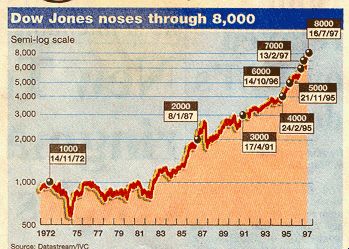
More about Wall Street and other crashes
Eastern crisis that could wreck the eurozone
The crisis started in the US, but Europe is where it might turn into catastrophe
Wolfgang Münchau, Financial Times February 22 2009
Can't pay or won't pay?
The write-downs, whether voluntary or court-ordered, could destroy the lenders’ capital.
Aggregate negative housing equity is thought to top $500 billion.
The Economist print Feb 19th 2009
European stocks tumbling to a six-year low
"We're near the cliff's edge, very close to capitulation, the mood is very gloomy," said Jean-Claude Petit, head of equities at Barclays Wealth Managers France.
"I'm not sure that governments and central banks are realizing what's really going on.
The gaffes made by West-European banks in East Europe revealed recently are having a devastating effect"
CNBC 20/2 2009
The U.S. housing market lost $3.3 trillion in value last year and
almost one in six owners with mortgages owed more than their homes were worth
Feb. 3 2009 (Bloomberg)
The U.S. Financial System Is Effectively Insolvent
There is a grave risk of a global L-shaped depression.
Nouriel Roubini, March 5 2009
Why the bank bailouts are doomed
The entire system is simply insolvent
Jon Markman, 1/29/2009
Nothing to lose but their supply chains
The Economist print Feb 19th 2009
Some say that manufacturing is special, because the rest of the economy depends on it.
In fact, the economy is more like a network in which everything is connected to everything else, and in which every producer is also a consumer
http://en.wikipedia.org/wiki/Supply_chain
They have nothing to lose but their web cameras
Rioters of the world unite
The Economist print, Dec 18th 2008
The famous final phrase of the Manifesto, "Working Men of All Countries, Unite!",
in the original German is: "Proletarier aller Länder, vereinigt euch!"
Thus, a more correct translation would be "Proletarians of all countries, Unite!"
"Workers of the World, Unite. You have nothing to lose but your chains!" is a popularisation of the last three sentences, and is not found in any official translation. Since this English translation was approved by Engels, we have kept the original intact.
Protectionist dominoes are beginning to tumble across the world
The riots have begun.
Dominique Strauss-Kahn, the head of the International Monetary Fund, is worried enough to ditch a half-century of IMF orthodoxy, calling for a fiscal boost worth 2pc of world GDP to "prevent global depression".
Ambrose Evans-Pritchard, 20 Dec 2008
Greece has been in turmoil for 11 days.
This is a foretaste of what the world may face as the "crisis of capitalism" - another Marxist phase making a comeback - starts to turn two hundred million lives upside down.
"If we are not able to do that, then social unrest may happen in many countries, including advanced economies. We are facing an unprecedented decline in output. All around the planet, the people have reacted with feelings going from surprise to anger, and from anger to fear," Dominique Strauss-Kahn said.
President-elect Barack Obama: "China must change its currency practices. Because it pegs its currency at an artificially low rate, China is running massive current account surpluses. This is not good for American firms and workers, not good for the world," he said in October.
This crisis has already brought us a monetary revolution as interest rates approach zero across the G10. It may overturn the "New World Order" as well, unless we move with great care in grim months ahead. This is where events turn dangerous.
The last great era of globalisation peaked just before 1914. You know the rest of the story.
"The question of having social unrest has been highlighted by journalists and I can understand that, but it's only part of the problem," he said.
"The problem is that all the whole society is going to suffer."
Dominique Strauss-Kahn, BBC 21/12 2008
Dominique Strauss-Kahn, Managing Director of the International Monetary Fund
Speech at the Banco de España, Madrid, Spain
December 15, 2008
G7 försäkrade att deras centralbanker ska fortsätta att samordna åtgärder för att lindra kreditkrisen.
Penningpolitiken måste vara den första försvarslinjen, enligt IMF.
Samtidigt har IMF-chefen Dominique Strauss-Kahn efterlyst en plan för samordnade finanspolitiska stimulanser världen över.
Sådana megakeynesianska övningar bör man vara försiktig med.
DN-ledare 14/4 2008
Fed's weapon of mass desperation
The mother of all bond market crashes
Wolfgang Münchau, Financial Times, November 23 2008
Roubini's Latest "Why Things Are Hopeless" List Hits New Record, 20 Items! Be sure to read down to his last point, where he draws his bottom line,
a peak to trough fall in GDP of 10%.
Naked capitalism 16/11 2008
The big difference in diagnosis is between those who still think in terms of a conventional business cycle with output fluctuating in familiar snakelike fashion around a stable trend given by “supply side” factors, and those who believe that something more apocalyptic has happened.
Samuel Brittan, Financial Times, November 6 2008
For this first group it is important to worry about the size of the current budget deficit, re-establishing fiscal guidelines in the medium term and the maintenance of an arm’s length relationship between governments and central banks. The obvious exponent of this view has been the European Central Bank, with its insistence that its economic task is just to maintain the stability of a consumer price index.
Critics say that Alan Greenspan’s reduction of the Fed funds rate to 1 per cent in 2003 sparked off the recent credit bubble and its subsequent collapse. They do not say what else should have been done to prevent Asian savings surpluses from generating a world depression. But even if it is conceded that Mr Greenspan went down too far for too long, Mr Bernanke now faces a radically different situation in which the very existence of the US and world monetary systems has been threatened.
Many analysts fear that central banks will soon have “run out of ammunition” because official interest rates cannot fall below zero. This is the famous “zero interest rate bound” known as ZIRB to its friends
central banks can expand the range of securities in which they deal, as they are to some extent now doing. But the ultimate weapon would be a fiscal stimulus financed by money creation – the equivalent of the famous helicopter drop.
More by Samuel Brittan at IntCom
The best recipe for avoiding a global recession
Before our political leaders get too fancy remaking capitalism
they should co-ordinate macroeconomic policies to stop a steep global downturn
Jeffrey Sachs, Financial Times, October 27 2008
The world's financial firms have now lost $2.8 trillion
the Bank of England has estimated
1.2 million homeowners in the UK now face going into negative equity
BBC 28 October 2008
It's like an avalanche.
A snowball of tumbling share prices began in Europe yesterday afternoon, picked up momentum on Wall Street - where the important S&P 500 index suffered its biggest loss in 21 years - and has been battering Asia overnight.
And that in spite of the £2 trillion pounds of taxpayers' precious money committed by governments to bank rescue plans all over the world.
What's more - and probably more worrying for the authorities - is that interest rates charged by banks for lending to each other for three months remain at disturbingly high levels
BBC's Robert Peston 16 Oct 08, 08:24 AM
The world financial system is teetering on the "brink of systemic meltdown",
the head of the International Monetary Fund (IMF)Dominique Strauss-Kahn has warned
BBC 12 October 2008
It is not too late.
If the world now pulls together, we can avoid the Armageddon endgame.
Stephen Roach, Financial Times October 9 2008
Notwithstanding my long-standing bearishness on the global economy and world financial markets, I am now actually hopeful that the world is at a critical turning point. We have gone to the edge of an abyss that few thought was ever possible. Having stared into the darkness, the authorities hopefully have a better appreciation of what is truly at stake. It is not too late. If the world now pulls together, we can avoid the Armageddon endgame.
Stefan Ingves:
– När det här är över skulle det inte förvåna mig om krisen som Sverige upplevde i början av 1990-talet, visar sig vara värre än det som vi idag ser i USA.
I det svenska fallet krympte ekonomin under tre år i rad och det var den största krisen som vi hade haft sedan 1930-talet.
Ekot 16/9 2008
Let me explain now in more detail why we are now back to the risk of
a total systemic financial meltdown…
This is not just a US financial crisis; it is a global financial crisis hitting institutions in the US, UK, Eurozone and other advanced economies (Iceland, Australia, New Zealand, Canada etc.).
Nouriel Roubini Sep 29, 2008
It is obvious that the current financial crisis is becoming more severe in spite of the Treasury rescue plan (or maybe because of it as this plan it totally flawed). The severe strains in financial markets (money markets, credit markets, stock markets, CDS and derivative markets) are becoming more severe rather than less severe in spite of the nuclear option (after the Fannie and Freddie $200 billion bazooka bailout failed to restore confidence) of a $700 billion package: interbank spreads are widening (TED spread, swap spreads, Libo-OIS spread) and are at level never seen before; credit spreads (such as junk bond yield spreads relative to Treasuries are widening to new peaks; short-term Treasury yields are going back to near zero levels as there is flight to safety; CDS spread for financial institutions are rising to extreme levels (Morgan Stanley ones at 1200 last week) as the ban on shorting of financial stock has moved the pressures on financial firms to the CDS market; and stock markets around the world have reacted very negatively to this rescue package (US market are down about 3% this morning at their opening).
In a solvency crisis and credit crisis that goes well beyond illiquidity no one is lending to counterparties as no one trusts any counterparty (even the safest ones) and everyone is hoarding the liquidity that is injected by central banks. And since this liquidity goes only to banks and major broker dealers the rest of the shadow banking system has not access to this liquidity as the credit transmission mechanisms is blocked.
The next step of this panic could become the mother of all bank runs, i.e. a run on the trillion dollar plus of the cross border short-term interbank liabilities of the US banking and financial system as foreign banks as starting to worry about the safety of their liquid exposures to US financial institutions;
For most readers, the commercial paper market is something you don't think about.
But it is the lifeblood of business.
We have seen this market drop by almost 30% in a year and by 10% in just the last three weeks!
I simply cannot overstate how serious this is.
John Mauldin, The Curve in the Road, 3/10 2008
There is something called the TED spread,
which is the difference between three-month LIBOR (the London Inter Bank Offered Rate which is in euro dollars, also called The Euro Dollar Spread, thus TED)
and three-month US Treasury bills. Three-month LIBOR is basically what banks charge each other to borrow money.
Many mortgages and investments are based on various periods of LIBOR. Look at the chart below. Typically the TED spread is 50 basis points (0.50%) or less. When it spikes up, it is evidence of distress in the financial markets. The last time the TED spread was as high as it is now was right before the market crash of 1987. This is a weekly chart, which does not capture tonight's (Friday) change, which would make it look even worse.
Quite literally, the TED spread is screaming panic.
John Mauldin, Sep 27 2008
The Bank of England moved on Friday to inject longer term cash into money markets,
with the US Federal Reserve, the European Central Bank and the Swiss National Bank.
The intervention follows the breakdown late on Thursday of talks over a $700bn bailout for the US financial system
Money market traders said that interbank lending for terms longer than a day had come to a near standstill
as counterparties feared that they may be lending to a bank that could suddenly become insolvent.
Financial Times September 26 2008 08:09
The money market, not the stock market, is where this financial crisis is playing out first and foremost. On this market, banks lend each others funds for short periods of time with no collateral. A favourite way to measure distress in the way money is the difference between the interest rate on 3-month Treasury – which are considered safe – and 3-month Libor. This is known as the TED spread. If you consider your counterparty bank safe, you would expect to receive only a slightly higher interest rate on 3 Libor than you would on 3 month treasuries. But if you expect to receive more than 300 basis points, as banks do now, then you doubt the financial viability of your counterparty.
Yesterday, the spread briefly peaked at 333bp, which must be an all-time record.
eurointelligence 26.09.2008
It’s 3 a.m., a few months into 2009, and the phone in the White House rings.
Several big hedge funds are about to fail, says the voice on the line,
and there’s likely to be chaos when the market opens.
Whom do you trust to take that call?
Paul Krugman, September 28, 2008
I’m not being melodramatic. The bailout plan released yesterday is a lot better than the proposal Henry Paulson first put out — sufficiently so to be worth passing. But it’s not what you’d actually call a good plan, and it won’t end the crisis. The odds are that the next president will have to deal with some major financial emergencies.
Maybe we can let Wall Street implode and Main Street would escape largely unscathed.
But that’s not a chance we want to take.
Paul Krugman New York Times September 25, 2008
Many people on both the right and the left are outraged at the idea of using taxpayer money to bail out America’s financial system. They’re right to be outraged, but doing nothing isn’t a serious option.
Right now, players throughout the system are refusing to lend and hoarding cash — and this collapse of credit reminds many economists of the run on the banks that brought on the Great Depression.
It’s true that we don’t know for sure that the parallel is a fair one. Maybe we can let Wall Street implode and Main Street would escape largely unscathed. But that’s not a chance we want to take.
Mr. Paulson never offered a convincing explanation of how his plan was supposed to work — and the judgment of many economists was, in fact, that it wouldn’t work unless it amounted to a huge welfare program for the financial industry.
the bipartisan “agreement on principles” released on Thursday looks a lot better than the original Paulson plan. it “requires that any transaction include equity sharing.”
Why is that so important? The fundamental problem with our financial system is that the fallout from the housing bust has left financial institutions with too little capital. When he finally deigned to offer an explanation of his plan, Mr. Paulson argued that he could solve this problem through “price discovery” — that once taxpayer funds had created a market for mortgage-related toxic waste, everyone would realize that the toxic waste is actually worth much more than it currently sells for, solving the capital problem. Never say never, I guess — but you don’t want to bet $700 billion on wishful thinking.
Over the past few weeks three experiences have helped clear my mind on this crisis.
First, I reread Hyman Minsky’s masterpiece, Stabilizing an Unstable Economy.
Martin Wolf, Financial Times, September 16 2008
Money market funds in the US suffered an estimated $197bn of net outflows last week as confidence in their safe-haven status weakened after one fund “broke the buck” and others closed.
The outflows mark a new and potentially dangerous phase for the $3,400bn money market fund industry as continued redemptions could result in forced selling of their securities into illiquid bond markets.
Financil Times September 22 2008
"Modern history’s greatest regulatory failure"
These are companies that refinance themselves in the capital markets every day. They depend on the confidence of lenders.
But, if that disappears, their solvency is threatened. This is where we are now.
This has put the Fed and the US Treasury into a nearly impossible position
Roger Altman, Financial Times, September 17 2008 18:52
The writer is chairman and chief executive of Evercore Partners and was deputy US Treasury secretary under President Bill Clinton.
He was a co-head of investment banking and a board member at Lehman Brothers in the 1980s
As Paul Volcker, former Fed chairman, has suggested, an enormous Resolution Trust Corporation-style approach for the banking and securities system may be required.
Extraordinary emergency actions by the Federal Reserve and the Treasury to date, while necessary, are insufficient to resolve the crisis.
We should move decisively to create a new, temporary resolution mechanism. There are precedents -- such as the Resolution Trust Corporation of the late 1980s and early 1990s, as well as the Home Owners Loan Corporation of the 1930s.
Brady, U.S. Treasury secretary from 1988-1993, Mr. Ludwig U.S. comptroller of the currency from 1993 to 1998, Volcker chairman of the Federal Reserve from 1979-1987
Wall Street Journal SEPTEMBER 17, 2008
Resolution Trust Corporation at Wikipedia
- Vi hade inte någon glaskula att titta i. Och vi hade blivit utskrattade.
- Det är svårt att vara olyckskorp när allt går som smort, sade en av hans högre medarbetare Stig Danielsson.
Rolf Englund tar sig för pannan: Det var ju inspektionens uppgift att varna i tid!
Om Hans Löwbeer, chef för Bankinspektionen
The U.S. financial system was badly shaken Sunday by the failure of Lehman Brothers , the surprise takeover of Merrill Lynch and big asset sales by major insurer American International Group.
"The U.S. financial system is finding the tectonic plates underneath its foundation are shifting like they have never shifted before," said Peter Kenny, managing director at Knight Equity Markets in Jersey City, New Jersey.
"It's a new financial world on the verge of a complete reorganization."
CNBC 14 Sep 2008
Sept. 14 (Bloomberg) -- Former Federal Reserve Chairman Alan Greenspan said the financial crisis that began with the collapse of the subprime-mortgage market last year ``is probably a once in a century event'' that will lead to the failure of more firms.
``There's no question that this is in the process of outstripping anything I've seen, and it is still not resolved,'' Greenspan said in an interview today on ABC's ``This Week with George Stephanopoulos.'' Greenspan, 82, retired from the Fed in January 2006 after serving for 18 years as chairman.
http://www.bloomberg.com/apps/news?pid=20601068&sid=amVkrOCQNBQs&refer=economy
Lehman Brothers
One Wall Street executive involved in the meetings put it this way:
"I'm thinking logically; if they do nothing it's Armageddon. That means they do a deal.
It will be announced at 6 p.m. (ET) Sunday."
CNBC 13/9 2008
What is a bundle of mortgages worth when nobody is willing to bid on them at auction?
With American banks already in trouble,
an Australian bank made matters worse—by telling the truth!
Robert Morley, theTrumpet.com, August 12, 2008
The risk of a downward spiral of house prices is the primary danger facing the American economy.
Because of the structure of securitised mortgage finance, this risk has the potential to cause a global financial crisis.
Both of these problems will remain until a new policy brings stability to house prices.
Martin Feldstein, Financial Times, August 26, 2008
Very Important Article
“The topic du jour is Fannie and Freddie.
Clearly, the market is looking for a solution that is permanent, clear and definitive. That dwarfs everything.”
Financial Times, August 24 2008
"Sedan i fjol har vår syn på världsekonomin förändrats markant.
Det är tydligt att vi inte har sett slutet på historien om kreditkrisen", säger Jacob Wallenberg.
DI 2008-08-22
"Jag är på den mörkare sidan av svart den här morgonen. Situationen är mycket värre än 2001", säger Thomas von Koch, som håller i investeringarna för EQT.

Klicka på flaggan för nästa artikel på svenska
Mostly Spain
America's house price time bomb
Some American home-owners are taking radical action;
they are choosing to walk away from homes and their mortgages.
Roubini: "You could have most of the US banking system wiped out, so this is a total disaster."
BBC, 29 July 2008
Highly Recommended
Only luck can save America’s economy
What more can be done? The short answer is nothing.
The policy options have narrowed almost to zero.
Clive Crook, Financial Times August 3 2008
"We interrupt regular programming to announce that the United States of America has defaulted …"
Part 1
Satyajit Das Eurointelligence 23.07.2008
Lenders to the United States government have suffered significant losses .The losses have not been from non-payment but because repayments have been in a constantly debased currency – the dollar.
"We interrupt regular programming to announce that the United States of America has defaulted …" Part 2
reductions in US real wages and living standards on a scale that those who have not experienced it first hand cannot understand
Satyajit Das Eurointelligence 24.07.2008
Ultimately, the US may be forced to finance itself in foreign currency. This would expose the US to currency risk but most importantly it would not be able to service its debt by printing money.
The US, like all borrowers, would become subject to the discipline of creditors.
For the moment, the US$ is hanging on – just. This reflects structural weakness in the Euro and Yen based on deep-seated problems in the respective economies.
The artificial nature of the Euro is also problematic.
In 1989, John Williamson described certain economic prescriptions - the Washington Consensus – that became a "standard" reform package promoted for crisis-wracked countries by the IMF.
The dry measured economic prose of the Washington Consensus does not capture its human elements. It will require reductions in US real wages and living standards on a scale that those who have not experienced it first hand cannot understand.
Warren Buffett in his 2006 annual letter
I believe that at some point in the future, U.S. workers and voters will find this annual 'tribute' (of interest payment on the debt) so onerous that there will be a severe political backlash … How that will play out in markets is impossible to predict – but to expect a 'soft landing' seems like wishful thinking.
You Know The Banking System Is Unsound When...
Mish, July 23rd, 2008
1. Paulson appears on Face The Nation and says "Our banking system is a safe and a sound one." If the banking system was safe and sound, everyone would know it (or at least think it). There would be no need to say it.
7. Paulson says Fannie Mae and Freddie Mac are "essential" because they represent the only "functioning" part of the home loan market. The firms own or guarantee about half of the $12 trillion in U.S. mortgages. Is it possible to have a sound banking system when the only "functioning" part of the mortgage market is insolvent?
More...
Merrill Lynch has warned that the United States could face a foreign "financing crisis"
within months as the full consequences of the Fannie Mae and Freddie Mac mortgage debacle spread through the world
Ambrose Evans-Pritchard, Daily Telegraph 16/07 2008
The country depends on Asian, Russian and Middle Eastern investors to fund much of its $700bn (£350bn) current account deficit, leaving it far more vulnerable to a collapse of confidence than Japan in the early 1990s after the Nikkei bubble burst. Britain and other Anglo-Saxon deficit states could face a similar retreat by foreign investors.
"Japan was able to cut its interest rates to zero," said Alex Patelis, Merrill's head of international economics.
"It would be very difficult for the US to do this. Foreigners will not be willing to supply the capital. Nobody knows where the limit lies."
Nouriel Roubini predicts the worst financial crisis since the Great Depression and
the worst U.S. Recession in the last few decades.
July 15, 2008
Dozens of large regional/national banks (a’ la IndyMac) are also bankrupt given their extreme exposure to real estate and will also go bust
Some major money center banks are also semi-insolvent and while they are deemed too big to fail their rescue with FDIC money will be extremely costly
In a few years time there will be no major independent broker dealers as their business model (securitization, slice & dice and transfer of toxic credit risk and piling fees upon fees rather than earning income from holding credit risk) is bust and the risk of a bank-like run on their very short term liquid liabilities is a fundamental flaw in their structure
Fannie and Freddie are insolvent and the Treasury bailout plan (the mother of all moral hazard bailout) is socialism for the rich, the well connected and Wall Street; it is the continuation of a corrupt system where profits are privatized and losses are socialized. Instead of wiping out shareholders of the two GSEs, replacing corrupt and incompetent managers and forcing a haircut on the claims of the creditors/bondholders such a plan bails out shareholders, managers and creditors at a massive cost to U.S. taxpayers.
This financial crisis will imply credit losses of at least $1 trillion and more likely $2 trillion.
SEC Panic - Shorting Curbs Placed on GSE Stocks
/government sponsored enterprises/
The panic at the Fed, the SEC, and the Treasury department continues. In an emergency action the SEC Curbs Shorting of GSE Stocks, Considers Limits for Wider Market.
Ackman Shorts Fannie, Freddie
Mish 15/7 2008
Treasury Acts to Save Mortgage Giants
The Bush administration on Sunday asked Congress to approve a sweeping rescue package that would give officials the power to inject billions of federal dollars into the beleaguered companies through investments and loans.
New York Times 14 July 2008
The California-based IndyMac Bank, has collapsed
Federal regulators seized the bank's assets
It is the second-largest financial institution to fail in US history
BBC, July 12 2008
The government officials said that the administration had also considered calling for legislation that would offer an explicit government guarantee on the $5 trillion of debt owned or guaranteed by the companies. But that is a far less attractive option, they said, because it would effectively double the size of the public debt.
The officials also said that such a step would be ineffective because the markets already widely accept that the government stands behind the companies.
The officials involved in the discussions stressed that no action by the administration was imminent, and that Fannie and Freddie are not considered to be in a crisis situation. But in recent days, enough concern has built among senior government officials over the health of the giant mortgage finance companies for them to hold a series of meetings and conference calls to discuss contingency plans.
It is unclear if current shareholders would see their holdings wiped out - leading to the pre-market sell-off.
Immediately after the market open shares of Fannie and Freddie were both off more 45% from their already battered close on Thursday.
In the first four trading days of the week, the shares of Fannie have lost 30% of their value, while Freddie shares have tumbled 45%.
For the year, Fannie is down 67% and Freddie 77% through Thursday's close.
CNNMoney July 11, 2008
Lehman Brothers shares tumbled 18% at the start of the session.
So far this year, Lehman shares are down 73%.
Late Thursday, the nation's fourth-largest investment bank provided greater details about the stunning $2.8 billion loss it suffered in the second quarter.
CNNMoney July 11, 2008
The word began spreading across Wall Street trading desks on Monday morning:
Fannie Mae and Freddie Mac, the giant companies at the heart of the nation's housing market, might be in trouble.
New York Times, July 11, 2008
Caveat Emptor
Remember, Cassandra was right!
Differently this time?
The Kirk Report, June 18, 2008
Just as with mortgage debt, credit card debt is put into pools that are then resold to investment houses, other banks and institutional investors.
About 45 percent of the nation's $900-plus billion in credit card debt has been packaged into these pools, and so many companies, not just a few, are at risk of being forced out of business by credit card debt write-offs.
Allen L Roland's Radio Weblog June 30, 2008
"My ongoing theme is always the truth , as I see it , and the exposure of lies, deception and manipulation wherever they exist."
That sound you hear is the popping of a financial bubble in housing,
the economy and the market.
And you can trace it all to Alan Greenspan's Federal Reserve.
Bill Fleckenstein, 30/6 2008
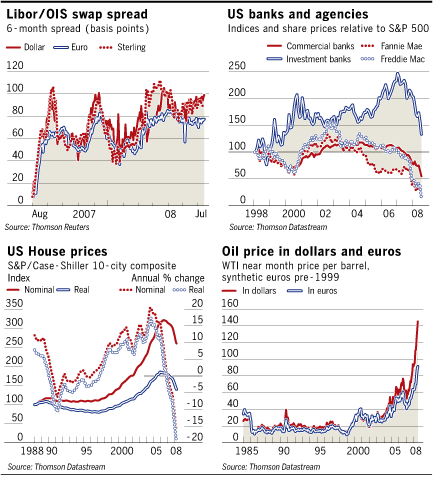
It is now almost a year since the US subprime crisis went global.
It has, in all likelihood, not even passed the end of its beginning.
The creditworthiness of the US government cannot be taken for granted.
Martin Wolf, Financial Times, July 15 2008
Spreads between rates of interest on inter-bank lending in dollars, euros and sterling and expected official rates over three and six months are now wider than they were in March.
So what happens to the world economy next?
It is hard to see any outcome other than a sustained slowdown in the world economy. It is even quite likely that the trend growth of the world economy is considerably slower than was hoped a few years ago.
The creditworthiness of the US government cannot be taken for granted. If the ongoing deleveraging of the US economy weakened US consumption, the economy might go into a deep recession. US fiscal deficits would then soar and long-term US interest rates might jump. This could make the debt dynamics of the US government look very unpleasant. A flight from the dollar and dollar bonds might even ensue.
It is time to take a break from the gloom.
That is what I will now do.
I will be back at the end of August.
Bank for International Settlements annual report
"How" asks the report, "could a huge shadow banking system emerge without provoking clear statements of official concern?"
How, indeed?
How big are the risks now? The answer is: very large.
As I argued in a speech at a BIS conference last week...
Martin Wolf, Financial Times, July 1 2008
It needs to be recognised that in the months ahead there is the real possibility that significant financial institutions will encounter not just liquidity but solvency problems as the economy deteriorates and further writedowns prove necessary.
It is quite possible that we are now at the most dangerous moment since the American financial crisis began last August.
Lawrence Summers, FT, June 29 2008
It is quite possible that we are now at the most dangerous moment since the American financial crisis began last August. Staggering increases in the prices of oil and other commodities have brought American consumer confidence to new lows and raised serious concerns about inflation, thereby limiting the capacity of monetary policy to respond to a financial sector which – judging by equity values – is at its weakest point since the crisis began. With housing values still falling and growing evidence that problems are spreading to the construction and consumer credit sectors, there is a possibility that a faltering economy damages the financial system, which weakens the economy further.
Unfortunately we are in an economic environment where we have more to fear than fear itself. But this is no excuse for fatalism.
The Royal Bank of Scotland has advised clients to brace for a full-fledged crash in global stock and credit markets over the next three months as inflation paralyses the major central banks.
Ambrose Evans-Pritchard, Daily Telegraph 19/6 2008
A report by the bank's research team warns that the S&P 500 index of Wall Street equities is likely to fall by more than 300 points to around 1050 by September as "all the chickens come home to roost" from the excesses of the global boom, with contagion spreading across Europe and emerging markets.
Such a slide on world bourses would amount to one of the worst bear markets over the last century.
RBS global crash alert: Quotes
Full text of Ambrose Evans-Pritchard
Under the placid surface, there are disturbing trends: huge imbalances, disequilibria, risks - call them what you will. Altogether the circumstances seem to me as dangerous and intractable as any I can remember, and I can remember quite a lot.
What really concerns me is that there seems to be so little willingness or capacity to do much about it.
Paul A. Volcker, Washington Post, April 10, 2005
Ben Bernanke: "We have a problem"
'We have a problem, which is that the spreads between the Treasury rates and lending rates are widening, and our policy is essentially, in some cases just offsetting the widening of the spreads, which are associated with signs of illiquidity."
Eurointelligence/calculatedrisk blog 29/2 2008
What Exactly Is The G7 plan?
Mish, April 12, 2008
The International Monetary Fund (IMF) has warned that potential losses from the credit crunch will reach $945bn and could be even higher.
BBC 8/4 2008
The IMF says that losses are spreading from sub-prime mortgage assets to other sectors, such as commercial property, consumer credit, and company debt.
It says that there was a "collective failure" to appreciate the risky borrowing by financial institutions.
För dem som har haft en övertro på marknadens självreglerande krafter är förstås den internationella kreditkrisen en allvarlig missräkning.
Ragnar Roos, DNs ledarsida, 30/3 2008
Klicka på flaggan för nästa artikel på svenska
The day $2 billion walked out the door
Inside a bank panic: Customers deserting, investors fleeing, billions in losses.
Survivors of a run at E*Trade tell how they fought to hang on.
CNN 4/4 2008
It was early in the morning on Jan. 8, and the company's newly minted chairman - soon to be CEO - was meeting with a contractor to fix up his weekend house in New York's Westchester County. He'd expected it to be a quiet day. Then the calls started coming in.
One way of measuring how perilously close the U.S. financial system came to melting down in mid-March 2008
is to look at how low the rate on one-month Treasury bills fell at the depths of the crisis.
That number is 12 basis points. 0.12%.
Michael Lewitt, at John Mauldin, 2008-03-31
The three-month Treasury bill rate, which our friend Jim Bianco of the highly respected Bianco Research points out is the "risk-free" rate for many models such as the capital asset pricing model, the arbitrage risk pricing model and the Black-Scholes pricing model, fell to a 50-year low of 56 basis points on Tuesday, March 25
The bailout of Bear was an obnoxious /odiously or disgustingly objectionable : highly offensive/ necessity in view of the fact that the firm was too interconnected as a Wall Street counterparty and prime broker to be permitted to fail. Its collapse would have placed many hedge funds and other financial firms at risk
The time to ask about moral hazard is not when the system is about the implode
- the appropriate time for such questions is much earlier, when the seeds of destruction that lead to the necessity to bail out players that act in ways that threaten long-term systemic stability are being sown.
If the current crisis, and the recurring crises of the last twenty years, tell us anything, it is that market solutions are insufficient to protect the system from the greed and fear that drive markets.
Fed bailout of Bear Stearns
Remember Friday March 14 2008
it was the day the dream of global free-market capitalism died.
Martin Wolf, Financial Times, March 26 2008
Two weeks ago, the world financial system hung by a thread as a battle raged among corporate leaders, government officials, portfolio managers and independent traders to control its destiny.
Half wanted to pull it down and spill the globe into economic Armageddon for personal profit, while the other half fought to stave them off.
Jon Markman, CNBC 27/3 2008
Stage I of dealing with a financial crisis is to provide liquidity to the banking system at high interest rates in order to keep commerce and finance liquid while punishing feckless overleveraged financiers. We passed out of Stage I at the end of last year.
Stage II is forgetting about punishing feckless financiers and focusing on lowering interest rates in order to raise asset prices to keep finance solvent. We are now in Stage II.
Now Alan Blinder says that it is time to--in a limited way--move on to Stage III: nationalization.
Brad DeLong's Weblog February 24, 2008
With link to ALAN S. BLINDER, NYT: What about the operation's scale? Based on current estimates, such an institution might be asked to consider refinancing one million to two million mortgages... as much as $200 billion to $400 billion. The midpoint, $300 billion, is one-seventh the size of Citigroup and would rank the new institution as the sixth-largest bank in the United States....
Like a 1930s bank run
There are now plans to split up the companies
that insure bonds and derivatives based on mortgages and buyout loans.
Jim Jubak 22/2 2008
America's economy risks mother of all meltdowns
The connection between the bursting of the housing bubble and the fragility of the financial system
has created huge dangers, for the US and the rest of the world.
Martin Wolf, Financial Times, February 19 2008
how bad might this downturn get? To answer this question we should ask a true bear.
My favourite one is Nouriel Roubini of New York University's Stern School of Business, founder of RGE monitor
His thinking deserves to be taken seriously. He first predicted a US recession in July 2006.
At that time, his view was extremely controversial.
It is so no longer.
Now he states that there is "a rising probability of a ‘catastrophic' financial and economic outcome"
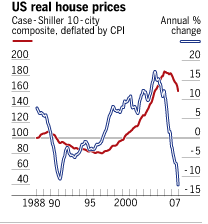
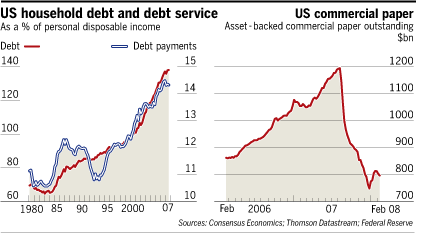
The risks are indeed high and the ability of the authorities to deal with them more limited than most people hope.
Speaking after the meeting of Group of Seven finance leaders, Peer Steinbrück, German finance minister,
said the G7 now feared that write-offs of losses on securities linked to US subprime mortgages could reach $400bn.
FT February 10 2008
The Rising Risk of a Systemic Financial Meltdown:
The Twelve Steps to Financial Disaster
by Nouriel Roubini, February 11, 2008
at John Mauldin
Why did the Fed ease the Fed Funds rate by a whopping 125bps in eight days this past January?
To understand the Fed actions one has to realize that there is now a rising probability of a "catastrophic" financial and economic outcome, i.e. a vicious circle where a deep recession makes the financial losses more severe and where, in turn, large and growing financial losses and a financial meltdown make the recession even more severe.
The Fed is seriously worried about this vicious circle and about the risks of a systemic financial meltdown.
To understand the risks that the financial system is facing today I present the "nightmare" or "catastrophic" scenario that the Fed and financial officials around the world are now worried about.
First, this is the worst housing recession in US history and there is no sign it will bottom out any time soon.
Second, losses for the financial system from the subprime disaster are now estimated to be as high as $250 to $300 billion. But the financial losses will not be only in subprime mortgages and the related RMBS and CDOs. They are now spreading to near prime and prime mortgages
Third, the recession will lead - as it is already doing - to a sharp increase in defaults on other forms of unsecured consumer debt: credit cards, auto loans, student loans.
Fourth, while there is serious uncertainty about the losses that monolines will undertake on their insurance of RMBS, CDO and other toxic ABS products, it is now clear that such losses are much higher than the $10-15 billion rescue package that regulators are trying to patch up
Any business that required an AAA rating to stay in business is a business that does not deserve such a rating in the first place.
Next, the downgrade of the monolines will lead to another $150 of writedowns on ABS portfolios for financial institutions that have already massive losses.
Fifth, the commercial real estate loan market will soon enter into a meltdown similar to the subprime one. Lending practices in commercial real estate were as reckless as those in residential real estate.
Sixth, it is possible that some large regional or even national bank that is very exposed to mortgages, residential and commercial, will go bankrupt. Thus some big banks may join the 200 plus subprime lenders that have gone bankrupt.
Already Countrywide - an institution that was more likely insolvent than illiquid - has been bailed out with public money via a $55 billion loan from the FHLB system, a semi-public system of funding of mortgage lenders.
hundreds of billions of dollars of leveraged loans are now stuck on the balance sheet of financial institutions at values well below par (currently about 90 cents on the dollar but soon much lower).
Eighth, once a severe recession is underway a massive wave of corporate defaults will take place
Ninth, the "shadow banking system" (as defined by the PIMCO folks) or more precisely the "shadow financial system" (as it is composed by non-bank financial institutions) will soon get into serious trouble. This shadow financial system is composed of financial institutions that - like banks - borrow short and in liquid forms and lend or invest long in more illiquid assets. This system includes: SIVs, conduits, money market funds, monolines, investment banks, hedge funds and other non-bank financial institutions
Tenth, stock markets in the US and abroad will start pricing a severe US recession - rather than a mild recession
Eleventh, the worsening credit crunch that is affecting most credit markets and credit derivative markets will lead to a dry-up of liquidity in a variety of financial markets
Twelfth, a vicious circle of losses, capital reduction, credit contraction, forced liquidation and fire sales of assets at below fundamental prices will ensue leading to a cascading and mounting cycle of losses and further credit contraction.
Total losses in the financial system will add up to more than $1 trillion and the economic recession will become deeper, more protracted and severe.
In this meltdown scenario US and global financial markets will experience their most severe crisis in the last quarter of a century.
Can the Fed and other financial officials avoid this nightmare scenario that keeps them awake at night?
I will argue - in my next article - that one should be pessimistic about the ability of policy and financial authorities to manage and contain a crisis of this magnitude; thus, one should be prepared for the worst, i.e. a systemic financial crisis.
Full text of this excellent article
On Friday I was in Davos in a panel on the "Ups and Downs of EMU" where ECB head Trichet, Italian Economy Minister Tremont,
a few other EU officials and myself were supposed to discuss the following questions:
Will EMU collapse in the future?
Unlike the other panelist that ignored the topic and spoke instead about all the good things allegedly associated with EMU, I took the questions seriously by considering some of the problems and risks faced by EMU and the risks of a break-up, especially for the case of Italy.
My remarks caused a stir with Minister Tremonti who interrupted me in the middle of my remarks, went into a temper tantrum and shouted - to the consternation of all participants - to me: "Go Back to Turkey!!".
Nouriel Roubini, 28/1 2006
America's economy risks mother of all meltdowns
A true bear. My favourite one is Nouriel Roubini
Martin Wolf, Financial Times, February 19 2008
The Credit Crisis is Simply Getting Worse
John Mauldin's Weekly E-Letter February 8, 2008
Highly Recommended
RE: Probably the monst frightening I have read so far
Goldman Sachs CFO David Viniar warned yesterday that some key mortgage bond insurers could collapse. Viniar, speaking at a CSFB conference, said credit markets are trading as if we are in a "worst recession"; and there is a "total disconnect between the equities market and the credit market." (The Bill King Report)
The credit markets have gone from bad to worse. There's almost no trading being done in the $2 trillion Collateralized Debt Obligation (CDO) markets. Perfectly good bank loans are trading at discounts of between 10-20% to par,
Let's take a look at a few graphs from www.markit.com.
This first one is an index of asset-backed paper, mostly mortgage-backed. This is the BBB-rated paper issued last year. It is trading at an 86% discount.
The "spread" is the difference you pay, typically over LIBOR (or the London InterBank Offered Rate). LIBOR is the most important interest rate in the world, as massive amounts of debt are set according to it. Let's say you are an AAA-rated borrower. Last summer you might have been paying as little as 3.84 basis points over LIBOR. If LIBOR was at 5%, you would be paying 5.0384%. There was very little premium for what was considered risk-free money.
Today you are paying as much as 1.89% more. Granted, 3-month LIBOR is now at 3.10, down 2.16% over the last six months, due to aggressive Fed, Bank of England, and ECB (European Central Bank) action. Thus your net cost of funding is the same, but only if you are AAA.
There are actually very few AAA borrowers in the world. Let's look at how your costs may have risen if you are still barely investment-grade at BBB.
There are hundreds of billions of dollars of Leveraged Buy Outs (LBOs) that were done last year that are still on the various lending banks books, which they thought they were going to be able to sell to investors. However, the price of risk has risen and no one is willing to take the loans at anywhere close to the original rates the banks committed to. I talked with one major investment banking executive this week, and they are having to cut back on the loans they are currently making, and tighten credit standards, as they now have to carry those old loans at very low rates on their books.
Goldman Sachs now estimates that the total loss in the mortgage security world will total $400 billion (this includes more than just subprime mortgages),
up from an estimated $200 billion only a few quarters ago.
And that is if home prices only fall about 20% on average.
2007 in USA: 95,000 new jobs per month, down from 175,000 in 2006.
Remember, it takes 150,000 jobs per month (or so) simply to maintain the employment rate, due to growth in the population.
The trigger for the Fed action was the move on Friday by Fitch to strip the US monoline insurer AMBAC of its `AAA' rating,
with the mounting risk that the rating agencies would soon downgrade its bigger peer, MBIA.
Why does it matter?
Because they have guaranteed a large part of that $2.4 trillion bond market.
Ambrose Evans-Pritchard
"I'm not predicting the collapse of the financial system."
"This is not a normal crisis," - "It is the end of an era."
the "era of superleverage,"
George Soros, Davos, New York Times, January 24, 2008
See also:http://www.soros.org/
han varnar för att EMU är en rigid struktur som kommer att skapa olösliga spänningar.
EMU riskerar att "rasera den europeiska unionen", menar Soros.
Johan Hakelius i SvD 1997-11-11
... the fate of global bond insurers and the $2,400bn of debt they guarantee.
Ambac, one of the biggest bond insurers, or so-called monolines, was downgraded
FT January 21 2008
George Soros säger i en intervju att världen står inför den värsta finansiella krisen sedan andra världskriget och att USA hotas av en recession.
DN 22/1 2008
Enligt anmälan i The Economist (10/10 1987) är
"Mr Soro's views of the world economy coloured by the experience of the debt crisis. Since 1982, he says, the international fincancial system has been near to the brink. Several times it has gone to it, only to be dragged back by governments.
Källa: Rolf Englund 1987-10-26 För Svensk Tidskrift nr 9/1987
The next banking crisis on the way
Write-downs for high-risk, high-yield corporate debt, known as 'junk,' could dwarf losses in the mortgage mess.
Jim Jubak January 18 2008
Doom
Although nearly 70% of the Americans do fear a recession, the possibility of a major crisis is not considered.
Sharon-Brigitte Kayser, January 16, 2008
RE: Highly recommended
The story of the upcoming world crash is hidden in plain sight. Even mayor Bloomberg has jumped in the gloom and doom bandwagon: a global economic downturn was looming, triggered by the "lunacy" of public debt, he declared last month. Meanwhile denial continues. Although nearly 70% of the Americans do fear a recession, the possibility of a major crisis is not considered.
We have 600 trillion in world liabilities plus more than a 400 trillion-derivatives neutron bomb, all of which will go off when the Westerners (from EU and US) will no longer be able to borrow. The credit crisis could be just beginning according to, the Calcutta-born Australian Satyajit Das , a derivatives specialist who speaks of nearly $500tn.
The article can also be read at her own blog
"dedicated to Aristotelian thinking, Austrian Economics and Human Sovereignty. Principles also endorsed by the U.S Constitution, as drafted by the Framers originally."
http://notodebtslavery.blogspot.com/2007/11/hey-buddy-can-you-spare-1000-trillion.html
The Next Dominos: Junk Bond And Counterparty Risk
one of the more important editions of Outside the Box this year. This is a must read. You absolutely need to understand the nature of the systemic risk we are facing, and Ted does a great job of explaining in very clear terms the nature of the risks that we have created in our modern markets.
Ted Seides at John Mauldin 26/11 2007
A perfect economic environment allowed the alchemists in structured finance to apply massive amounts of leverage on low quality, securitized mortgages
Over the past decade, the exponential growth of credit derivatives has created unprecedented amounts of financial leverage on corporate credit.
The amount of outstanding corporate credit and leverage applied to it dwarfs the market for subprime mortgages. As such, the consequences of a problem in this arena may be far more severe than what happened in subprime. If we are going to experience the downside of another economic cycle, we may be in for a painful ride.
One way of thinking about the CDS market is that of a huge, new insurance industry whose providers reserve nothing for future losses. Imagine what would happen if $45 trillion worth of insurance policies experienced an actuarial average of 5% losses and no one had $2.25 trillion sitting around to foot the bill!
The Second Domino: "High"-Yield Bonds
The anatomy of the high-yield bubble started with a virtuous cycle. When both the markets and the economy were strong, investors paid little attention to risk. The more investors assumed risk, the more they received rewards. Companies seized the opportunity to obtain inexpensive financing and issued paper to the market on attractive terms. As leverage increased, private equity buyers drove up asset values. Higher asset values enhanced collateral and allowed companies to borrow more or refinance their way out of trouble. Without defaults, creditors were willing to lend on ever more egregious terms. As the cycle grew stronger, buyers received less compensation for the risks they assumed.