Finanskrisen
The Great Recession

Finanskrisen -
The Great Recession
Home - Index -
Economics - Cataclysm -
Wall Street Bubbles - Houseprices
The Economic Consequences of the Peak
Martin Wolf about The End Game
Rebalancing the world economy
"This crisis was, first and foremost, about the unsustainability of macro imbalances –
imbalances within and between nations"
What if they find that it tips economies into recession, or even deflation?
Martin Wolf, 8 June 2010
American competitiveness is back, albeit largely because of the pain we've endured.
Our dollars are worth less, and real wages are lower.
U.S. has added nearly 500,000 manufacturing jobs since the beginning of 2010
- the first period of significant growth since the late 1990s.
Anthony Mirhaydari, MSN Money 11 April 2012
And so far, if the economy is reviving, most workers aren't sharing in it. Real, inflation-adjusted wages have fallen in three of the past four months. This has never happened outside recession before. So it's very possible we're following Europe into the depths of a new downturn.
Last September, I argued that "the real recession never ended" and that, in reality, it started a decade or more ago as labor participation peaked in the late 1990s.
We've been sliding lower ever since, trying to compensate for a lack of high-quality jobs and stagnant pay, with voodoo stimulus efforts out of Washington and an extreme, inflation-igniting easy-money policy from the Federal Reserve.
The current-account deficit in the U.S. widened more than forecast in the fourth quarter
to $124.1 billion, the biggest in three years
Bloomberg 14 March 2012
The underlying cause of this mess is the same as it was in the banking crash and Great Recession of 2007-9
- which is the recycling of the great surpluses of the exporting nations, China, Germany and Japan,
into the unsustainable debts of the great consuming nations, the US, UK, and much of the eurozone.
Robert Peston, BBC Business editor, 9 August 2011
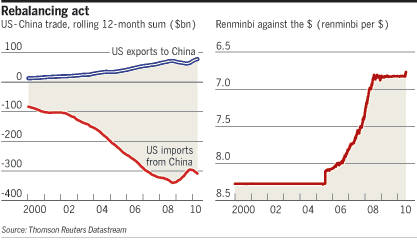
Between 1998 and 2006, the high-savings economies - China, Japan, Germany - produced $1 trillion a year more than they consumed; and those of us in the rich deficit countries increased our indebtedness by $1tn a year to buy the stuff they produced.
Those so-called imbalances have not been corrected.
Our lifestyles in the UK, US and much of the eurozone are still financed on cheap money, much of it in effect recycled from the savings of the countries that sell to us.
The advanced countries are in no sense back to normality:
fiscal deficits remain exceptional; monetary policy is hugely accommodative; the financial sector is fragile, particularly in the eurozone; credit growth has been remarkably slow in the US and eurozone; households of several countries, including the US and UK, remain highly indebted; and there exists the possibility of sovereign defaults, bank failures or both within the eurozone.
Moreover, despite the scale of the monetary and fiscal stimuli applied, the recovery in these countries is still expected to be anaemic
Martin Wolf, FT April 19 2011
*
It's as if 2008 never happened.
Once again the world's investors are pumping up bubbles that will probably explode in their faces.
Bloomberg Businessweek's Economics editor Peter Coy, April 14, 2011
Current Account Imbalances Coming Back
Joseph E. Gagnon, Peterson Institute for International Economics
January 2011
World-Record
China Reserves Pass $3 Trillion
Policy Challenge for G-20
Bloomberg 14 april 2011
Waiting for the great rebalancing
I can say that nine trillion dollars is surely enough
Martin Wolf April 5 2011
Global reserves rose by a further $2,192bn between February 2009 and December 2010.
This rate of accumulation is surely destabilising. But it is ongoing. I will not forecast when it might end. I can say that nine trillion dollars is surely enough.Mervyn King, governor of the Bank of England, has given an account of the role of the so-called global imbalances in February’s Financial Stability Review of the Banque de France.
The Bank of England's most consistently interesting economist had some bad news today
He thinks that those current-account imbalances are likely to get bigger, probably a lot bigger, in the next 10 to 20 years - and there may not be very much that anyone can do about it.
Stephanie Flanders, BBC , 21 December 2010
In today's remarks at Chatham House he's branched out into international macroeconomics, to ask why global current-account deficits and surpluses grew so big in the lead-up to the crisis - and what is likely to happen to them in future.
He starts by pointing out that the imbalances we have seen in the past few years are larger than any we have seen in the last 100 years
The American financial system has been all too efficient at getting financing to US companies - and US households - without anyone having to take the trouble to save.
Housing equity withdrawal alone accounted for 4% of personal disposable income in the US in 2005, up from less than 2% in 2000.
De globala ekonomiska obalanserna fortsätter att växa och med dem skuldsättningen hos de redan hårt skuldsatta och ansamlingen av allt osäkrare fordringar hos kreditorerna.
Risknivån i den globala balansräkningen ser alltmer ohälsosam och ohållbar ut.
Den växande valutaoron är ett tydligt tecken på att spänningarna börjar närma sig bristningsgränsen.
Per Lindvall e24 2010-11-15
G20 show how not to run the world
This is not collective leadership but joint abdication of power.
Financial Times editorial November 12 2010
This does not, of course, mean that the world economy will not be rebalanced.
Unsustainable imbalances will eventually be adjusted by economic forces.
By not agreeing on co-ordinated action, the world’s leaders have chosen to let the world rebalance itself, without political steering, or to address the process at the national level only, with the inevitable result of making things harder for each other.
Konventionell ekonomisk visdom säger att det är ohållbart att i längden ha så stora obalanser i världshandeln som vi haft sedan början av 2000-talet.
Länder med underskott i utrikeshandeln måste ta sig samman och och sluta att leva på utlandslån (USA, Storbritannien och PIIGS-länderna).
Här är euro-området en svag punkt. Den europeiska centralbanken ECB har en mycket rigid inställning till QE. En bedömare som professor Nouriel Roubini menar att ECB är beredd att offra PIIGS-länderna för att slippa vidta QE med hänvisning till inflationsfaran.
Roubini pekade i förrgår på att risken för PIIGS-länderna istället är deflation. Nu utmålar han allvarliga risker för att en ny världsdepression är under uppsegling.
Danne Nordling 16 oktober 2010
“Achieving a ‘strong, balanced and sustained world recovery’ – to quote from the goal set in Pittsburgh by the G20 – was never going to be easy...
It requires two fundamental and difficult economic rebalancing acts.”
The first is internal rebalancing – a return to reliance on private demand in advanced countries and retrenchment of the fiscal deficits that opened in the crisis.
The second is external rebalancing – greater reliance on net exports by the US and some other advanced countries and on domestic demand by some emerging countries, notably China.
Unfortunately, concludes, Professor Blanchard, “these two rebalancing acts are taking place too slowly”.
Martin Wolf 12 october 2010
Over the next week some of the world’s leading policymakers and economists will be addressing in the FT the all-consuming contemporary economic debate: austerity versus stimulus. The writers, including Larry Summers, Jean-Claude Trichet and the FT’s Martin Wolf will argue whether cutting now risks suffocating the fragile recovery of the global economy.
FT July 18 2010
Currency wars, trade barriers and other protectionist policies
are rising to the top of domestic political agendas as governments across the world struggle to resurrect economic growth.
After the early united front to stem the global collapse in 2008, "the momentum [of economic co-operation] is decreasing",
Dominique Strauss-Kahn said at the IMF's annual conference in Washington.
Nice (?) photo of DSK
DT 7 Oct 2010
"That is a real threat. Many do consider their currency a weapon. That is not good for the global economy… There is no domestic solution to a global crisis."
His concerns were echoed by Robert Zoellick, President of the World Bank, who warned that failure to co-operate would risk plunging the world economy into depression. He said: "If one let's this slide into protectionism, we run the risk of the mistakes of the 1930s."
The forces that will stop the imbalances are already very evident
Fiscal consolidation cannot properly occur in advanced economies until there is a strengthening in private demand.
For well rehearsed reasons, this is proving difficult to achieve.
The handover from fiscal stimulus to private demand growth isn’t happening as quickly as hoped.
Unfortunately, the private sector is still in a strongly deleveraging frame of mind.
Jeremy Warner, Daily Telegraph 7 Oct 2010
According to the wisdom of Herb Stein, one time economic adviser to President Richard Nixon, if something can’t go on for ever, it will stop.
This must be as true of global imbalances as everything else.
The forces that will stop the imbalances are already very evident, and are actually spelt out at some length in the IMF’s World Economic Outlook. Fiscal consolidation cannot properly occur in advanced economies until there is a strengthening in private demand.
For well rehearsed reasons, this is proving difficult to achieve.
The handover from fiscal stimulus to private demand growth isn’t happening as quickly as hoped.
Unfortunately, the private sector is still in a strongly deleveraging frame of mind.
This in turn is going to make fiscal retrenchment much more difficult. A double dip in advanced economies looks unlikely, but the debt overhang, both private and now public, is going to act as a powerful brake on growth for years to come.
IMF report
It isn’t only Spain where the current account deficits are going to persist.
Edward Hugh, A fistful och euros 7 august 2010
If you want to worry about something, I can recommend the US current account deficit.
A modest depreciation in the US dollar would only be enough to stimulate a J-curve making imports more expensive and having little effect on the deficit.
The magnitude of the adjustment is likely to be far more disruptive than what little overall price instability seems to be in store.
Richard Robb, Economists' Forum, FT August 2, 2010
By continuing to run deficits equal to 5 per cent of GDP as the US has averaged over the past six years, in a generation it would transfer assets to foreigners that are equivalent to its entire stock market.
"The U.S. trade deficit widened unexpectedly"
CNBC 13 July 2010
Samma fråga som om svenska bilköpare kan ställas om banker och stater, hur skulle det gå om alla slutade leva över sina tillgångar?
Den berättelsen skulle man gärna vilja höra, hur det skulle kunna gå till att demontera de globala skuldbergen, om det är möjligt att sluta köpa saker vi inte behöver, för pengar vi inte har.
Marie-Louise Samuelsson, Sydsvenskan 11 juli 2010
In his foreword to the new World Economic Outlook, Olivier Blanchard, the IMF’s economic counsellor, states:
“Achieving a ‘strong, balanced and sustained world recovery’ – to quote from the goal set in Pittsburgh by the G20 – was never going to be easy...
It requires two fundamental and difficult economic rebalancing acts.”
The first is internal rebalancing – a return to reliance on private demand in advanced countries and retrenchment of the fiscal deficits that opened in the crisis.
The second is external rebalancing – greater reliance on net exports by the US and some other advanced countries and on domestic demand by some emerging countries, notably China.
Unfortunately, concludes, Professor Blanchard, “these two rebalancing acts are taking place too slowly”.
Martin Wolf 12 october 2010
US policymakers will do whatever is required to avoid deflation.
China wants to impose a deflationary adjustment on the US, just as Germany is doing to Greece.
As a creditor, it would enjoy an increase in the real value of its claims on the US.
But US deflation would threaten a world slump.
The US is going to win this war, one way or the other: it will either inflate the rest of the world
or force their nominal exchange rates up against the dollar.
It would be far better for everybody to seek a co-operative outcome.
...
Rolf Englund | October 13 1:57am
Can this be done without a Cataclysm like this?
The dollar drops, the inflation goes up, the bonds go down, i.e. interest rates up, houseprices and stock market down, euro up, EU unemployment goes up and the EMU goes pop
Euron spricker när dollarn faller
Rolf Englund, Nya Wermlands-Tidningen 8/1 2001
The world’s biggest excess savers, Germany, Japan and China, are not going to stimulate domestic demand in a way that would allow the G20 to announce an agreed strategy for global rebalancing. Real default, in the form of debt restructuring, seems likely in parts of southern Europe.
Inflation is a plausible outcome for the US in the long run.
John Plender, FT 15 June 2010
Rereading my post on the folly of the G20, it seems to me that I didn’t fully convey just how crazy the demand for fiscal austerity really is.
Here’s the IMF’s estimate of sources of the growth in debt over the next few years
Paul Krugman 7 June 2010
So far, so good. But here is my question: what is your “plan B”?
I have been fascinated – if appalled – by the pre-Keynesian approach you and the prime minister have taken to the UK’s fiscal challenges.
What Keynes called “the Treasury view” – that fiscal policy has no effect on activity, even in a deep recession – is alive and well in Downing Street.
Martin Wolf, 10 June 10 2010
In this week’s speech by David Cameron, the prime minister, on the need to cut the fiscal deficit, the word “demand” appeared just once and then only in a reference to the demand by investors for higher interest rates
However carefully you carry out your public relations, the cuts you intend to impose will be viewed as punishment of the innocent for the sins not just of the guilty, but of the rescued and now bonus-receiving guilty.
So remember this: the imposition of futile misery is not an act of wise policy, but rather a sign of folly.
You must remember this
A kiss is just a kiss, a sigh is just a sigh.
The fundamental things apply
As time goes by.
...
The parallel with what happened in 1931 is irresistible.
The current stampede to thrift shows that the re-conversion to Keynes in the wake of the financial collapse of 2008 was only skin-deep
We are about to embark on a momentous experiment to discover which of the two stories about the economy is true
Robert Skidelsky, FT June 16 2010
These propositions are a re-run of the famous “Treasury view” of 1929.
The eurozone’s tragic small-country mindset
One of the most important characteristics of a small open economy is that its own actions have little impact on the rest of the world.
Wolfgang Münchau, FT 13 June 2010
Tyskland ska spara 771 miljarder
DI 2010-06-07
A consensus is forming that policymakers should tighten fiscal policy
Yet what makes these policymakers sure that business and consumers will spend in response to austerity?
What if they find that it tips economies into recession, or even deflation?
Martin Wolf, 8 June 2010
As Adam Posen, outside member of the Bank of England’s monetary policy committee, pointed out in a recent speech, fiscal contraction, along with persistent banking problems and insufficiently loose monetary policy, generated the negative shock in 1997 that entrenched deflation in Japan.
Many economic historians argue that the US made a similar mistake in 1937.
---
Det börjar likna 1937, banne mig.
Rolf Englund blog 8/6 2010
---
The world economy confronts two risks, not one: the first is, indeed, that much of the developed world is going to be Greece; the second is that it will be Japan.
In developed countries today, fiscal deficits are surely a consequence of post-crisis private retrenchment, not the other way round.
Some economists do believe in “Ricardian equivalence” – the notion that private spending would automatically offset fiscal tightening. But, as Mr Posen argues of Japan, “there is no good evidence ...
A year ago, I argued – in response to a vigorous public debate between the Harvard historian, Niall Ferguson, and the Nobel-laureate economist, Paul Krugman – that the rapid rise in US long-term interest rates was no more than a return to normal, after the panic. Subsequent developments strongly support this argument.
The fixed-exchange mechanism had gone horribly wrong
The tragedy of the interwar years in Germany was that the Social Democrats - then the world’s foremost socialist party - became fatally tainted by acquiescing in /accepting/ Bruning’s deflation torture from 1930 to 1932.
They did so, of course, because they dared not confront the orthodoxies of the Gold Standard.
The result in Germany was the Reichstag election of July 1932 when the Communists and Nazis won over the half the seats.
Ambrose Evans-Pritchard 23 May 2010
Germany should boost domestic demand and wages to ease the lopsided euro-region trade flows
that restrict growth in economies from Greece to Portugal, Bank of England policy maker Adam Posen said.
Bloomberg March 25 2010
“If you look at real wage costs in these countries, or unit labor costs, Germany’s has been flat for the last 10 years,”
“In all these countries that are now in trouble -- Spain, Ireland, Italy, Greece, Portugal -- they’ve been shooting up. You’ve got huge trade imbalances within the euro area and Germany is the surplus on most of them.”
G20 central banks are delaying their withdrawal of emergency stimulus
as Europe’s debt crisis shakes financial markets and threatens to hinder the global recovery
Bloomberg 4 June 2010
“Given the increase in uncertainty in the economy, it would be perfectly natural for people to be less eager to tighten,”William White, a former Bank for International Settlements chief economistwho pointed to risks in financial markets before the 2008 credit crisis, said in an interview in Seoul.
World leaders are choosing recession
The world economy will not grow as it did during the boom, so how will it now expand?
That is the cardinal problem in macroeconomics.
FT Editorial March 19 2010
The Chinese currency policy is, in effect, a development policy that works by subsidising foreign consumers who buy Chinese goods.
The export machine, at its peak in 2008, was running a colossal $426bn current account surplus.
China is sticking with this mercantilist policy. This year, its current account surplus is expected to be $291bn
Similarly, Germany with an expected current account surplus of $187bn this year, should spend more.
If Germany does not, it will force its less competitive eurozone partners to stagnate and deflate.
So the world faces a choice: either the serial exporters can choose to consume more and rebalance the world economy through growth.
Or – as Mr Schäuble would prefer – they can sit on their hands, allow demand to crumble and rebalance the world economy through stagnation.
There is only one sane answer.
Finanskrisens problem löstes genom att socialisera riskerna och efterfrågan
Det behövs ”en uthållig ökning av den privata sektorns efterfrågan”
"alla länder kan inte samtidigt ha exportledd tillväxt"
Martin Wolf intervjuad i SvD/e24 av Johan Myrsten 2010-01-16
– På en mycket djup nivå tror jag att finanskrisens problem löstes genom att socialisera riskerna och efterfrågan. Nästan varje utvecklat land och särskilt de krisdrabbade länderna har enorma budgetunderskott. Statsskulderna kommer troligen att minst fördubblas.
Dessa underskott är ohållbara, och för att ta sig ur krispolitiken behövs ”en uthållig ökning av den privata sektorns efterfrågan”.
Men den efterfrågan ser ut att förbli ”kroniskt svag” trots de extremt låga räntorna, inte minst i euroländer med stora statsfinansiella problem. I det läget blir det mycket svårt att minska budgetunderskotten
Därför hoppas de flesta – inklusive USA, Storbritannien, euroländerna, Japan och Kina – att exporten ska dra i gång deras tillväxt. Men alla länder kan inte samtidigt ha exportledd tillväxt, noterar han bitande.
Obalanserna mellan Kinas överskott och USA:s underskott var väl kända och kritiserade, men de allra flesta ekonomer misslyckades ”med att förstå riktigt hur bräcklig kärnan i världens finanssystem hade blivit.”
– Det var något vi missade. Mycket av tillväxten som var knuten till finanssektorn var en illusion. Det var ett stort misslyckande, för det ledde till den katastrof vi nu ser.
Utvecklingen de närmaste tio åren måste var annorlunda i två grundläggande avseenden, sammanfattar han.
– I Kina måste efterfrågan växa snabbare än produktionen, i stället för tvärtom.
Och i USA, Storbritannien och andra utvecklade länder måste det vara omvänt.
Det räcker med att läsa Martin Wolf
Varför skall vi vanliga dödliga småtyckare anstränga oss, läsa fundera och skriva?
Rolf Englund blog 6/1 2010
As the great bear rally of 2009 runs into the greater Chinese Wall of excess global capacity, it will become clear that we are in the grip of a 21st Century Depression
– more akin to Japan's Lost Decade than the 1840s or 1930s, but nothing like the normal cycles of the post-War era.
Ambrose Evans-Pritchard
Posted to John Mauldin's Outside the Box on 4/1 2010
The contraction of M3 money in the US and Europe over the last six months will slowly puncture economic recovery as 2010 unfolds, with the time-honoured lag of a year or so. Ben Bernanke will be caught off guard, just as he was in mid-2008 when the Fed drove straight through a red warning light with talk of imminent rate rises – the final error that triggered the implosion of Lehman, AIG, and the Western banking system.
As the great bear rally of 2009 runs into the greater Chinese Wall of excess global capacity, it will become clear that we are in the grip of a 21st Century Depression – more akin to Japan's Lost Decade than the 1840s or 1930s, but nothing like the normal cycles of the post-War era.
The surplus regions (China, Japan, Germania, Gulf ) have not increased demand enough to compensate for belt-tightening in the deficit bloc (Anglo-sphere, Club Med, East Europe), and fiscal adrenalin is already fading in Europe. The vast East-West imbalances that caused the credit crisis are no better a year later, and perhaps worse.
Household debt as a share of GDP sits near record levels in two-fifths of the world economy. Our long purge has barely begun. That is the elephant in the global tent.
We will be reminded too that the West's fiscal blitz – while vital to halt a self-feeding crash last year – has merely shifted the debt burden onto sovereign shoulders, where it may do more harm in the end if handled with the sort of insouciance now on display in Britain. Yields on AAA German, French, US, and Canadian bonds will slither back down for a while in a fresh deflation scare. Exit strategies will go back into the deep freeze. Far from ending QE, the Fed will step up bond purchases. Bernanke will get religion again and ram down 10-year Treasury yields, quietly targeting 2.5pc.Avslutningsvis verkar det nu som att vi har klarat av den värsta krisen. Vägen tillbaka är dock inte utan risker för bakslag.
Exempelvis kvarstår stora globala obalanser och många länder har problem med sin statsskuld.
Återhämtningen kommer att ta tid, men 2010 blir bättre än 2009.
Stefan Ingves DN Debatt 2009-12-31
The Age of Deleveraging
Total consumer debt is shrinking for the first time on 60 years.
And the decline shows no sign of abating.
John Mauldin 19/12 2009
Arvind Subramanian argues that economics has redeemed itself by rescuing the world economy from the crisis. I agree, but only up to a point.
These extraordinary interventions have not returned the patient to health. They have merely prevented him from dying.
We now must heal five chronic conditions, instead of survive last year’s brutal heart attack.
Martin Wolf, December 29 2009
The rest of the world was inclined to believe that the west, whatever its faults, knew what it was doing, particularly where running a market economy was concerned. But then the teacher failed the examination.
Thirty years of surging growth in private sector leverage, in the balance sheets of the financial sector and in notional profitability of the financial sector in the US and other high-income countries has ended in calamity.
The emergence of massive global current account “imbalances” has proved highly destabilising.
Martin Wolf December 23 2009
After predicting in his 2003 book "The Dollar Crisis" that the U.S. property bubble would trigger a global recession,
Duncan's new book argues that governments will have to keep stimulating their economies because U.S. demand for cheap goods will not return to the halcyon days of the 2003 to 2007 boom.
CNBC 16 december 2009
"The Dollar Crisis: Causes, Consequences, Cures"
Richard Duncan, How Japan financed global reflation
Click here
Having accumulated $2,273bn in foreign currency reserves, China has kept its exchange rate down, to a degree unmatched in world economic history.
China has, as a result, distorted its own economy and that of the rest of the world.
Martin Wolf, FT December 8 2009
Unfortunately, as we have also long known, two classes of countries are immune to external pressure to change policies that affect global “imbalances”: one is the issuer of the world’s key currency; and the other consists of the surplus countries. Thus, the present stalemate might continue for some time.
But the dangers this would create are also evident: if, for example, China’s current account surplus were to rise towards 10 per cent of GDP once again, the country’s surplus could be $800bn (€543bn, £491bn), in today’s dollars, by 2018. Who might absorb such sums?
US households are broken on the wheel of debt, as are those of most of the other countries that ran large current account deficits.
That is why governments are now borrowers of last resort.
Jag tycker det är skriande uppenbart att räntan världen över är för låg och att en större del av stimulanserna borde ske via finanspolitiken. Finanspolitiska Rådets chef Lars Calmfors är inne på liknande tankar:
- Lars Calmfors budskap är: Riksbanken måste agera. Annars hotar en bolånebubbla
Trade imbalances will grow from their current low levels in the months ahead, and this is politically dangerous.
Deficit country economies remain extremely fragile, and even if they avoid a double dip recession their unemployment rates will continue to rise well into next year.
Kevin O'Rourke Eurointelligence 4.12.2009
Kevin O’Rourke is a Professor of Economics at Trinity College Dublin, and a co-organiser of the CEPR’s Economic History Initiative.
There is widespread agreement that one of the root causes of the Great Credit Crisis of 2008 was the interaction between global imbalances and under-regulated financial systems.
A falling dollar is one of the things required to rebalance the world economy, along with a shift in expenditure away from deficit countries towards surplus countries. The fact that the dollar is falling is thus, taken in isolation, a positive development. Nevertheless.....
It seems clear, however, that these pressures will be even greater in Europe, and in particular in the Eurozone.
Barack Obama, president of the US, met Hu Jintao, president of the People’s Republic of China,
This, then, was an opportunity for Mr Obama to tell some brutal truths. I hope he did
Martin Wolf, FT November 17 2009
Our current fiscal and monetary policies have a straightforward cause:
we were contemplating the abyss a year ago.
Even now, our recovery is too weak to reduce unemployment from intolerable levels.
Confronted with these risks, the Federal Reserve and my administration have acted to sustain demand.
if anything, those who warned our stimulus package would prove too small were right.
We faced a slump for a simple reason: the financial crisis we inherited triggered a collapse in US private spending and a sharp rise in private saving. My advisers have told me that between the fourth quarter of 2007 and the second quarter of 2009, the balance between US private income and spending shifted from a deficit of 2.1 per cent of gross domestic product to a surplus of 6.2 per cent
– a swing towards frugality of 8.3 per cent of GDP.
The collapse of our fiscal position is no more than the mirror image of this shift in the balance between private income and spending.
The Fed’s easing is also an inevitable response to the collapse.
“I am president of the US. I am not going to put our economy into a depression, to protect the value of Chinese savings.
After all, nobody in the US asked you to intervene on so massive a scale in currency markets and so accumulate the incredible total of $2,275bn in foreign currency reserves by September of this year, much of it in our currency.
“As Dominique Strauss-Kahn, managing director of the International Monetary Fund, has just pointed out here in Beijing, ‘at the end of the day, higher Chinese domestic demand, along with higher US savings, will help rebalance world demand and assure a healthier global economy for us all’.
The price of oil has reached a new high for 2009,
continuing its recent rise on the back of the weak US dollar and strong US company results.
US crude rose 52 cents to $79.05
BBC 19 October 2009
A year ago the price came close to $150 a barrel
The oil market is volatile at the best of times. But the last year has been extraordinary even by those standards.
A year ago the price came close to $150 a barrel. At that price even many oil producers thought the commodity overpriced.
And yet, some analysts were forecasting $200 a barrel before long and oil producers were under international political pressure to do something.
Producers, however, had such little spare capacity that there was not very much they could do.
Whatever happened to imbalances?
Samuel Brittan, FT October 15 2009
Do you remember all the fuss about international imbalances? China, some of the emerging countries, the oil exporters, Germany and Japan were building up huge current account surpluses, while the US, the UK, Australia, some other European countries such as Spain and Ireland, and central and eastern European countries were enormously in deficit.
In dollar terms the sums seemed huge. For instance, the US had in 2006 a current deficit of $760bn, while by 2008 the Chinese surplus was well over $400bn and that of the “fuel exporters” over $600bn. In relative terms the numbers are much less frightening. At their 2008 peak, on International Monetary Fund estimates, the global imbalances amounted to 2½ per cent of world gross national product, measured by total surpluses or deficits.
Nevertheless, they worried many observers. Indeed, to the extent to which the present recession was even faintly foreseen, it was expected to come from a run on the dollar triggered by these imbalances. We may or may not be seeing the beginning of such a run now, but its timing makes it quite implausible as a recession trigger.
I am afraid I could never see what the fuss was about. International capital flows, which are the counterpart to these imbalances, are a normal feature of a global economy. Some of the fuss was at bottom moralistic. A poor country such as China should not be lending to finance a US consumer boom
America and China have a problem
A very big multi-trillion dollar problem that shows no sign of going away whatever the financial crisis throws at it.
Patrick Allen Senior News Editor, CNBC 12 Oct 2009
China's huge holding of US dollars has been built up over years as US consumers snapped up Chinese goods and Beijing built an economic power house off the back of those exports.
This relationship was at the heart of the global growth story in the build up to the 2007 credit crisis and ultimately led to a global imbalance that no one would now deny needs to be, as the economists would put it, rebalanced. But when you owe a country around $2 trillion, actually making this happen is not easy even if the will is on both sides, which it is not.
Faced with the prospect of having to raise trillions of dollars via the bond markets over his first term Obama is looking for an exit strategy from his trade deficit at a time when his budget deficit is set to balloon to historic levels.
The authorities in Beijing view this shift in policy from Washington with trepidation. They say if you owe the bank $100 then it is your problem but if you owe the bank $1 million then it is their problem. When the numbers you are owed are close to $2 trillion then you have an unprecedented problem.
This crisis was, first and foremost, about the unsustainability of macro imbalances – imbalances within and between nations – as well as about the egregious flaws in policies, regulatory structures, and risk-management practices that allowed these imbalances to take the world to the brink.
Stephen Roach, FT October 6 2009
Repeatedly, we were told by the apostles of yet another New Era that imbalances were to be ignored – whether they took the form of an unprecedented build-up of current account deficits and surpluses around the world or an increasingly virulent strain of asset- and debt-dependent growth in the US.
As someone who warned of the imperatives of global rebalancing as long ago as 2002, I draw comfort that the authorities are now looking back on the era of excess with a more jaundiced view.