Skuldfrågan/ Who is responsible?
SIV = structured investment vehicle

Financial Crisis
|
Rolf Englund IntCom internetional
|
Home - Index - News - Kronkursförsvaret 1992 - EMU - Economics - Cataclysm - Wall Street Bubbles - US Dollar - Houseprices - Contact
Banks...
Basel - Too Big To Fail - The Volcker Rule - Finanskrisen/The Great Recession
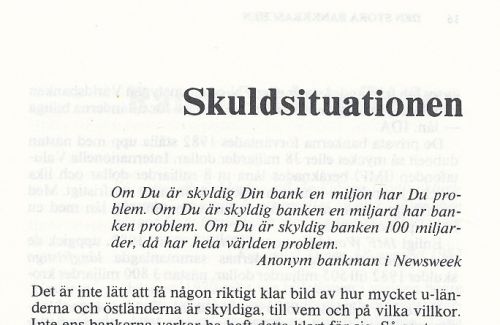
Så här blir du bank
Click
Recall that the conventional story in which banks merely channel existing funds from savers to those with investments to finance is wrong.
Banks create new money in the form of deposits when they issue loans.
This is why banking is an inherently unstable and destabilising activity.
Martin Sandbu, FT 1 March 2018
Svaret på galaxens alla frågor är inte 42.
För ekonomi och banker är svaret 20.
Rolf Engluns blog 23 augusti 2013
The legacy of the great crash of 2008 — economic, financial and political — hangs heavy in the air:
banks bailed out to the tune of £500bn; the bankers responsible punished only in the court of public opinion;
the imbalance between risk and sky-high rewards barely addressed by boards and shareholders.
FT editor Lionel Barber 23 November 2018
How Greece Is Scrambling to Save Its Banks — Again
Bloomberg 23 november 2018
Bank runs in the digital era
Thomas Hale FT Alphaville 29 March 2019
He /former Canadian central banker Mark Zelmer/ the argues that “past experience” has shown how quickly runs can take place in a digital world, and that the risk may grow due to the introduction of Open Banking, which was introduced in the UK last year to require banks to allow third parties to access account data
Once, you closed down the bank. Now, it’s the internet you’d have to close.
Minsky
Liquidity is an elusive quality at the best of times. In a bear market it can disappear in a moment.
Rest assured that not all of today’s trading strategies are predicated on that reality.
John Plender FT 13 November 2018
Peter Praet, the ECB’s chief economist, told a Financial Times conference that
he was particularly worried about “the degree of leverage in the financial system ...
because of the shadow banking system”.
Patrick Jenkins FT 1 October 2018
Under krisåren spenderade EU-länderna sammanlagt över 2 000 miljarder euro i skattepengar för att rädda banker.
Teresa Küchler SvD 15/9 2018
Grekland, Irland, Portugal, Spanien och Cypern fick alla enorma räddningslån från EU och IMF,
och en stor del av pengarna gick till att hålla kommersiella banker flytande
– samtidigt som befolkningarna i de krisdrabbade länderna underkastades hårda åtstramningspaket, med sänkta löner och pensioner.
...
- Den stora risken var att Grekland skulle utlösa en kris i italienska, franska och tyska banker.
Nu finns i praktiken en EU-garanti för de utestående grekiska statsobligationerna.
Anders Borg, TT, SvD papper 22 februari 2012
Småstadsbank blev nordisk jätte – när gick det fel?
I dag ställer sig alla samma fråga:
Är det möjligt att ledningen och styrelsen inte hade någon aning om vad som pågick?
SvD 23 februari 2019
Vi som barn läste Lyckoslanten har en lika romantisk som felaktig bild av banker
Idoga sparare satte in pengar på Sparbanken (numera Swedbank) som lånade ut pengarna till driftiga företagare i bygden mot god säkerhet.
Riktigt så är det inte.
Man skall först och främst skilja på inlåning och upplåning.
Englund blog 11 augusti 2018
Är storbankerna så stresståliga som Finansinspektionen antyder?
Patricia Hedelius: SvD 25 november 2018
Alldeles nyligen presenterade Riksbanken sin senaste finansiella stabilitetsrapport.
Där skriver den svenska centralbanken att vissa av storbankerna både spås få brist på utländska valutor och svenska kronor i en kris. Riksbanken bedömer till exempel att en del av bankerna bara har buffert för tre dagar i en stressad situation.
Det stannar inte där. Enligt Riksbanken är storbankernas affärer så insyltade i varandra att det motsvarar 40 procent av det viktiga kärnkapitalet.
Bankernas utlåning till hushållen - Swedbank störst
Cornucopia 18 juli 2018
Av 3 597 048 MSEK i utlåning till hushållen står Swedbank, Handelsbanken, SEB och Nordea för 74 %.
Bankcheferna tror inte på kris:
”Borg för alarmistisk”
SvD 5 juli 2018
Sweden
Indebtedness worries both FI and the central bank, the Riksbank, which fears that a sharp fall in house prices could lead debt-laden households to spend less, knocking back growth and employment.
It worries that banks, of which just four account for 75% of mortgages, could find loans harder to fund.
They do this by selling bonds, some in foreign currency, with the loans as collateral.
The Economist 21 June 2018
Håller vi på att återuppleva 2007?
Om utlänningar börjar bli nervösa över hur det står till i landet så kan bankerna få problem eftersom två tredjedelar av de pengar de lånar upp är utländsk valuta.
Birgitta Forsberg, SvD Näringsliv 30 april 2018
---
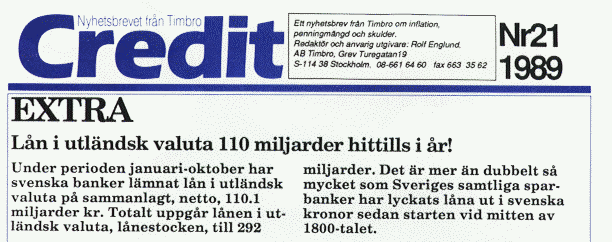
www.internetional.se/cred2189.htm
---
Rolf Englund på Nationalekonomiska Föreningen januari 1990
Vi ser också att affärsbankernas lånestock i utländsk valuta är nästan lika stor som den är i svenska kronor.
Lånen i utländsk valuta hos affärs- och sparbankerna är tillsammans nästan 300 miljarder. Det är mer än dubbelt så mycket som sparbankernas utlåning i svenska kronor.
Jag föreställer mig att de som har lånat upp dessa 300 miljarder inte avser att ha dessa lån när nästa devalvering kommer.
Fyra svenska börsbolag står för nästan hälften - 46 procent - av storbolagens samlade utdelningar.
Börsbolagen är händelsevis Handelsbanken, Nordea, SEB och Swedbank.
En svensk medelklassfamilj som bor i hus eller bostadsrätt kan nu ta stora lån och betala pyttelite i ränta
för att renovera, köpa bilar eller fritidshus.
Aftonbladet 27 November 2017
Det är inte längre för att Sverige säljer bilar, malm och skog som tillväxten ökar. Det är för att våra banker går så bra.
I dag är det - tack vare att bostadspriserna ökat - lån på banken som gör att vi har råd att handla och höja vår levnadsstandard.
I Katalys rapport No. 38 Finansialiseringen av Sverige visar rapportförfattarna Markus Kallifatides och Claes Belfrage att svenskt samhällsliv finansialiserats.
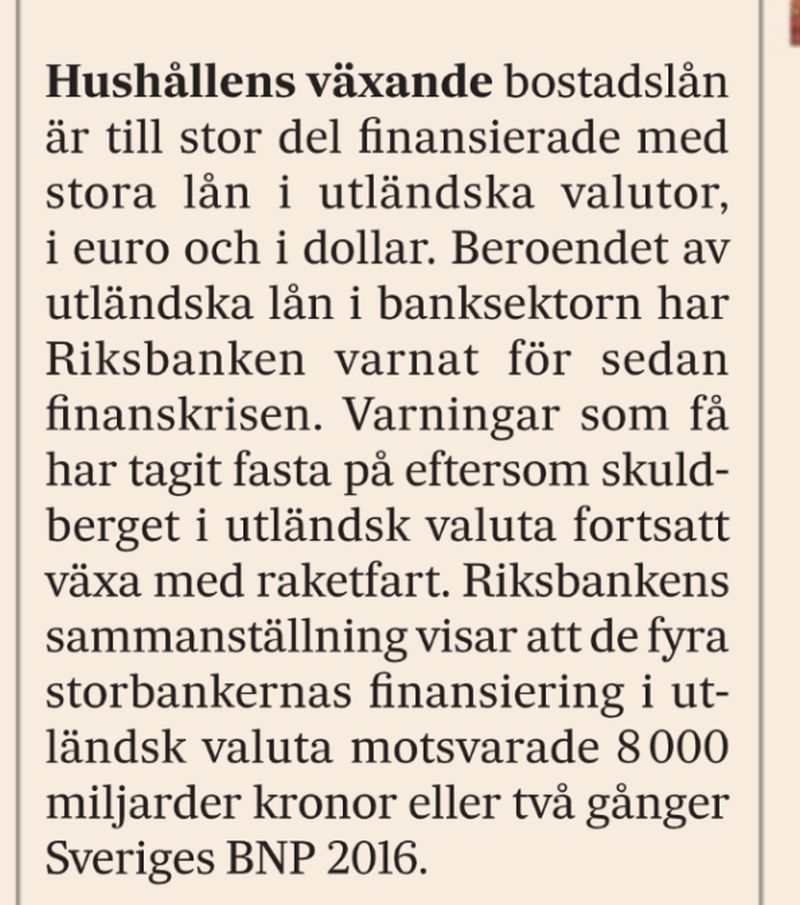
Bankernas utlandslån 8.000 miljarder kronor
Patricia Hedelius SvD 8 oktober 2018
Hjälp från USA spelade en avgörande roll för svensk ekonomi under den förra finanskrisen.
Men Sverige kan inte räkna med någon hjälp alls nästa gång en kris slår till.
Varningen kommer från vice riksbankschef Cecilia Skingsley, SvD 10 oktober 2018
Krisen drabbade inte minst svenska banker som lånar det mesta av sina pengar på kreditmarknaden i stället för från vanliga sparare – pengar som de sedan lånar ut till exempelvis bolånetagare. Svenska banker tar också stora lån i dollar, och när finanskrisen slog till fanns det helt plötsligt inga dollar som bankerna kunde låna för att betala sina skulder.
Situationen var mycket allvarlig och räddades av den amerikanska centralbanken som gick med på att förse Riksbanken med tillräckligt med dollar för att rädda de svenska bankerna.
Hushållens höga och stigande skuldsättning utgör ett allvarligt hot mot den finansiella och den makroekonomiska stabiliteten.
Det finns även sårbarheter i det svenska banksystemet och dess motståndskraft behöver därför stärkas.
Det gäller såväl bankernas förmåga att hantera likviditetsrisker som deras kapitalnivåer.
Samtidigt är det nödvändigt att Riksbanken har en tillräckligt stor valutareserv om det uppstår likviditetsbehov i utländsk valuta som inte bankerna själva kan hantera.
Riksbanken Finansiell Stabilitet 24 maj 2017
Riksbankens rapport De svenska storbankernas strukturella likviditetsrisker
De lånar in korta pengar och lånar ut långa – det klassiska receptet för allvarliga finanskriser.
Den svenska banksektorns tillgångar motsvarade 340 procent av BNP i slutet av 2015.
Gunnar Wetterberg, Expressen 26 februari 2017
Tidigare hanterades bolånen av särskilda bolåneinstitut. De gav ut bostadsobligationer med mycket långa löptider, som svarade mot låntagarnas amorteringstider.
På 1950-talet uppgick den återstående löptiden på bostadsobligationerna till nästan 40 år.
Problemet är att löptiden på bankernas tillgångar är mycket längre.
Swedbank och Handelsbanken är värst, med 15,5 respektive 14,8 års löptid på tillgångarna, mot 3,7 år på skulderna.
De svenska storbankernas strukturella likviditetsrisker
Finansiella stabilitetsrådet skall vara redo vid skarpt läge
Stockholm och andra svenska storstäder kan bli det Nya Norrland, fast i en ond spiral av utflyttning och bristande affärsunderlag.
När bostäderna stiger i värde konsumerar hushållen ungefär 25 procent av värdestegringen.
Den konsumtionen försvinner om bostadspriserna inte längre stiger.
Mattias Svensson, Fastighetstidningen 3 oktober 2017
Basel
Sweden also has objected to the 75 percent floor
because its banks have bigger holdings of mortgages than those in other countries.
Sweden’s historically stable housing market makes such mortgages less risky than what standardized formulas suggest, Swedish regulators and banks have argued.
Bloomberg 3 January 2017
So a bigger proportion of mortgages make the risk weighting look small compared with total assets.
Deutsche Bank AG and Commerzbank AG will be affected more than most big lenders and may have to raise additional capital,
if and when the Basel Committee on Banking Supervision implements a proposed floor for how much their risk-weighting of assets can veer from standardized measures.
Catherine Mann, the OECD’s chief economist, Canada and Sweden,
had “very high” commercial and residential property prices
Telegraph 2 January 2017
Storbankerna är skyldiga att hålla en viss mängd tillgångar som ses som likvida, som alltså enkelt kan säljas vid behov.
Bankernas så kallade likviditetsreserver består till stor del av andra bankers bostadsobligationer,
ett korsägande som kritiserats av bland annat internationella valutafonden.
SvD Louise Andrén Meiton 12 december 2016
Per Bolund säger att Finansdepartementet inte har gjort några egna stresstester av systemet med bostadsobligationer.
Han litar på Finansinspektionen och Riksbankens analyser.
Riksbanken
Storbankernas likviditet och kapitaltillgång behöver säkras
och riskerna med hushållens ökande skuldsättning måste hanteras
SvD 23 November2016
Då storbankerna är exponerade på flera marknader anser banken bland annat att Finansinspektionen bör ställa krav på likviditetstäckningskrav i alla väsentliga valutor
och snarast införa ett bruttosoliditetskrav. Nivån på kravet bör sättas till fem procent, föreslår Riksbanken.
– Under alla de negativa scenarior som vi kan tänka oss
så är det extremt svårt att se hur man som investerare kan förlora pengar på bostadsobligationer,
därför har de en unik position, säger John Arne Wang, chef för upplåning och likviditetshantering på SEB.
Myntet har två sidor. Om investerarens risk är liten är den potentiellt långt större för bolånekunden.
SvD Näringsliv, Louise Andrén Meiton, 15 november 2016
Någon som länge varnat för åska och storm är riksbankschef Stefan Ingves.
Han har skrikit sig hes och varnat för att de svenska storbankerna bara blir större och större och därmed innebär en större risk för hela landets ekonomi.
Det är ingen hemlighet att Stefan Ingves varit kritisk till Nordeas planer att bli en gigantisk bank med Sverige som yttersta garant i en kris.
SvD 19 juni 2016
FI-chefen Erik Thedéen å sin sida gillar riskvägda mått – att banken behöver ha mer egna pengar när de lånar ut till byggbolaget Svea än till familjen Svensson som vill köpa en lägenhet.
Svenska storbanker kan tvingas låna upp 588 miljarder kronor i efterställda lån,
som ska kunna omvandlas till eget kapital i ett krisskede, enligt ratinginstitutet Moody's
SvT/TT 12 maj 2016
zc
Bank lending in 2018 looks a lot like bank lending pre-2008.
Worse, macroeconomic policies, designed as a methadone fix to see a debt-addicted world though the post-crisis years,
have actually led to increased leverage outside the banking sector
FT 9 October 2018
In aggregate, global debt now stands at close to $250tn, according to the Institute of International Finance,
nearly 40 per cent more than in 2008. In that artificially low-interest environment, investors’ hunger for decent yields has pushed asset prices — from Florida apartments to fine art — up to record levels.
The world has not learned the lessons of the financial crisis
Banks are safer, but too much of what has gone wrong since 2008 could happen again
The Economist editorial 6 September 2018
Europe’s banking union lacks the key element of deposit insurance
Isabel Schnabel member of the German Council of Economic Experts FT 28 August 2018
Turkish lira tumbles further as crisis mounts
ECB concerned about exposure of European banks to borrowers in Turkey
FT 10 August 2018
How To Deal With Failed Banks
Resolving a failing bank should rely on bail-ins:
private stakeholders should bear the losses
IMF blog 3 July 2018
During the global financial crisis, policymakers faced a steep trade-off in handling bank failures. Using public funds to rescue failing banks (bail-outs) could weaken market discipline and lead to excessive risk taking—the moral hazard effect.
Letting private investors absorb the losses (bail-ins) could destabilize the financial sector and the economy as a whole—the spillover effect. In most cases, banks were bailed out.
This created public resentment and prompted policymakers to introduce measures to shift the burden of bank resolution away from taxpayers to private investors.
Lehman Brothers
While risk no longer sits in the banking system, it has not vanished.
It grows ever clearer that risk has been moved, primarily to the pension system.
John Authers FT 26 July 2018
When Richard Fuld, the chief executive of Lehman Brothers, received the news in 2008 that no one would ride to the rescue of his failing bank, he is reported to have said: “So I’m the schmuck?”
The sheer complexity of pensions also helps to make them a much more attractive place to bear risks. Few understand them, so they tend not to be the subject of mainstream debate.
China’s $10 trillion ecosystem of unregulated lending, known as shadow banking.
Bloomberg 19 July 2018
German savings banks, known as Sparkassen, form an important feature of the country's banking assets.
Unlike in other European countries, German Sparkassen also hold direct links with local political communities.
Bruegel July 2018
European banks still have post-crisis repairs to do
Former US policymakers say their counterparts did not do enough to stop the rot
Gillian Tett FT 19 July 2018
“In the early days of the crisis the European banks were in worse shape than the US banks and they hid it because...
Ben Bernanke, Henry Paulson and Timothy Geithner
Martin Wolf: My own view is that the people, including Geithner, who dealt with this crisis made big mistakes
but also saved the world from another Great Depression
Click
Should stresses emerge, market liquidity will evaporate again:
the insidious illusion of permanent liquidity has not gone away.
Agustín Carstens, general manager of the Bank for International Settlements, FT 25 June 2018
Banks may be disguising their borrowings
with debt ratios falling within limits imposed by regulators just four times a year.
Bloomberg 24 June 2018
Lenders use repurchase agreements -- known as repos -- to massage down their assets as reporting dates approach, typically as quarters end,
the Bank for International Settlements said in its Annual Economic Report.
Post-crisis, financial regulators decided to nominate a select few GSifis
(global systemically important financial institutions).
From the market top on January 26 until May 31, they lost $800bn in market capital, or about 18 per cent.
John Authers FT 14 June 2018
Bankunion
Man vill skapa förutsättningar för att bryta den så kallade ”doomloop”,
den negativa feedback, som finns mellan ett svagt banksystem och svaga offentliga finanser.
Statssekreterare Karolina Ekholm Intervju: Per Lindvall Realtid 15 juni 2018
Att /för Sverige/ bara lämna walk-over och ställa sig utanför bankunionen med motiveringen att detta är ett sätt för euroländerna att hantera sina självförvållade problem är inget självklart val.
När det gäller hanteringen av krisbanker enligt resolutionsmekanismen SRM, som innefattar resolutionsfonden och resolutionsstyrelsen,
så har hanteringen av de italienska bankerna med storbanken Monte dei Paschi i spetsen skapat en viss oro för hur reglerna kommer att tillämpas.
Huvudregeln är att bankernas ägare och fordringsägare i första hand ska ta smällen, så kallad bail-in.
Euron lyfter Sverige
Den inre marknaden är EU:s viktigaste ekonomiska projekt. Men nationella valutor med rörliga växelkurser fungerar som handelshinder.
Därför är en gemensam valuta ett naturligt och nödvändigt steg för att realisera den gemensamma marknaden.
Pontus Braunerhjelm, Karolina Ekholm, Klas Eklund, Richard Friberg, Mattias Ganslandt, Hans Genberg, John Hassler, Ulf Jakobsson, Pehr Wissén Carl Johan Åberg
SvD Brännpunkt 14/5 2003
Författarna medverkar i boken "Därför euron" som i dag ges ut på Ekerlids förlag.
Sluta dalta med krisbankerna
Svajande storbanker hålls under armarna med hjälp av statliga insatser, läs subventioner,
där staten och skattebetalarna bär en allt större del av riskerna utan att få eller ta betalt.
Per Lindvall e24.se 2009-06-10
What fixes does the euro really need?
As Isabel Schnabel and Nicolas Véron have recently explained, this requires, at a minimum,
that banks’ creditworthiness is no longer at the mercy of the public finances in the country they happen to emerge from —
that the “doom loop” between banks and sovereigns be broken.
Martin Sandbu 11 June 2018
Mario Draghi, the euro’s central banker, inimitably set out what this means in his speech in Florence last month;
the single best guide to the eurozone’s challenges.
Italy turmoil shows banking ‘doom loop’ still a powerful force
FT 5 June 2018
The idea that Italy could vote in a referendum to leave the eurozone and bring back the lira still sounds far-fetched to most investors. But even the faintest chance of such a dire outcome for anyone holding Italian sovereign bonds was enough to prompt Moody’s to put the credit ratings of 12 Italian banks on review for downgrade last week.
The reason the Italian political crisis caused so much angst was the ill health of Europe’s banks
which remain bloated and over-levered.
John Authers FT 2 June 2018
I find it unforgivable that the last Irish government guaranteed bank debt so insouciantly and that the rest of the European Union has supported this decision.
For a sovereign to destroy its own credit, to save creditors of its banks, is plainly wrong.
It does not make it better, but worse, that it is doing so largely to protect financial systems in other countries.
Martin Wolf, FT March 8 2011
How to Escape Basel III Doom Loop
What has been the biggest economic policy error of the post-Lehman era?
I used to think the answer was obvious. The euro zone's decision to impose losses on holders of Greek government bonds
Simon Nixon, WSJ 7 October 2011
The European Commission is urging governments and the European Parliament to complete the EU’s banking union by 2019
and thus cut the “doom loop”, in which weak banks and sovereigns drag each other down
The Economist print 30 November 2017
The European Union's effort to break the link between banks and government debt may make things worse.
Bloomberg 15 December 2017
However, if the price of these bonds plummets -- or, worse, if these bonds have to be restructured -- banks get into trouble, as Greek banks found.
RBS Government’s stake is worth around £24bn,
little more than half the £45bn of public money used to keep the bank afloat
Jeremy Warner 12 May 2018
Even adding back the £6bn the Government creamed off RBS via the so-called “asset protection scheme”, that’s quite a loss to the public purse.
I am no populist.
Yet when I think of the sums earned by those responsible for dumping this mess on to the UK taxpayer,
even my blood boils.
Martin Wolf, Financial Times March 5 2009
The reason the Italian political crisis caused so much angst was the ill health of Europe’s banks
which remain bloated and over-levered.
John Authers FT 2 June 2018
This makes them vulnerable to risks such as an Italian default.
And as the banks remain huge, they are effectively too big for their governments to save.
It is European banking health that makes any risk to the structure of the eurozone so toxic.
Banks today are much better capitalised than before, and much of the risky lending is now occurring in the non-bank world,
namely by hedge funds, private equity groups and mutual funds. But that is not a reason to relax.
Gillian Tett FT 26 April 2018
Just a few days ago the IMF warned about the risks of overheating in risky loan and bonds markets.
“Signs of late cycle credit dynamics are already emerging in the leveraged loan market,” the IMF Global Financial Stability Report observes, noting that “in some cases, [this is] reminiscent of past episodes of investor excesses”.
To protect the economy from future mega-bank failures, much more work needs to be done.
Mark Roe, professor at Harvard Law School, Project Syndicate 17 April
Twin reports by the IMF sketch a chain-reaction of dangerous consequences for world finance.
The policy – if you can call it that – puts the US on an untenable debt trajectory.
It smacks of Latin American caudillo populism, a Peronist contagion that threatens to destroy the moral foundations of the Great Republic.
Ambrose Evans-Pritchard Telegraph 18 April 2018
Taken together, existing capital requirements and stress tests still aren't enough to prepare banks for a real crisis.
As soon as people start to think a bank is going bust, it’s doomed.
So it needs enough equity to absorb severe losses and continue operating.
Bloomberg Editorial 16 April 2018
Recall that the conventional story in which banks merely channel existing funds from savers to those with investments to finance is wrong.
Banks create new money in the form of deposits when they issue loans.
This is why banking is an inherently unstable and destabilising activity.
Martin Sandbu, FT 1 March 2018
Crisis and Response: An FDIC History, 2008–2013
FDIC December 2017
US ‘too big to fail’
Treasury plans ‘Chapter 14’ bankruptcy process to shield taxpayers from bank collapses
FT 21 February 2018
The Coming Financial Crisis
Bank deposits fell strictly into two classes, depending on the preference of the depositor and the terms offered by banks:
time deposits, and demand deposits.
Doug Casey 27 December 2017
In the business of accepting time deposits, a banker is a dealer in credit, acting as an intermediary between lenders and borrowers.
An honest banker should no more lend out demand deposit money than Allied Van and Storage should lend out the furniture you’ve paid it to store.
In 1934, to restore confidence in commercial banks, the US government instituted the Federal Deposit Insurance Corporation (FDIC) deposit insurance in the amount of $2,500 per depositor per bank, eventually raising coverage to today’s $250,000.
In Europe, €100,000 is the amount guaranteed by the state.
FDIC insurance covers about $9.3 trillion of deposits, but the institution has assets of only $25 billion.
Earlier this year, Fed Chair Janet Yellen explained how she doesn’t think we’ll have another financial crisis “in our lifetimes.”
Ben Bernanke said in May 2007
- We believe the effect of the troubles in the subprime sector on the broader housing market will likely be limited, and we do not expect significant spillovers from the subprime market to the rest of the economy or to the financial system.
As many of you know, I have spent much of the last seven years explaining to anyone who will listen that banks do not "lend out" deposits or reserves.
Rather, they create both loan assets and matching deposit liabilities "from nothing" by means of double entry accounting entries.
Creating money with a stroke of the pen (or a few taps on a computer keyboard) is what banks do.
Frances Coppola, 29 October 2017
Regulators approve living wills designed to avert future bailouts
Fed and FDIC found “living wills” drawn up by eight of the country’s largest and most complex banks were satisfactory.
FT 20 December 2017
The revised Basel bank-capital standards are complete at last
But have Europe’s banks got off lightly?
The Economist print 14 December 2017
Europe’s banks are stronger than they were, but not strong enough
The Economist print 30 November 2017
The European Commission is pushing ahead on yet another front. It is urging governments and the European Parliament to complete the EU’s banking union by 2019 and thus cut the “doom loop”, in which weak banks and sovereigns drag each other down
One big missing piece is a common European deposit-insurance scheme. Germans and other northerners have balked at the thought of bailing out supposedly feckless southerners. To allay such fears, the commission wants to go gradually
Among their other shortcomings, banks had done too little, too late, to recognise losses on wobbly assets.
Under existing standards they make provisions only when losses are incurred, even if they see trouble coming.
IFRS 9, which comes into force on January 1st, obliges them to provide for expected losses instead.
The Economist 16 November 2017
“Shadow banking”
It's larger than the world economy. It poses risks to financial stability.
Bloomberg, 20 November 2017
The most devastating runs of the 2008 financial crisis were not on bank deposits — as happened during the Great Depression —
but on shadow banks such as Lehman Brothers (a broker-dealer) and money-market funds.
As many of you know, I have spent much of the last seven years explaining to anyone who will listen that banks do not "lend out" deposits or reserves.
Rather, they create both loan assets and matching deposit liabilities "from nothing" by means of double entry accounting entries.
Creating money with a stroke of the pen (or a few taps on a computer keyboard) is what banks do.
Frances Coppola, 29 October 2017
Banking remains far too undercapitalised for comfort
Leverage ratios closer to 5:1 will help give creditors confidence in liabilities
Martin Wolf, FT 21 September 2017
Western capitalism has few sacred cows left.
It is time to question one of them: the independence of central banks from elected governments.
Yanis Varoufakis, Project Syndicate 29 August 2017
Italy’s €17bn bank rescue deal
Critics say use of state funds to deal with failing Veneto banks undermines EU rules
FT 26 June 2017
Italy will commit as much as 17 billion euros ($19 billion) to clean up two failed banks
Banca Popolare di Vicenza SpA and Veneto Banca SpA
The lenders will be split into good and bad banks.
Bloomberg 25 June 2017
Markets Don't Trust Banks, and They're Right
The financial crisis should have led to fundamental change. It hasn’t happened.
Mark Whitehouse, Bloomberg 30 maj 2017
Almost a decade after a crisis that nearly brought down the global financial system, markets still aren’t showing much confidence in banks.
It’s understandable that, after years of wrangling and thousands of pages of new rules, regulators might want to consider their mission accomplished.
Yet, as former U.S. Treasury Secretary Larry Summers has taken to pointing out, markets don’t appear to believe that banks are much healthier. This is evident in how they value equity -- that is, the amount by which a bank says its assets exceed its liabilities.
Back in the early 2000s, investors often paid $2 or more for each dollar in book equity, a sign that they trusted banks’ accounting and expected to reap significant profits.
Now, though, even after the mini-boom following Donald Trump’s election, they’re valuing the largest five U.S. banks at about $1.16 per dollar of book equity, and the top five European banks even less.
Here’s how that looks:
Monte dei Paschi rescue deal now close
MPS, the oldest bank in the world, was shown to be one of the sickest, too.
FT 22 May 2017
A decade after the crisis, how are the world’s banks doing?
For too many, leverage was the path first to profit and then to ruin.
The Economist 6 May 2017
IMF Global Financial Stability Report
April 2017
Glass-Steagall was one of the most successful financial laws Congress has ever enacted.
Before Glass-Steagall, financial panics, as they used to be called, were a staple of American life.
But after the Depression, financial crises stopped until 2008, by which time it had been repealed.
Joe Nocera, Bloomberg 6 April 2017
Deutsche Bank Seeks $8.6 Billion Selling Shares at 35% Discount
Bloomberg 19 March 2017
The bank said previously that the latest share sale would boost its common equity Tier 1 ratio, a key benchmark of financial strength, to 14.1 percent and vowed to keep it “comfortably above” 13 percent. The measure stood at 11.9 percent at the end of 2016.
Postmortem plans for banks under threat of exinction
If there was one big realisation to come out of the financial crisis
— alongside the fact that banks were riskier than believed —
it was this: policymakers did not know how to wind up a bank without causing chaos.
FT 6 March 2017
Banks globally have paid $321 billion in fines since 2008
for an abundance of regulatory failings from money laundering to market manipulation and terrorist financing,
according to data from Boston Consulting Group.
Bloomberg 2 March 2017
Why are German banks the only ones backtracking on integration?
One possible reason is that domestic financial authorities, skeptical about the euro’s future, have instructed banks to cut their exposure to the rest of the eurozone.
German banks received €239 billion ($253 billion) in state aid between 2009 and 2015.
Federico Fubini, Project Syndicate 30 January 2017
The global financial system is no safer today than it was in 2007.
If those who use overnight mortgage pools receive priority over other creditors, as is the case today...
Mark Roe, professor at Harvard Law School, Project Syndicate, 31 January 2017
Just €300bn
Study shows 133 banks will have to issue no more than €300bn to meet capital standards
FT 14 December 2016
Risky banks face higher capital needs from latest Basel reforms
FT 7 October 2016
Deutsche Bank
Merkel and other EU leaders face a quandary. Markets assume they won’t deploy their biggest weapon
-- bail-in, or imposing losses on private investors --
when it comes to a giant like Deutsche Bank because of the risk of contagion.
Bloomberg 5 October 2016
More than nine years after the start of the global financial crisis,
worries over the health of the financial system remain significant, especially in Europe.
Martin Wolf. FT 4 October 2016
This should not be surprising. But it should be disturbing.
Since August 2007 the 471 financial companies that form Datastream’s financials equities sector
lost over one trillion euros in market value.
FT 8 August 2016
Italy’s banking woes have the potential to wipe out investors and
undo over 60 years of supranational state-building in Europe.
zerohedge 12 July 2016
The 2007-08 episode clearly demonstrated that financial crises, particularly when they involve the banking sector,
can be enormously expensive both in terms of direct fiscal costs and associated costs for the real economy.
Over the period 2008-14 accumulated gross financial sector assistance by euro area governments amounted to 8% of euro area GDP,
of which, so far, around 3% has been recovered
Lecture by Vítor Constâncio, Vice-President of the ECB, 7 July 2016
If the Fed wants the big banks to ease off on lending to the commercial real estate sector, for example,
it simply increases the hypothetical losses under the most stressful scenario.
Hey presto: the bank in question has to taper its plans for dividends and share buybacks
— reducing its return on equity — or risk a damaging rejection when the results are in.
FT 8 July 2016
The big bank bloodbath:
losses near half a trillion dollars
MarketWatch 7 July 2016
At 20 big banks, plunging share prices this year have erased a quarter of their combined market value
I agree with those who reacted to Mr Renzi’s proposal by saying
there is no case to suspend the bail-in rules that are encapsulated in the Bank Recovery and Resolution Directive,
which came into force at the start of the year,
and that doing so would fatally damage the credibility of the brand-new bailout framework.
Philipp Hildebrand, FT 5 July 2016
But, as Angela Merkel, German chancellor, has pointed out...
The writer is vice-chairman of BlackRock and a former chairman of the governing board of the Swiss National Bank
Shares in Italy’s two largest banks Intesa Sanpaolo and UniCredit,
closed down almost 23 per cent and almost 24 per cent respectively.
In Spain, Banco Santander and Banco Sabadell’s stocks fell more than 14 per cent and 19 per cent respectively.
Germany’s Deutsche Bank dropped about 14 per cent.
FT 28 June 2016
Will IT disrupt finance?
Martin Wolf FT 8 March 2016
Stocks Tumble After Fed Plans Too-Big-To-Fail Bank Counterparty Risk Cap
The Fed proposed a rule that would limit banks with $500 bln or more of assets from having net credit exposure
to a “major counterparty” in excess of 15% of the lender’s tier 1 capital.
zerohedge 4 March 2016
What is 'Tier 1 Capital'
investopedia.com
Bill Gross says negative rates are going to crush the banks
MarketWatch 3 March 2016
Baltikum Swedbank SEB och Bolånen
Andreas Cervenka, SvD 3 mars 2016
Royal Bank of Scotland's shares dived 8 pc as the bank reported
its eight consecutive year of losses since it was bailed out by the taxpayer in 2008.
Telegraph 26 Febr 2016
The bailed-out bank lost £2bn in the year, taking its total losses since the financial crisis to £ 51.6 bn.
Sub-zero central bank rates should be welcomed, not lamented,Sandbu
Rolf Englund blog 16 Febr 2016
European stock markets rallied for a second straight session on Monday,
with bank shares leading the charge higher after news
the European Central Bank may buy Italian bad loans.
MarketWatch 15 Febr 2016
A negative feedback loop between bail-in instruments and equity has developed, leading to a loss of confidence.
Recent developments in Italy and Portugal have awoken investors to these new risks.
FT 15 Febr 2016
Basel
Bank turmoil:
are Europe’s new bail-in rules to blame?
FT, February 11, 2016
The Stoxx 600 index of European financial institutions fell 5.6 per cent on Monday
Deutsche Bank led a rout in global bank stocks
FT 8 Febr 2016
Deutsche has one of the weakest capital ratios among large global banks.
Deutsche Bank Is Forced To Issue Statement Defending Its Liquidity
Deutsche Bank Co-Co bond yields hit 12%.
Two-year German government bonds now yield -0.50%.
MishTalk, Febr 8. 2016
Why coco bonds are worrying investors
FT February 9, 2016
Banks
John Kay’s new book, “Other People’s Money”, does the job;
it should be read by everyone concerned with preventing the next crisis.
The Economist 22 August 2015
The early books after the crash, like Andrew Ross Sorkin’s “Too Big to Fail”, analysed how the collapse unfolded in minute detail;
Mr Kay, an academic and columnist for the Financial Times, takes the longer and broader view.
“We need some of the things that Citigroup and Goldman Sachs do, but we do not need Citigroup and Goldman Sachs to do them,” he writes.
Banks are Not Intermediaries of Loanable Funds – and Why This Matters
Yves Smith, June 19, 2015
Draghi would like his trillion euros to go to Italian factories to re-equip themselves, to Greek tourist resorts to smarten themselves up,
and to German consumers to spend more on that Italian-made stuff and those Greek holidays.
But banks won’t want to lend to Italian or Greek companies just because they have a lot more money on their balance sheet.
So if a trillion euros get printed in Frankfurt, a lot of it will wash its way across the English Channel.
Matthew Lynn, Telegaph 19 Jan 2015
Svenska storbanker kan tvingas låna upp 588 miljarder kronor i efterställda lån,
som ska kunna omvandlas till eget kapital i ett krisskede, enligt ratinginstitutet Moody's
SvT/TT 12 maj 2016
Finanskriskommittén
Riksgäldens garantiprogram för bankerna infördes 2008.
Sammanlagt ställdes bankgarantier för 354 miljarder kronor.
SvD Näringsliv 18 november 2014
Ingen av garantierna behövde infrias.
– Jag tycker att det var en lyckad åtgärd. Den sattes in när svenska och utländska banker hade finansieringsproblem och därför behövde den här typen av statligt stöd, säger Lars Hörngren, chefsekonom på Riksgälden och tidigare ordförande i Finanskriskommittén.
– Det var för att säkra kreditgivningen under kristiden. BNP föll för att exporten drabbades
men den inhemska konsumtionen tuffade ändå på någorlunda väl. Det berodde på att det fanns krediter att tillgå
Anders Borg är duktig, men tänk om de goda tiderna beror på bostadsbubblan, som på Irland
Rolf Englund 2011-11-23
Finanskriskommittén
På basis av nya EU-regler för finanskrishantering lämnar Finanskriskommittén förslag om ett nytt förfarande kallat resolution.
Förförandet innebär att om en konkurs i en krisbank skulle hota den finansiella stabiliteten,
kan staten genom att besluta att sätta den i resolution ta kontroll över banken.
Staten kan sedan sälja hela eller delar av verksamheten eller driva den vidare och genom rekonstruktionsåtgärder på nytt göra den livskraftig.
Bakgrund
I december 2013 antog EU ett direktiv som syftar till att ge medlemsstaterna de befogenheter som krävs
för att utan spridningseffekter till andra banker och utan stora kostnader för staten hantera banker i kris.
Finanskriskommitténs uppdrag har varit att lägga förslag om hur EU-direktivet ska genomföras i svensk lagstiftning.
Will the asset quality review and stress tests conducted by the European Central Bank and the European Banking Authority mark a turning point in the eurozone’s crisis?
Leverage is 20 to 1 in Spain and Italy; 25 to 1 in Germany and France; and 30 Lto 1 in the Netherlands.
It is questionable whether this is enough loss-absorbing capital.
Martin Wolf, FT October 28, 2014
America’s eight biggest banks used to have 23 times more loans and investments than loss-absorbing capital
if a twenty-third of their assets had had to be written off, they would have gone bust.
Now they are only 14 times “levered”.
The Economist print September 27th 2014
The Bankers’ New Clothes start
I cannot think of a sillier approach to the problem than that suggested by Ms Admati.
Banks would shrink their balance sheets to match, with devastating consequences for the wider economy
Jeremy Warner, Telegraph 11 August 2014
Anat argues that current capital requirements are grossly inadequate. Banks will never be entirely safe, she insists, until equity capital is expanded to 30pc of lending, roughly six times current requirements
Any adverse consequences for lending, she argued, could be avoided by forcing bankers to suspend dividends and cut pay until they had achieved the new thresholds. Come again? No, that is not how banks would deal with such capital requirements.
In practice, they would shrink their balance sheets to match, regardless of any ban on dividends and bonuses, with devastating consequences for the wider economy.
This is in essence what’s happening in Europe right now in response to the European Central Bank’s asset quality review.
Paul Volcker, the former Federal Reserve chairman who gave his name to a new rule that limits commercial banks from using deposits for risky proprietary trading, once confided that his rule would only work if it were kept simple enough to be written on half a page.
In the event, the final version runs to 71 pages, with a further 900 of interpretation.
The age of the mega investment banks, with their free ride on government-guaranteed deposits, may be over
Anat Admati
When bank apologists write self-serving balderdash, I shrug my shoulders and move on. Anat gets on a plane.
She said she was glad that policy makers finally seemed to be listening. But, she said, she was frustrated by the lack of progress and not sure about how to press ahead.
To the contrary, this has been one of the most successful campaigns to change ideas in economic policy, in a short time, that I have ever seen.
If you want to study how an academic economist can have a major influence on public policy, this is it.
The Grumpy Economist, 10 August 2014
“The Bankers’ New Clothes: What’s Wrong With Banking and What to Do About It,”
Bankers are nearly unanimous on the subject of Anat R. Admati, the Stanford finance professor and persistent industry gadfly:
Her ideas are wildly impractical, bad for the American economy and not to be taken seriously.
But after years of quixotic advocacy, Ms. Admati is reaching some very prominent ears.
Last month, President Obama invited her and five other economists to a private lunch to discuss their ideas.
Binyamin Applebaum, New York Times 9 August 2014
She left him with a copy of “The Bankers’ New Clothes: What’s Wrong With Banking and What to Do About It,” a 2013 book she co-authored.
A few weeks later, she testified for the first time before the Senate Banking Committee.
This is the most important book to have come out of the financial crisis.
The Bankers’ New Clothes: What’s Wrong with Banking and What to Do About It,
by Anat Admati and Martin Hellwig, Princeton
Review by Martin Wolf, March 17, 2013
bankersnewclothes.com/
Click here
The Bankers’ New Clothes start
The world's oldest surviving bank, Monte dei Paschi di Siena (MPS), has reported a bigger-than-expected loss.
The Italian bank, which has been in business since 1472, reported a second quarter loss of 179m euros (£142m),
three times the loss analysts had been expecting. It was the bank's ninth consecutive quarterly loss
BBC 7 August 2014
The end game may have finally arrived for Banca Monte dei Paschi di Siena SpA.
An institution that’s seen its stock fall by 99 percent since 2009, recorded 15 billion euros in losses
Has until year-end to raise 5 billion euros of capital - seven times its current market value
Bloomberg 23 November 2016
"extend and pretend."
Some banks have a special technique for dealing with business borrowers who can't repay loans coming due:
Give them more time, hoping things improve and they can repay later.
Banks call it a wise strategy. Skeptics call it "extend and pretend."
Wall Street Journal, 7 July 2010
Varifrån fick SEB 498 miljarder?
Rolf Englund blog 2014-07-14
Sverige i skuldfällan
"Låneskulden i utlandet 719 miljarder förra året, skriver Englund"
Svenska Dagbladet, Näringsliv, Ord mot Ord, 1991-05-30
De svenska bankerna har tillgångar som motsvarar fyra gånger Sveriges hela BNP.
– Schweiz, Cypern och Nederländerna ligger högre. De har haft sina problem. Och under oss har vi Storbritannien, Danmark och Spanien och de har haft sina problem
– Samtidigt vet vi att mer än hälften av bankernas finansiering sker utomlands och det betyder att man där kan ha synpunkter på vår bolånemarknad.
I slutändan är det de utländska placerarnas syn på oss som är avgörande.
Den svenska bolånemarknaden har därmed blivit systemviktig
Stefan Ingves, DN 3 januari 2014
"Enligt vår uppfattning stod det finansiella systemet i Sverige inför en kollaps den 24 september 1992."
Klick
Regeringen presenterade idag nya åtgärder kring hur den finansiella stabiliteten ska värnas
Sverige har Europas tredje största banksystem, ett system som dessutom har sämre tilltagna buffertar än i många andra länder.
Och som är väldigt beroende av att låna utomlands.
Andreas Cervenka, SvD Näringsliv, 26 augusti 2013
Liksom tidigare var Peter Norman tydlig med att Sveriges stora banksektor är ett bekymmer.
- Bara Storbritannien och Schweiz i Europa har större banksystem i förhållande till BNP.
Regeringen föreslår att bankerna ska betala en avgift för Riksbankens valutareserv, vars huvudsakliga syfte är att se till att svenska banker kan få tag i pengar i kristider eftersom de envisas med att vara beroende av utländska kapitalmarknader.
Riksbanken tog ju ifjol det mycket omdebatterade beslutet att utöka valutareserven med 100 miljarder kronor av detta skäl.
- Det är är därför rimligt att bankerna är med och finansierar detta, sade Peter Norman.
Regeringen skriver också i sin promemoria att avgifterna till den fond, Stabilitetsfonden, som ska användas för att stötta banker i kristider är för låga och att avgifterna ses över. Men det räcker inte.
Regeringen funderar också på att ytterligare skärpa kraven på bankerna.
- Det svenska banksystemet är väldigt välkapitaliserat och robust och omvärlden ser med på avund på Sveriges finansiella stabilitet, sade Norman men tillade i nästa andetag: - Vi behöver öka bufferterna i det svenska banksystemet utöver redan aviserade och beslutade åtgärder.
En paradox. Om nu de svenska bankerna är de finansiella fort som ministern (och bankerna själva) hävdar, varför behövs det ytterligare skyddsvallar?
Sverige har ju redan tidigare sagt att kapitalnivåerna i svenska banker ska vara högre än vad regelverket i övriga EU kräver.
En liten ledtråd kanske finns i en skrift som Riksbanken publicerade i somras. I rapporten behandlas så kallad bruttosoliditet, det vill säga hur mycket kapital bankerna har i förhållande till sina tillgångar utan hänsyn till olika komplicerade riskmodeller, ett ämne som bloggen bland annat avhandlat här, här och här.
Det nuvarande systemet med så kallade riskvikter har fått hård kritik eftersom det lämnat stort utrymme för bankerna att själva skruva på siffrorna.
I rapporten avslöjas att den största orsaken till att de svenska bankerna ökat sina kapitalnivåer de senaste åren är inte att det skjutits till pengar från ägarna utan att de riskvägda tillgångarna minskat. Det har skett genom att riskfylld utlåning minskat och lågriskutlåning ökat (läs bolån).
Men den största effekten kommer från att bankerna omklassificerat låneportföljerna så att de själva tillåtits bedöma risken, vilket, som av en händelse, inneburit lägre kapitalkrav.
”I det senare fallet har alltså riskvikterna minskat trots att den faktiska kreditrisken som är förknippad med lånen sannolikt inte har förändrats”, skriver Riksbanken.
Riksbanken konstaterar också att svenska banker ligger ganska dåligt till när det gäller bruttosoliditet. Den genomsnittliga siffran (kapital genom skulder) för svenska banker är 3,4 procent, jämfört med det globala snittet på 3,8 procent.
I de nya så kallade Basel III-reglerna är golvet satt vid 3 procent, vilket motsvarar att banken kan belåna varje krona i kapital 33 gånger om, något som skulle betraktas som en huvudlöst hög risk i vilken annan bransch som helst.
Full text2012 var icke finansiella företag och hushållens skulder i Sverige uppe i 576 % av BNP mot eurozonens 340 % år 2011.
http://cornucopia.cornubot.se/2013/05/den-svenska-skuldbubblan-i-relation.html
De fyra svenska storbankerna Swedbank, SEB, Handelsbanken och Nordea visar på samlade
tillgångar (utlåning) på 12 500 miljarder kronor.
Det samlade aktiekapitalet i samma banker är 565 miljarder kronor.
Det motsvarar att varje krona i kapital är belånad 22 gånger
Andreas Cervenka, SvD Näringsliv 11 februari 2013

"some malfunctions occurred and mistakes were made"
U.S. poised to impose record fine /nearly $9 billion/ on BNP Paribas
French bank expected to plead guilty to sanctions breaches
MarketWatch 30 June 2014
On Friday, Jean-Laurent Bonnafé, the BNP Paribas’s CEO, sent a humble message to the bank’s 200,000 employees:
“Let me put it clearly: We will be severely punished. Because some malfunctions occurred and mistakes were made.”
Secular stagnation
There’s something more significant going on in the industrialised global economy than the effects of a banking crisis per se
The financial intermediation industry loses its raison d’etre in such an environment
Izabella Kaminska, FT Alphaville 17 April 2014
Part of the BEYOND SCARCITY SERIES
Larry Summers was interviewed by Chrystia Freeland at the INET conference in Toronto last week, in a conversation that very usefully expanded upon his thoughts about secular stagnation.
It’s a reassuring interview for us because so many of the statements he made echo what we (and other bloggers such as Steve Randy Waldman) have been saying for some time. Namely, that there’s something more significant going on in the industrialised global economy than the effects of a banking crisis per se, and that that *something* is probably related to technological abundance.
More so, that this phenomenon is having strange macro effects on capitalist incentives.
There was also a nod to the point we’ve made for a long time, that the financial intermediation industry loses its raison d’etre in such an environment, and worse than that, potentially becomes a malignant rather than constructive force on development and growth. In short, that negative rates are hardly the solution.
Biggest US banks forced to hold $68bn in extra capital
US regulators have held out the prospect of more draconian measures after ratcheting up capital requirements for the biggest US banks
– from JPMorgan Chase to Goldman Sachs – forcing them to hold at least $68bn in additional capital.
A new “leverage ratio” will force the eight largest US banks to hold a minimum of 5 per cent equity to total assets to absorb losses in a crisis and proposes adopting a more stringent way of calculating the rule.
FT April 8, 2014
Wall Street banks and their foreign rivals have paid out $100bn in US legal settlements
since the financial crisis, according to Financial Times research
regulators and the Obama administration seek to counter perceptions that bankers have got off lightly for their role in the financial crisis.
Financial Times, 25 March 2014
One of the abiding truisms of economics is that growth doesn’t happen without credit expansion.
This is well explained in a recent paper by the Bank of England,
which points out that money in the modern economy is largely created by commercial banks making loans.
It is a common misconception to think that banks only lend what they can borrow from depositors.
Jeremy Warner, 24 March 2014
European Banking Authority (EBA) revealed what information would be published about each bank.
The region's 124 most important banks are undergoing an assessment of their risky assets
designed to determine how well they would cope with future market shocks.
CMBC 20 August 2014
It also revealed that, for the first time, what's known as a bank's "fully-loaded" common equity tier 1 capital ratio would be published.
The common equity tier 1 capital ratio measures a lender's core equity capital against its risk-weighted assets and is a key measure of a bank's ability to withstand economic shocks. This "fully-loaded" ratio is designed to provide a comparable measure across the EU, to avoid reporting discrepancies in different countries.
European Banking Authority (EBA)
Fed stress test:
Banks lose $501 bln in bad recession
29 of 30 banks above Fed’s minimum levels for capital
MarketWatch, March 20, 2014
...
Of 30 banks tested, only Zions, a Utah-based lender, failed to maintain a minimum capital ratio of 5 per cent equity to risk-weighted assets.
But BofA, Morgan Stanley, JPMorgan and Goldman all came out with less than a 7 per cent capital ratio – much weaker than anticipated.
FT 20 March 2014
Thousands of ECB auditors have begun examining the balance sheets of euro-zone banks.
Stress tests are coming soon. With the European Central Bank in charge of oversight, many hope the EU's financial industry will return to health. But there are risks.
http://www.spiegel.de/international/business/banks-in-europe-concerned-about-upcoming-ecb-run-stress-tests-a-956668.html
This week, the Federal Reserve will present the results of stress tests designed to ensure that the largest U.S. banks won't turn the next financial crisis into an economic disaster.
There's just one problem: If the tests were realistic, most of the banks would fail.
Bloomberg 19 March 2014
Bankföreningens förslag om att fler bankkunder ska amortera är sunt. Men mellan raderna framgår att det tycks handla om att slippa andra bolåneregler – som skulle kosta bankerna betydligt mer.
”Vi är inga krängare av banklån, vi är seriösa rådgivare som bryr oss om samhället och kunden.”
Det verkar vid en första anblick vara budskapet från banksektorn nu. Bankföreningen, med vd Thomas Östros
SvD 19 mars 2014
These concerns have led the Bank of Italy to conduct its own intensive examinations across the nation, such as the one at Banca Alberobello, ahead of the ECB tests. From Banca di Sicilia in the deep south to Banco di Trento e Bolzano, in the German-speaking northeast, the Bank of Italy is staging its toughest examination of the nation’s banks in history.
Financial Times, 4 March 2014
RBS shares were down by more than 9% to around 320p.
The average price paid by the government in 2008 was 500p.
BBC 27 February 2014
Janet Yellen announced February 19th that America’s central bank is moving to
cut off the massive financial lifeline that has been subsidizing the European banking system since the beginning of the global financial crisis in March of 2008.
By delaying foreign bank compliance with the stringent capital and borrowing requirements of section 165 of the Dodd–Frank Wall Street Reform and Consumer Protection Act (Dodd-Frank) imposed on American banks,
the Fed was engaging in the moral hazard of allowing Europe to borrow at virtually zero interest from the Fed to fund its bloated social welfare states.
Chair Yellen’s actions mean the Fed is cutting off Europe and providing greater support for U.S. borrowing.
Breitbart, 24 February 2014
EU, Ryssland och IMF bailar ut Ukrainas fordringsägare?
Rolf Englund blog 2014-02-24
Quick: I say "German banks," and what's the first thing that comes to your mind?
Deutsche Bank? Big, German – must be stable and low-risk.
The fact that southern Europeans are opening accounts left and right in DB must mean that DB is lower-risk than the local wild guys.
Except that they have the largest derivatives portfolio, at $70 trillion
(but don't worry because it all nets out, sort of, and of course there is no counter-party risk!),
and they are the most highly leveraged bank in Europe (at 60:1 in the last tests – not a misprint)
John Mauldin, 16 december 2013
Are banks dead?
Mobile payments are a smarter financial investment
Jeff Reeves, MarketWatch Dec. 16, 2013
A host of technological innovations, regulations and long-term trends have reshaped the financial sector… and not all for the better.
Here’s a quick rundown of the challenges bank stocks are facing in this new environment.
At the base of the Volcker rule is a sound principle – that federally insured deposits should be not be used for speculation. If banks want cheap funding from deposits, they must accept limits on what they can do with the money.
Lex, Financial Times December 6, 2013
"This is the most important book to have come out of the financial crisis", Martin Wolf
Martin Hellwig har skrivit boken ”The Bankers' New Clothes: What's Wrong with Banking and What to Do About It”.
Han anser att en äkta bankunion är en absolut nödvändighet om eurosamarbetet ska överleva.
SvD Näringsliv 26 december 2013
Martin Hellwig radar upp exempel på hur stresstesterna borde göras.
– Gå igenom de spanska sparbankerna Cajas och värdera de underliggande säkerheterna i fastigheter. Gör samma sak med holländska banker.
Gå igenom de 100 miljarder euro som de tyska bankerna HSH Nordbank, Commerzbank, Nord LB, har lånat ut till shipping. Och så vidare och så vidare
Martin Hellwig betonar att många problem återfinns i det tyska banksystemet. Förutom de stora lånen till shipping finns det en överkapacitet i banksystemet och de tyska bankerna har för lite eget kapital. det största problemet är Landesbankerna.
– De tyska landesbankerna (regionala banker delvis ägda av tyska delstater, reds anm.) har nästan aldrig tjänat några pengar men de älskas av tyska delstatsregeringar. För en politiker är en bank fantastisk, banken kan finansiera saker utan att politikerna behöver ta ansvar.
”The Bankers' New Clothes: What's Wrong with Banking and What to Do About It”.
Amazon
Martin Hellwig ”The Bankers' New Clothes: What's Wrong with Banking and What to Do About It”
The 2008 crisis was made possible by an extremely fragile financial system
in which banks and many other businesses indulged in excessive leverage — too much borrowing — as well as hazardous reliance on short-term funding
and negligent risk management, with lax regulatory supervision by the government.
Roger E. Alcaly, The York Review of Books, 5 June 2014
This is the most important book to have come out of the financial crisis.
The Bankers’ New Clothes: What’s Wrong with Banking and What to Do About It,
by Anat Admati and Martin Hellwig, Princeton
Review by Martin Wolf, March 17, 2013
Link from FT November 29, 2013 Books of the Year
This is the most important book to have come out of the financial crisis.
It argues, convincingly, that the problem with banks is that they operate with vastly insufficient levels of equity capital, relative to their assets.
Targeting return on equity, without consideration of risk, allows bankers to pay themselves egregiously, while making their institutions and the economy hugely unstable.
It is two years since Mario Draghi launched his first big policy initiative as ECB president,
with the longer-term refinancing operation gratefully taken up by about 1,000 banks across the eurozone
The €1tn flood of cheap money extended under the scheme has served three vital purposes.
Patrick Jenkins, FT, November 27, 2013
Strong Governments, Weak Banks
Banks in the northern eurozone have capital ratios that are, on average, less than half of the capital ratios of banks in the eurozone’s periphery.
Paradoxically, financially strong governments breed fragile banks.
Paul De Grauwe, Yuemei Ji, CEPS Policy Briefs, 25 November 2013
13 miljarder dollar - 86 miljarder kronor
US bank JP Morgan Chase has agreed to a record $13bn settlement with US authorities
for misleading investors during the housing crisis.
BBC, 20 November 2013
It is the largest settlement ever between the US government and a corporation.
The bank acknowledged it made "serious misrepresentations to the public", but said it did not violate US laws.
Prospect of a deal on Volcker rule worries banks
FT, November 11, 2013
I bankvärlden är förändringen före och efter Lehman Brothers krasch dramatisk.
Då: En sektor beroende av pengar varje dag för att överleva.
I dag: Betydligt starkare banker, väl förberedda på nästa skandal och med målet att faller en ska resten stå starka.
Carolina Neurath, SvD Näringsliv, 13 september 2013
Rodney Alfvén, ir-chef på Nordea, betonar att bankerna, vid finanskrisens upprinnelse, hade betydligt lägre likviditet än i dag.
–Om du inte fick din dagliga dos av likviditet var du borta från marknaden. Nu har bankerna byggt upp betydligt större likviditetsbuffertar, säger han.
Nordea, som exempel, gick från 23 miljarder då till 66 miljarder i likviditet i dag.
–Så vi har nästan trefaldigat likviditetsbufferten, det är helt enkelt för att om det fryser till på marknaden igen så finns
tillräckligt med likviditet som gör att en bank överlever i minst 30 dagar i stressade situationer.
Det är så länge en bank ska ha likviditet för, förut var det i princip bara några dagar, säger han.
Anniversary of that Lehman collapse, is the system any safer or saner?
The good news is that the chance of another full-blown banking crisis has receded
The bad news is that the system is just as insane – perhaps more so.
Gillian Tett, Financial Times, September 12, 2013
Five years ago, the markets plunged into an Alice-in-Wonderland world. For when Lehman Brothers collapsed, the repercussions were so violent investors were faced with confronting “six impossible things before breakfast” each day, to paraphrase Lewis Carroll.
There are at least six peculiar features that might make Alice blink
The big banks are bigger – not smaller. The shadow banking world is taking over more activity, not less. The system depends more than ever on investor faith in central banks. The rich have become richer. Financiers have been prosecuted – but not for the credit bubble. Fannie and Freddie are alive and well.
Eurozone banks need to shed €3.2tn in assets to meet Basel III
Europe’s biggest banks will have to cut €661bn of assets and generate €47bn of fresh capital
Deutsche Bank, Crédit Agricole and Barclays the banks most in need
Financial Times, August 11, 2013
Commerzbank - The second-biggest bank in Europe’s strongest economy
Buying Dresdner Bank in the summer of 2008
The Economist, July 27th 2013
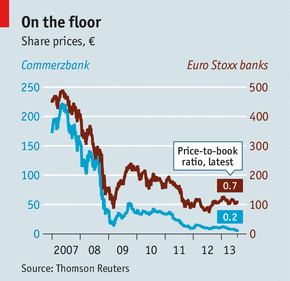
Brussels is demanding that Monte dei Paschi di Siena, the world's oldest bank, be subjected to tougher penalties
before it approves the €3.9bn state bailout of Italy’s third-biggest bank by assets.
Financial Times, July 28, 2013
Treasury secretary, Jacob J. Lew, effectively issued an ultimatum to Wall Street,
calling for the swift adoption of rules introduced through the Dodd-Frank financial overhaul law, which Congress passed in 2010.
New York Times, July 18, 2013
European Union reaches deal on failed banks
Another piece of a eurozone banking union that could eventually share the costs of future bank bailouts.
European taxpayers have extended about €1,600bn of support to banks since 2008.
Financial Times, June 27, 2013
Germany’s largest banks were €14bn short of the capital needed to meet incoming Basel III banking rules
The banks, which include the two largest by assets – Deutsche Bank and Commerzbank – managed to cut
their collective capital shortfall from €32bn in the second half of 2012,
as lenders responded to pressure from investors to improve their balance sheets ahead of the introduction of the Basel III rule book by 2019.
Financial Times 28 May 2013
Seven Dumb Things Bankers Say
Many of the arguments used to justify the size of the largest U.S. financial institutions simply don’t stand up to scrutiny.
It's important that folks in Washington keep this in mind as the political debate over
what to do about too-big-to-fail banks heats up.
Mark Whitehouse, Bloomberg, Apr 5, 2013
Critics of the big banks -- including the editors of Bloomberg View -- argue that the main advantage of being a JPMorgan-size giant is the ability to extract a subsidy from taxpayers. The larger and more systemically threatening banks are, the more confident they and their creditors can be that the government will bail them out in an emergency. This too-big-to-fail status allows such banks to borrow at lower rates than they otherwise would -- a perverse incentive that undermines market discipline, artificially bloats the financial sector and promotes the kind of credit binges that end in crises.
Michel Barnier, EU:s kommissionär för den inre marknaden, väntas inom kort lägga fram ett förslag om bankuppdelning baserat på idéer från Erkki Liikanen
Bankerna bör delas upp i två delar, där den traditionella bankverksamheten separeras från tradingen
Banker med garanterade insättningar förbjudas att ägna sig åt handel med allt för hög risk
SEB är den bank som skulle drabbas hårdast.
Finansmarknadminister Peter Norman gör allt vad han kan för att stoppa EU-processen.
Dagens Industri, 5 april 2013
What does a guarantee mean?
The argument for deposit insurance is that banks are inherently unstable, by virtue of their economic function;
they borrow money in the form of deposits (which can be instantly withdrawn) and lend to businesses on a longer-term basis.
The Economist, Buttonwood, March 19th 2013
Banks have a powerful incentive to get big and unwieldy.
The larger they are, the more disastrous their failure would be and
the more certain they can be of a government bailout in an emergency.
The result is an implicit subsidy
Why Should Taxpayers Give Big Banks 83 Billion USD a Year?
Bloomberg, Editors, 21 February 2013
The banks that are potentially the most dangerous can borrow at lower rates, because creditors perceive them as too big to fail.
Lately, economists have tried to pin down exactly how much the subsidy lowers big banks’ borrowing costs. In one relatively thorough effort, two researchers -- Kenichi Ueda of the International Monetary Fund and Beatrice Weder di Mauro of the University of Mainz -- put the number at about 0.8 percentage point. The discount applies to all their liabilities, including bonds and customer deposits.
Small as it might sound, 0.8 percentage point makes a big difference.
Multiplied by the total liabilities of the 10 largest U.S. banks by assets,
it amounts to a taxpayer subsidy of $83 billion a year.
Värdet av de så kallade implicita statsgarantierna för bankerna
Swedbanks Sverigechef Catrin Fransson:
”Det är inte skattebetalarna som bär risken, utan aktieägarna”
Vi behöver dock inte raljera utan kan istället konsultera en rapport från Riksbanken
Andreas Cervenka, SvD Näringsliv 14 februari
En rapport som även kollegan Carolina Neurath skrivit om nyligen.
/Därför slutade Borg skälla på bankerna/
Titeln är: ”Lämplig kapitalnivå i svenska storbanker – en samhällsekonomisk analys” och publicerades i debember 2011.
I rapporten konstateras att svenska bankers kapitalnivå i förhållande till de totala tillgångarna sjunkit stadigt, från cirka 17 procent på 20-talet till bara 4 procent för storbankerna idag.
Värdet av de så kallade implicita statsgarantierna för bankerna,
det vill säga den tysta överenskommelsen om att staten alltid finns där i bakgrunden med en hjälpande hand.
Garantin har inneburit att bankerna lånat i genomsnitt 0,86 procentenheter billigare. Det motsvarar 30 miljarder om året,
eller 270 miljarder under perioden 2002-2010.
Det utgör i sin tur drygt hälften (!) av storbankernas samlade vinster före skatt under samma tid, enligt Riksbanken.
Enligt vårpropositionen är riskerna i det svenska banksystemet i vissa avseenden större än i andra länder.
Regeringen ser att förnyad oro skulle kunna spridas till Sverige och påverka den finansiella stabiliteten.
De fyra största bankkoncernerna är nära sammanlänkade och deras gemensamma tillgångar är fyra gånger större än Sveriges BNP.
Dessutom är de svenska bankerna sammanlänkade med den internationella marknaden och svenska hushåll har en hög skuldsättning.
SvD Näringsliv, 15 april 2013
Sedan mitten av 1990-talet har hushållens skulder som andel av årlig disponibel inkomst, den så kallade skuldkvoten, ökat från 100 procent till 170 procent.
OECD, Internationella Valutafonden och senast Europeiska kommissionen har alla påpekat riskerna med den höga belåningsgraden.
"minst nio år med lågt resursutnyttjande"
Osäkerheten om den framtida konjunkturutvecklingen är stor och riskerna för en sämre utveckling överväger.
I euroområdet råder fortsatt stor osäkerhet om hur den statsfinansiella krisen kommer att utvecklas.
Politisk oro i flera euroländer kan leda till att turbulensen på de finansiella marknaderna återkommer.
Anders Borg, DN Debatt 15 april 2013
De fyra svenska storbankerna Swedbank, SEB, Handelsbanken och Nordea visar på samlade
tillgångar (utlåning) på 12 500 miljarder kronor.
Det samlade aktiekapitalet i samma banker är 565 miljarder kronor.
Det motsvarar att varje krona i kapital är belånad 22 gånger
Andreas Cervenka, SvD Näringsliv 11 februari 2013
De totala skulderna är därmed 11 935 miljarder kronor.
Som jämförelse kan nämnas att Sveriges BNP 2011 var cirka 3 500 miljarder.
Inom EU är bankernas totala tillgångar 47 000 miljarder euro, vilket motsvarar 366 procent av BNP.
(Det motsvarar över 400 000 miljarder kronor, svårt att förstå men sant).
Krockkudden för denna utlåning, eller kapitalandelen, är i genomsnitt strax under 5 procent, enligt Bank of International Settlements.
På 1800-talet var det inte ovanligt att bankerna hade så mycket som 50 procent i eget kapital. På den tiden bar nämligen ägarna fullt ansvar för alla förluster,
konstaterar Andrew Haldane, ansvarig för avdelningen för finansiell stabilitet på Bank of England i den här rapporten.
Finansministern har rätt, som när han i gårdagens DN-intervju pekade på
de svenska bankernas finansiering i utländsk valuta.
”Den är hög, den avviker från andra länders och den utgör ett väldigt tydligt riskmoment”, sade Anders Borg.
DN-ledare 28 december 2012
Faktum är att den så kallade krispolitiken från dag ett har handlat om en enda sak: att skydda och rädda bankerna.
Den turbulenta hösten 2008 bestämdes det att världens regeringar skulle skriva ut en blank check till alla stora banker och deras långivare.
Andreas Cervenka, SvD Näringsliv 23 december 2012
Om du lånar en miljon är det ditt problem. Lånar du en miljard kan det snabbt bli bankens huvudvärk.
Hundra eller tusen miljarder? Det får någon annan ta hand om, läs så kallat vanligt folk. Ganska få företagsägare kan tjäna enorma pengar på att trycka gaspedalen i botten och samtidigt surra fast ett lager av kvinnor, barn och pensionärer vid motorhuven som en skyddande krockkudde om det skulle inträffa tråkigheter längs vägen.
Detta är ingen slump. Tidningen Fokus beskrev nyligen i ett reportage hur den internationella banklobbyn lyckades övertyga europeiska politiker om nödvändigheten av att ”rädda” skuldtyngda länder som Grekland genom att i praktiken hålla banker och finansbolag skadelösa.
En manöver som ekonomiprofessorn Mats Persson kallar en av de största förmögenhetsöverföringarna någonsin från skattebetalare till bankägare.
It comes to something when one of the world’s major banks admits to fraud, but that’s what UBS did On Wednesday in agreeing to pay USD 1.5 bn (SEK 9.825 miljarder) in fines for rigging inter-bank interest rates.
Not that it seems to be creating much of a stir outside the financial pages.
It is as if we’ve been so anaesthetised by the events of the past five years that fines like this have lost their capacity to shock.
Jeremy Warner, Telegraph 19 Dec 2012
For the 12 or so banks involved in Libor manipulation, regulatory sanction is actually the least of their worries. No, it’s in the potential for compensation that the real threat to the banking system lies.
At any one time, the value of products based on Libor runs to hundreds of trillions of dollars. Potential losses from mis-stating Libor could therefore run to hundreds of billions of dollars.
Utdelningsfest för bankerna
Som så ofta i Anders Borgs retorik började meningen "Låt mig vara tydlig".
Sedan kom ännu en frustande kritiksalva mot banksektorn – som handlade om att de ska hålla i pengarna i stället för att dela ut till aktieägarna.
Om bankerna tänker lyssna på det? Nope.
Carolina Neurath, SvD Näringsliv 31 december 2012
De fyra storbankerna Swedbank, SEB, Nordea och Handelsbanken väntas tillsammans dela ut närmare 29 miljarder kronor på vårens årsstämmor.
Strax innan jul beslutade Riksbanken att förstärka den svenska valutareserven med 100 miljarder kronor.
Anledningen sades vara att Riksbanken i en krissituation ska kunna rädda svenska banker med utländsk valuta
Den avgående Riksgäldsdirektören Bo Lundgren: Ett demokratiskt problem. Det är rimligt att Sveriges Riksdag uttalar sig om hur stor valutareserven ska vara.
SvD Näringsliv 23 januari 2013
– Hur jag än rådbråkar min hjärna har jag svårt att se ett scenario där vi inte kan låna i dollar, det är en överdriven rädsla, säger Bo Lundgren.
Amorteringskrav
Anders Borg anser inte att amorteringskrav är aktuellt
se vad vi kan göra för att bankerna ska bli mindre beroende av växelkursberoende finansiering
SvD Näringsliv, 17 januari 2013
- Vi ska följa den plan vi har lagt fast - stärka kraven på bankernas kapitaltäckning, öka riskvikterna och sedan se vad vi kan göra för att bankerna ska bli mindre beroende av växelkursberoende finansiering, säger Anders Borg.
- Sedan får vi se hur hushållen reagerar. Vi vill inte åstadkomma en kraftig sättning på bostadsmarknaden.
Finansministern har rätt, som när han i gårdagens DN-intervju pekade på
de svenska bankernas finansiering i utländsk valuta.
”Den är hög, den avviker från andra länders och den utgör ett väldigt tydligt riskmoment”, sade Anders Borg.
DN-ledare 28 december 2012
Bankerna har sedan slutet av 1990-talet gjort sig mycket mer beroende av lån i utländska pengar, främst dollar.
Enligt Riksbanken handlar det om en ökning från motsvarande 200 miljarder kronor år 1998 till 1 500 miljarder år 2011.
Funding - Bankernas Upplåning, som skall rullas runt
– Poängen med en avgift eller kassakrav är att /bankerna/ ska gå ur en del av
sitt väldiga beroende av valuta- och swapmarknader och kanske mer gå över till en traditionell insättningsfinansiering
som ju är mer stabil och mindre riskfylld, säger Anders Borg.
DN/TT 14 december 2012
Finansminister Anders Borg (M) anser att bankerna ska vara med och betala för en ökad valutareserv, genom avgifter eller ökade kassakrav.
Det kan också vara ett sätt att få dem att öka den inhemska finansieringen, enligt Borg.
– Eftersom bankerna skapar en risk för den finansiella stabiliteten är det bra och klokt om de får ta ett ekonomiskt ansvar för det, sade Borg till journalister efter en debatt i riksdagen.
– Jag tror att vi långsiktigt behöver gå mot en större valutareserv. Vi har ett så pass stort banksystem och systemet har en så pass tung finansiering via valutamarknaderna att det är en risk för den finansiella stabiliteten.
Riksbanken lyfte nyligen på nytt bankernas stora beroende av utländsk finansiering som en risk för den finansiella stabiliteten.
Affärsbankernas lånestock i utländsk valuta är nästan lika stor som den är i svenska kronor.
Lånen i utländsk valuta hos affärs- och sparbankerna är tillsammans nästan 300 miljarder.
Det är mer än dubbelt så mycket som sparbankernas utlåning i svenska kronor.
Jag föreställer mig att de som har lånat upp dessa 300 miljarder inte avser att ha dessa lån när nästa devalvering kommer.
Rolf Englund på Nationalekonomiska Föreningen, januari 1990
Tittar man noga i bankernas balansräkningar kan man se att det är skillnad på å ena sidan ”inlåning” - insättarnas pengar – och å andra sidan ”upplåning” - pengar man lånat på marknaden bankerna emellan.
Banker kan komma i betalningssvårigheter om insättarna kommer och ställer sig i kö för att ta ut sina pengar – vilket är ovanligt och väl i Sverige senast drabbade HSB.
Banker kan också komma i betalningssvårigheter om de får bekymmer med sin ”upplåning”, dvs om andra banker, på goda eller dåliga grunder tror att banken har för mycket dåliga lån, inte vill rulla runt sina krediter.
Det var detta som gjorde den svenska finanskrisen i början på 90-talet akut.
Utländska banker misstrodde de svenska storbankerna med Handelsbanken och S-E-banken i spetsen. Mest misstrodde de Nordbanken och Götabanken.
- Enligt vår uppfattning stod det finansiella systemet i Sverige inför en kollaps den 24 september 1992. Det skrev Göran Lind och den nuvarande riksbankschefen Stefan Ingves i Ekonomisk Debatt nr 1/1998
Rolf Englund blog 15 augusti 2007
British banks will have to raise £20bn-£50bn of new capital or dramatically restructure their businesses
after the Bank of England made it clear it did not trust the way they value their books.
Financial Times, November 29, 2012
The BoE’s new Financial Policy Committee yesterday said banks must report capital ratios which reflect a “proper valuation” of their assets and a “realistic assessment” of the cost of recent scandals, such as the manipulation of Libor and mis-selling of insurance products.
The demand comes shortly after the International Monetary Fund called on European lenders to shore up balance sheets and adds to growing concerns that risk-weighted capital ratios are exaggerating the health of the global banking system.
The Faustian Bargain between States and Banks
States and banks have made a deal with the devil. Banks buy the sovereign bonds needed to prop states up in the tacit understanding that the states will bail them out in a pinch.
But experts warn that this symbiotic arrangement might be putting the entire financial system at risk.
Stefan Kaiser, Der Spiegel 23 November 2012
What's happening in Greece right now provides a dramatic example of how a state can make itself dependent on banks. The country is de facto insolvent and can no longer secure any loans on the financial markets. Nevertheless, it continues to be able to secure fresh funds by issuing short-term bonds, primarily to Greek banks, as it has recently to make up for a lack of liquidity as euro-zone member states continue to delay the release of the next tranche of emergency aid. Greek banks, for their part, finance their ailing country not only because the bonds have high yields, but also because they can deposit the bonds as collateral at Greece's central bank in return for fresh cash infusions of their own.
The books of many Spanish and Italian banks are also brimming with sovereign bonds issued by their home countries. They have taken out huge amounts of cheap loans at the ECB and reinvested most of the money in sovereign bonds.
The business logic behind this strategy is clear: While the ECB only charges 1 percent interest on its loans, the sovereign bonds have yields of up to 6 percent.
Beware the Faustian bargains of central banks
Scott Minerd, Financial Times August 21, 2012
In Goethe’s 1831 drama Faust, the devil persuades a bankrupt emperor to print and spend vast quantities of paper money as a short-term fix for his country’s fiscal problems. As a consequence, the empire ultimately unravels and descends into chaos.
Today, governments that have relied on quantitative easing instead of undertaking necessary structural reforms have arguably entered into the grandest Faustian bargain in financial history.
In the US, bank assets were close to 80 per cent of gross domestic product.
In the EU, they were 350 per cent.
EU has a banking sector that is not only too big to fail, but too big to save
Martin Wolf, Financial Times, 4 October 2012
It doesn’t involve wholesale deposits, collateralised debt obligations, or structured investment vehicles – or even an investment bank
It is the kind of fiasco that always brings down banks
Over-leverage, a commercial property bubble, poor supervision and hubris
John Gapper, Financial Times 30 May 2012
so where are all these increased profits coming from?
Click to find the answer
Banks will always blow themselves up, regulator warns
Policymakers will simply have to learn how to deal with banks that blow themselves up because it may be impossible to stop them
Telegraph 13 Nov 2012
Jackson Hole Paper 2
Destroying the Tower of Basel
Andy Haldane, the Bank of England’s executive director for financial stability is about to call on the world’s top economic officials
to cast aside more than 50 years’-worth of thinking on how the global financial system should be regulated.
Financial Times, Money Supply Blog, August 31, 2012
Banks, computer models and Risk
Nicholas Brady, former US Treasury secretary, Financial Times, August 26, 2012
Han har givit namn åt Brady Bonds, dollar-denominated bonds, issued mostly by Latin American countries in the late 1980s, a novel debt-reduction agreement for developing countries. Wikipedia
LDC Debt Crisis, Argentina, Brazil, Mexico etc, remember?
Jag skrev en bok om det, Den Stora bankkraschen, Timbro, 1983
Det vore synd, skrev jag, om västvärlden skulle drabbas av en djup ekonomisk kris just när Sovjetväldet håller på att vittra sönder ekonomiskt, politiskt och moraliskt.
The days when a large multinational bank could borrow money from depositors – backed by a government insurance guarantee – and then lend it out to customers at a reasonable spread are gone, at least as their main source of revenues. With net margins squeezed, banks have had to reach for profits in increasingly esoteric areas, such as derivatives trading, which rely on complicated computer models and mathematical algorithms few people understand.
Most of these activities boost profits by cranking up leverage, which the banks feel comfortable using because of confidence in their computer models.
This computer modelling is impressive stuff. However, while these models create the appearance of mathematical certainty about the relationships between markets and the way world events will affect prices, it is essential to recognise that, at their root, these models rely on man-made assumptions about human behaviour – not iron-bound laws of nature.
In addition, the behaviour of derivative markets can be episodic and illiquid at precisely the times we most need greater liquidity and confidence. No matter how sophisticated the maths or how large the data base supporting a model, no one can predict behaviour – human or market – with certainty. Inevitably, this means the formulas break down at the most critical times.
Banks may have to disclose profits from carry trades derived from 1 trillion euros in ECB loans
and exclude the money from bonus pools
Bloomberg May 4, 2012
Basel
Mitt i natten gav EU:s finansministrar upp om att komma överens om nya kapitaltäckningsregler för banker.
Finansminister Anders Borg (M) var nöjd
Regeringen har redan, med stöd av riksdagen, Finansinspektionen och Riksbanken, sagt att de fyra svenska storbankerna måste öka sitt kapital till 10 procent 2013 och 12 procent 2015.
Orsaken till att regeringen vill kunna ställa hårdare krav på svenska banker är att
Sverige har den näst största banksektorn i EU, mätt som andel av BNP.
SvD Näringsliv 3 maj 2012
Bankerna saknade 4.300 miljarder
De största globala bankerna skulle ha haft en brist på kärnkapital i juni 2011,
om de kommande Baselreglerna om kapitaltäckning hade trätt i kraft vid den tidpunkten.
DI/Bloomberg 12 april 2012
Varje gång ett viktigt förfallodatum inträffat, ända sedan euroländerna gav det första nödlånet i maj 2010,
har de privata placerarna lastat av en del av sina innehav på skattebetalarna
Mats Persson, professor i nationalekonomi vid IIES, Stockholms universitet,
ledamot av Kungliga Vetenskapsakademien och av Nobelkommittén för Ekonomipriset
SvD Brännpunkt 24 februari 2012
En del av Greklands statsskuld förfaller till betalning den 20 mars. Då ska femton miljarder euro betalas tillbaks till långivarna, och Grekland självt klarar inte detta. Men om euroländernas skattebetalare ställer upp med ett nödlån kan dessa pengar användas – inte till att hjälpa grekerna, men till att lösa de obligationer som förfaller den 20 mars. Det betyder att lånen i praktiken lyfts över från privata placerare (banker, försäkringsbolag, hedgefonder) till Europas skattebetalare.
Om nedskrivningen skjuts upp till efter den 20 mars slipper de privata långivarna undan, och förlusten drabbar skattebetalarna i stället. Därför använder sig de privata placerarna av alla tänkbara medel för att övertyga de politiska beslutsfattarna om att nedskrivningen måste ske ”i ordnade former” – vilket betyder ”inte nu, senare”. Men sedan är det dags för ett nytt förfall av grekiska obligationer i sommar, och kan man skjuta upp nedskrivningen då också – ja, då kan de privata placerarna lasta över ytterligare en del av sina innehav på skattebetalarna.
Detta har pågått i snart två år, ända sedan euroländerna gav det första nödlånet i maj 2010. Varje gång ett viktigt förfallodatum inträffat har de privata placerarna lastat av en del av sina innehav på skattebetalarna. Och fortfarande får vi efter varje toppmöte höra att nedskrivningen ska äga rum – men inte nu, utan senare, ”i ordnade former”.
I dag har nästan hälften av Greklands statsskuld lyfts över på euroländernas skattebetalare, genom EU:s stödfonder EFSF och EFSM, och genom Europeiska centralbanken ECB. En del har också lyfts över på den övriga världens skattebetalare (däribland Sverige) genom Internationella Valutafonden IMF.
Frågan är hur länge detta ska fortsätta.
Vad finns det egentligen för ekonomiska argument för att EU eller EMU ska låna ut pengar till de medlemsländer som inte har ordning på sina statsfinanser? Vad skulle hända om vi inte ställde upp, utan i värsta fall lät exempelvis Grekland göra en ensidig nedskrivning av sina skulder med kanske tjugo eller trettio procent?
för skattebetalarna vore det naturligtvis billigare om staten bara räddar bankerna från konkurs, och om man dessutom gör det på ett sådant sätt att man inte räddar dessa bankers aktieägare, utan bara den systemviktiga verksamheten.
Mats Persson, DN Debatt 2011-01-09
Det är bankerna man räddar, inte det grekiska folket
Man vinner tid, sägs det. Kanske man kan skjuta upp kraschen till efter nästa val?
Men under tiden lider det grekiska folket under en åtstramning som alla förstår inte kommer att lyckas att återställa den grekiska ekonomin.
Rolf Englund blog juni 2011
- Den stora risken var att Grekland skulle utlösa en kris i italienska, franska och tyska banker.
Nu finns i praktiken en EU-garanti för de utestående grekiska statsobligationerna.
Anders Borg, TT, SvD papper 22 februari 2012
The Violent, Scandalous Origins of JPMorgan Chase
Bloomberg May 3, 2012
Americans like to imagine that the Founding Fathers were virtuous and civic-minded giants bestriding the continent. But many of them kept a sharp eye on the main chance, alert to opportunities for personal profit.
The birth of the mega-bank JPMorgan Chase & Co. (JPM) may be traced to two such figures: Aaron Burr, the dark star of America’s early years, and his longtime nemesis, Alexander Hamilton, the first secretary of the Treasury
An enormous mismatch of assets and liabilities has lain
at the heart of international finance for the past several decades.
John Gapper, FT 16 Sept 2011
Retail and private bank deposits in the US, UK, Germany, Switzerland and France have been used to support the expansion by banks such as UBS, Barclays, Société Générale, Deutsche Bank and JPMorgan into global markets.
The euro was emblematic – a cross-border project supported by the political elite and by businesses about which many ordinary Europeans had doubts because they could not see what use it was to them.
But they tolerated it as long as it appeared to work, just as the growth of global investment banking was regarded as irrelevant to most people’s day-to-day lives.
In the cold light of day, it is not clear which is the more depressing:
that successive Greek administrations ever thought it sensible to borrow as much as they did,
or that banks and investors thought it wise to lend to them.
Robert Peston, BBC Business editor, 21 February 2012
Bankernas stora problem: Ytan = Basen x Höjden
Rolf Englund blog, 16 Februari 2012
All this is supposedly being done to save the euro. Nonsense. It's not actually about the euro.
Three years after the collapse of the Lehman Brothers investment bank, it is to forestall a new banking crash
which would supposedly have catastrophic, difficult to control consequences.
Der Spiegel, 23 Sept 2011
Ännu letar Europa i korrekt samtalston efter en lösning. Grälar politikerna så sker det fortfarande bakom lyckta dörrar.
Till oss talar de om “solidaritet” med Grekland och andra nödlidande,
fast det egentligen inte handlar om hjälp till skuldsatta stater utan till egna banker som lånat ut för mycket pengar.
Det skulle kunna kallas hyckleri, men låter alla rädda ansiktet.
Richard Swartz, DN 17 september 2011
Denna politiska korrekthet är ett slags sista livboj. Men den har samtidigt en baksida av just förljugenhet.
Den döljer vad alla redan vet eller åtminstone tror sig veta, och som den europeiska boulevardpressen redan skriver i svart på vitt. Den tyska, i en blandning av skadeglädje och den bedragnes indignation, har redan förslag till vilka grekiska öar som bör avträdas till Tyskland, och den grekiska, i en blandning av fördomsfullhet och självömkan, har redan sedan länge utrustat Angela Merkel med Hitlermustasch.
Ingenting av detta vore förstås praktisk politik eller har med verkligheten att göra. Men politikernas upprepade försäkringar att de har läget under kontroll är minst lika verklighetsfrämmande.
Boulevardpressen ger sannolikt en bättre bild av stämningsläget i Europa just nu än något av vad politikerna säger och försäkrar oss.
The 21 July agreement gives the €440bn European rescue fund discretion to use the money for bank bailouts
What we are dealing with here is not so much a sovereign debt crisis as a profound banking crisis.
Governnments must take immediate steps to recapitalise their banking systems.
Central bankers on Thursday moved to offer further liquidity support. Funding difficulties are only symptom of solvency crisis.
Jeremy Warner, DT September 16th, 2011
European banks are “grossly under-capitalized”
and the debt crisis is more serious for the region than the 2008 meltdown
“The euro cannot survive in its present form, it’s going to have to be reformed dramatically.
Gordon Brown, Bloomberg 16 Sept 2011
“In 2008, governments could intervene to sort out the problems of banks,” Brown said at the World Economic Forum in the Chinese port city of Dalian today. “In 2011, banks have problems, but so too do governments.”
“The euro cannot survive in its present form, it’s going to have to be reformed dramatically. We are I think at an hour to midnight in the way that we look at this issue.”
Regulators should stick to their commitments to implement bank capital rules agreed by the Basel Committee on Banking Supervision irrespective of opposition from lenders, Trichet said
Basel Top of pageSociété Générale, France’s third-biggest bank, has been stirring financial markets once again on concerns about its big holdings of the debt of shaky European neighbors like Greece.
Although its shares closed slightly up on Friday, Société Générale’s stock has fallen more than 40 percent since mid
Svenska bankers riskabla dollarlån uppgår till 450 miljarder kronor
Vice riksbankschefen Lars Nyberg satte nyligen fingret på en annan öm punkt. Under finanskrisen fick de svenska bankerna problem med att betala sina amerikanska lån eftersom det saknades dollar.
Riksbanken fick undsätta bankerna med dollar från valutareserven, men också med dollar som den amerikanska centralbanken Fed ställde upp med.
Patricia Hedelius, e24, 23 maj 2011
Till skillnad mot sina europeiska konkurrenter har de svenska bankernas kunder inte särskilt mycket pengar på sina inlåningskonton. Det innebär att de svenska bankerna måste låna betydligt mer själva för att kunna låna ut pengar till kunderna. I och med bolånefesten har bankernas sårbarhet kraftigt ökat.
De svenska bankerna har lånat cirka 1500 miljarder kronor med hjälp av så kallade bostadsobligationer. Mer än en tredjedel av obligationerna har sålts utomlands. Under finanskrisen tvingades svenska banker att köpa tillbaka sina egna bostadsobligationer som blev allt svårare och dyrare att omfinansiera.
Utländska långivare sålde nämligen ganska snabbt svenska obligationer för 120 miljarder kronor. Det tvingade Riksbanken att agera pantbank för bankernas bostadsobligationer. Sedan krisen har bankerna lånat ytterligare 400 miljarder kronor, en siffra som fortsätter att öka.
Jag vet inte varför majoriteten i Riksbankens direktion vill
öka valutareservens storlek med 100 miljarder kronor till 400 miljarder kronor
De svenska storbankerna framstår i dag som säkra i ett internationellt perspektiv och har ingen svårighet att låna pengar på marknaden.
Lars Nyberg, vice riksbankschef 1999–2012, DN Debatt 5 mars 2013
Svenska banker har skulder i utländsk valuta motsvarande på 1,5 gånger Sveriges BNP
Enligt Riksbankens senaste stabilitetsrapport är de svenska bankernas beroende av marknadsfinansiering bland de högsta i Europa.
Och en allt större del av pengarna till kredittörstiga svenska hushåll hämtas utomlands.
Andreas Cervenka, e24, 17 april 2011
Den som vill förstå hur det hänger ihop kan läsa en rapport från Riksgälden. Där konstateras att staten inte kan låta en bank gå i konkurs.
Om en bank inte kan betala sina fordringsägare hamnar räkningen hos Anders Borg.
De fyra storbankerna SEB, Swedbank, Nordea och Handelsbankens samlade balansomslutning (skulder och tillgångar) var vid utgången av förra året 11284 miljarder. Det kan jämföras med Sveriges BNP på 3260 miljarder. Det räcker med att en av dessa banker hamnar i stora svårigheter för att Sverige kan pensionera pratet om tigerekonomi.
I Europa är det bara Schweiz, Storbritannien och Nederländerna som har en större banksektor i förhållande till ekonomins storlek än Sverige, där siffran är drygt 400 procent av BNP.
Kommentar av Rolf Englund:
Vi har sett det förut.
- Krisen i banksystemet /1992/ utlöstes inte av en klassisk "bank run", utan av ett internationellt misstroende och finansieringssvårigheter på den internationella marknaden,
skrev Urban Bäckström i Ekonomisk Debatt nr 1/98.
Se även "Sverige i skuldfällan"
Låneskulden i utlandet 719 miljarder förra året
Rolf Englund, Svenska Dagbladet, Näringsliv, Ord mot Ord, 1991-05-30
There are a couple of things to say about Britain’s banks
They still pose a serious threat to the nation’s long-term stability and prosperity.
They rely for their profits – and for the huge bonuses paid to senior staff – on the fact that taxpayers are underwriting the risks.
Thus public subsidy is turned into private profit
Philip Stephens, FT, April 11, 2011
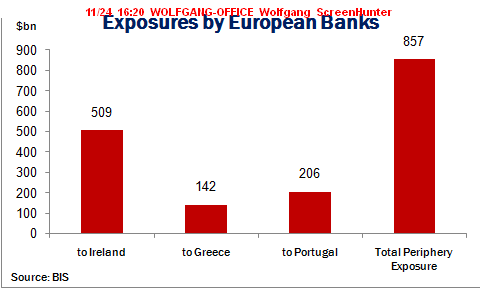
Den danska banken Amagerbanken har begärt sig själva i konkurs.
Banken blir ett fall för det statliga bolag, som bildats för att avveckla krisande banker.
Ekot 7/2 2011
Every intervention so far has pretended that the crisis is one of liquidity, which can be solved by making loans to the troubled banks and governments in question.
Since there has been no open admission of default or debt restructuring by any of the troubled nations, the banking sector has not been forced to write down debt and raise more capital.
Gavyn Davies, FT blog June 19, 2011
Even after Friday’s rebound, the FTSE-Eurofirst 300 banks index is 20 per cent below its February peak
and 66 per cent below its pre-crisis high. German banks index trades at only 0.4 times book value (lower than Greek banks)
from a lame 0.65 times book in the summer of 2009, just after the worst of the financial crisis.
FT Lex 22 July 2011
France’s banks have stayed flat, trading at 0.64 times. While they are so cheap, it is tempting to treat them as options on a positive outcome to the Greek crisis.
Frankfurter Allgemeine;
Deutsche Banken bangen mit Griechenland
The irony of all this is that Germany would take the biggest hit if there was the private sector participation that Angela Merkel and Wolfgang Schäuble are always asking for.
Eurointelligence 7 June 2011
German banks have become the most exposed financial institutions in terms of government bonds from the crisis ridden euro periphery, according to news reports in Frankfurter Allgemeine Zeitung and Financial Times Deutschland on the latest statistics from the Bank of International Settlement (BIS).
With holdings in the magnitude of $62bn (BIS statistics are in dollars) the German banks bypassed the French financial institutions which $58bn worth of government bonds from Greece, Ireland, Portugal and Spain.
The German lead is particularly pronounced in Greece with German banks holding bonds over almost $23bn. This does not even take into account the €7.4bn held by FMS Wertmanagement which took over all the bad loans that were previously in the books of Hypo Real Estate (HRE).
The irony of all this is that Germany would take the biggest hit if there was the private sector participation that Angela Merkel and Wolfgang Schäuble are always asking for.
German banks are among the biggest holders of eurozone sovereign debt
– with €46.5bn of bonds from the governments of Greece, Ireland, Portugal and Spain combined,
according to the most recent data from the Bundesbank
The banks have another €91bn of exposure to those countries’ banking sectors
James Wilson and Gerrit Wiesmann, FT, April 5, 2011
German president and SPD chief attack bankers
Like his predecessor Horst Köhler, who had called the financial markets “a monster”, German President Christian Wulff attacked the bankers by accusing them of being highly paid inhabitants of a parallel world.
Eurointelligence 1/4 2011
“The causes of the crisis have not been dealt with and we cannot say today that we have realized and effectively dealt with the dangers. Thanks to the numerous state sponsored bail-outs many of the bankers seem “to return to old habits”, Wulff went on. Whoever enjoys benefits must also be prepared to take losses, he said. Tax payers are not prepared to shoulder another multi billion bailout, he warned.
SPD chief Sigmar Gabriel was even more blunt. He said the bankers were the beneficiaries of a form of “loss socialism: Whenever something fails the taxpayer jumps in”.
It is hard to estimate the exact amount it will cost to recapitalise the European banking sector. I have heard a credible estimate of €100bn-€200bn.
Last year’s bank stress tests came up with a puny €3.5bn – a deliberate attempt by Europe’s regulatory authorities to misrepresent facts and mislead the public.
Everything I hear about the next round of stress tests tells me they will once again try to hide the truth.
Wolfgang Münchau. FT February 6 2011
This is not a joke
At the height of the financial crisis, the Federal Reserve allowed the world’s largest banks to turn more than $118 billion in junk bonds, defaulted debt, securities of unknown ratings and stocks into cash.
Collateral of those asset types made up 72 percent of the total $164.3 billion in market-rate securities pledged to the Fed on Sept. 29, 2008, two weeks after the bankruptcy of Lehman Brothers
CNBC Apr 1, 2011
No public money was lost in the Fed’s emergency lending programs, Chairman Ben S. Bernanke testified to the Senate Banking Committee in July, 2010. The loans didn’t represent permanent cash given to the dealers and had to be repaid the next day.
Citigroup, the nation's third-largest bank by assets, was on the verge of being closed by regulators the week of Nov. 24, 2008
as depositors rapidly withdrew money and the bank's counterparties declined to provide it credit, according to a government report
Huffington Post 13/1 2011
US banks have been bailed out again from huge potential writeoffs by loosey-goosey accounting accepted by the accounting profession and the regulators.
They are allowed to accrue interest on non-performing mortgages ” until the actual foreclosure takes place,
which on average takes about 16 months.
Forbesblog 12/1 2011
The statement that systemic breakdowns are surprisingly rare
in the free-wheeling Anglo-Saxon model is false.
Martin Wolf February 9, 2009
Click here
The destruction of wealth - that of investors, including more-or-less anyone saving for a pension - has been savage, running to tens of billions of pounds in each case.
But for RBS, the Financial Services Authority as watchdog has already ruled - just before Christmas - that there was no wrongdoing.
Robert Peston, BBC, 4 January 2011
Between the beginning of 2008 and the end of 2009, the losses on loans made by Lloyds and HBOS combined were £39bn
- of which the vast bulk was contributed by HBOS (which became a part of Lloyds two years ago).
Robert Peston, BBC, 4 January 2011
Gordon Brown:
'We have a major crisis in the euro area'
The enormous liabilities of the eurozone's banks are
a serious and substantial accident waiting to happen.
BBC, 8 December 2010
The FT has news from the Bank of International Settlements,
according to which Irish banks are extremely exposed to borrowers in Greece, Spain and Portugal,
Irish banks are also the fifth largest global lender in Italy.
Eurointelligence, 2 December 2010
One German bank, Depfa, an Irish-based subsidiary of HRE, accounts for much for the lending that goes on between Germany, Ireland, Italy, and Spain.
Raghuram Rajan, one of the few economists to see the financial crisis coming,
wins the Financial Times and Goldman Sachs Business Book of the Year award
FT 28/10/2010
Prof Rajan was the International Monetary Fund’s chief economist when he warned the 2005 Jackson Hole conference of central bankers that the seeds of disaster were being sown in the financial sector. His presentation jarred with the self-congratulatory tone of the conference, Alan Greenspan’s last as chairman of the US Federal Reserve. Prof Rajan writes in the book that the critical reaction from other participants made him feel “like an early Christian who had wandered into a convention of half-starved lions”.
As the third anniversary of the credit crunch approaches, I have been doing some reflecting on where I went wrong as an economist.
As the greenest student of economics will tell you, there are counter-examples to the principle that markets work and the financial system of the past five years has made a compelling case to be added to the list.
Tim Harford, FT August 3 2010
As Raghuram Rajan of the University of Chicago Booth School of Business and former chief economist of the International Monetary Fund notes in a thought-provoking new book, the underlying “fault lines” are still with us.
Martin Wolf July 13 2010
Do We Still Need Commercial Banks?
Raghuram G. Rajan
Rajan is Director of the NBER’s Program on Corporate Finance and the Joseph L. Gidwitz Professor at the University of Chicago’s Graduate School of Business.
Mervyn King says banking must be reinvented
I am away from the mothership for a few days, but I could not resist beaming back a few thoughts about
the remarkable speech given last night in New York by Mervyn King,
Banking: from Bagehot to Basel, and back again
Robert Peston, BBC 26 October 2010
Bank of England Governor Mervyn King has attacked the 'absurd' level of risk taken on by banks
He called the banks' reliance on short-term debt to meet funding needs in 2008 an "accident waiting to happen".
He said that, in future, banks must be forced to rely much more on equity to finance their risky activities.
BBC 26/10 2010
The world is facing the worst financial crisis since at least the 1930s “if not ever”
the Governor of the Bank of England said last night
DT 6 Oct 2011
In contemporary banks, leverage of 30 to one is normal.
Higher leverage is not rare.
Reform of regulation has to start by altering incentives
Banks central activity is creating and trading assets of uncertain value, while their liabilities are, as we have been reminded, guaranteed by the state.
This is a licence to gamble with taxpayers’ money. The mystery is that crises erupt so rarely.
Martin Wolf, Financial Times, June 23 2009
Central banks should not rescue fools
Martin Wolf, Financial Times, August 29 2007
Svenska banker tillhör tillsammans med banker baserade i Australien, Hong Kong och Singapore de bättre kapitaliserade bankerna.
En lärdom från den senaste finansiella krisen är dock att även om banker är relativt välkapitaliserade
kan detta förhållandevis snabbt förändras.
Budgetprop. våren 2011, sidan 47
Hösten 2008 var hela det finansiella systemet hotat.
Regeringen införde då en rad stödåtgärder, höjd insättningsgaranti, garantiprogram och kapitaltillskottsprogram.
och en stabilitetsfond som ska finansieras med avgifter från bankerna själva, som en slags försäkring.
Den innebär att bankerna ska betala 0,036 procent av sin balansräkning till fonden varje år.
Andreas Cervenka e24, 21 maj 2010
"Bankerna har god motståndskraft"
En ökad oro för länder med statsfinansiella problem kan leda till att de finansiella marknadernas funktionssätt påverkas. Detta kan i sin tur påverka de svenska bankernas tillgång till marknadsfinansiering.
Det finns också risker som grundar sig i den svenska bostadsmarknaden som kan medföra refinansieringsrisker för de svenska bankerna.
Riksbanken 2010-12-02
”Som banker fungerar i dag är den enda verkliga tillgången förtroende.
Om förtroendet försvinner är det slut – ungefär som ett pyramidspel”, säger Larry Kotlikoff.
Spelet kallas bråkdelsreserver eller fractional reserve banking.
Andreas Cervenka, SvD/e24, 2010-10-10
We need to learn from those countries that evidently did it right.
And leading that list is our neighbor to the north. Right now,
Canada is a very important role model.
PAUL KRUGMAN January 31, 2010
Bank runs have not recurred (after Norther Rock), in spite of the eurozone’s continuing crisis.
But the calm ignores a writhing nightmare of worries behind the doors of once unquestionably sound institutions from Dublin to Athens.
Financial Times December 8 2010
Queues outside branches as anxious depositors at Northern Rock tried to retrieve their cash: the scenes of Friday September 14 2007 are by now firmly embedded in British banking history as one of the industry’s most shameful episodes. A run on a bank was not seemly in a modern European economy.
Whatever the reasons – sweeping government guarantees in Ireland, growing confidence that the European authorities will always be there with a safety net – archetypal bank runs have not recurred, in spite of the eurozone’s continuing crisis.
The banks’ undoing in Ireland and Spain – just as in the US earlier in the crisis and, to an extent, the UK too – stemmed from the same root cause: an overdeveloped, overheated and overpriced property market that since 2007 has collapsed in a heap.
The supply of deposits is sadly insufficient, leaving the European Central Bank as a vital liquidity supplier of last resort. The use of its emergency facility has increased sharply in the past couple of months – much to the frustration of Jean-Claude Trichet, ECB president, who wants to close that window.
Homeowners - the root of all evil?
Villaägarna - Roten till allt ont?
There was a common ingredient in most /Bank/ failures:
an over-reliance on wholesale borrowing.
As the Western banking system has expanded over the past two decades
its assets have grown to about 2.5 times its deposits
The Economist print, September 3rd 2009
Bear Stearns and Northern Rock, largely reliant on short-term borrowing, faced the modern version of a “run” when their counterparties refused to roll over debts. Most other banks suffered some loss of confidence, forcing them to turn to funding from the state.
In America, the euro zone and Britain, central-bank lending and public guarantees of bank bonds have reached about $2.7 trillion.
The collapse of Lehman Brothers has shown the havoc that can ensue when large, interconnected banks implode.
Quite apart from the fact that the world is littered with banks which are too big to fail (but too costly to keep saving),
the world also has banks that are too big to manage.
Gillian Tett, Financial Times June 18 2009
After the US, the country with the biggest banking problem is probably Germany.
a bank can apply to set up its own bad bank
It buys the structured securities from the bank at 90 per cent of book value, guaranteed by the government
Wolfgang Münchau, Financial Times May 17 2009
The decision to guarantee deposits raises large questions.
Deposit liabilities are nationalised, while the financial system’s assets, albeit regulated, remain in private hands.
Martin Wolf, Financial Times September 19 2007
If you do not understand the implications of that, you have not paid attention to what has been happening in the financial sector.
I must declare an interest: members of my immediate family had money in Northern Rock.
As an individual, therefore, I am pleased. As a hard-nosed commentator, I deplore it.
Yet there are other and wider questions. As long as governments cannot – or will not – let ordinary depositors suffer inconvenience, moral hazard runs rife. The answer must surely include tighter regulation: more capital, perhaps an obligation to obtain long-term subordinated debt and specific liquidity requirements.
...
The Global Crisis of LegitimacyThe greatest systemic risk is not an economic concept but a political one
There were those who were concerned that a united Europe would exist to benefit the elites, rather than the broader public.
George Friedman May 4, 2010 at John Mauldin
Systemic risk emerges when it appears that the economic elite used the law's allocation of risk to enrich themselves in ways that undermined the wealth of the nation. Put another way, the crisis occurs when it appears that the financial elite used the politico-legal structure to enrich themselves through systematically imprudent behavior while those engaged in prudent behavior were harmed, with the political elite apparently taking no action to protect the victims.
The crisis was rooted in the appearance that it was triggered by the behavior not of small town banks or third world countries, but of the global financial elite, who took advantage of the complexities of law to enrich themselves instead of the shareholders and clients to whom it was thought they had prior fiduciary responsibility.
We see a similar crisis in Europe. The financial institutions in Europe were fully complicit in the global financial crisis. They bought and sold derivatives whose value they knew to be other than stated, the same as Americans. Though the European financial institutions have asserted they were the hapless victims of unscrupulous American firms, the Europeans were as sophisticated as their American counterparts. Their elites knew what they were doing.
This goal always created unease in Europe. There were those who were concerned that a united Europe would exist to benefit the elites, rather than the broader public. There were also those who believed it was designed to benefit the Franco-German core of Europe rather than Europe as a whole. Overall, this reflected minority sentiment, but it was a substantial minority.
Halting the financial doomsday machine
The combination of state insurance (which protects creditors)
with limited liability (which protects shareholders) creates a financial doomsday machine.
Martin Wolf, FT April 21 2010
The doomsday cycle
Over the last 30 years, the US financial system has grown to proportions threatening the global economic order.
This column suggests a ‘doomsday cycle’ has infiltrated the economic system and could lead to disaster after the next financial crisis.
Peter Boone, Simon Johnson, 22 February 2010
Very Important Aritcle
”Som banker fungerar i dag är den enda verkliga tillgången förtroende.
Om förtroendet försvinner är det slut – ungefär som ett pyramidspel”, säger Larry Kotlikoff.
Spelet kallas bråkdelsreserver eller fractional reserve banking.
Andreas Cervenka, SvD/e24, 2010-10-10
Enkelt uttryckt går det ut på att varje tia som du sätter in på ett bankkonto kan banken förvandla till 90 nya kronor som den an tingen kan låna ut eller som i fallet med HQ Bank, Lehman Brothers eller Bear Sterns satsa i diverse exotiska värdepapper.
Limited purpose banking beskrivs i Larry Kotlikoffs bok Jimmy Stewart is dead: ending the world’s ongoing financial plague.
How to take moral hazard out of bankingNiall Ferguson and Laurence Kotlikoff, FT December 2 2009
European banks
Waiting for the big one
The Economist print June 3rd 2010
Some banks are becoming dangerously addicted to the medicine the ECB has been administering. They can easily borrow from the ecb and then invest the proceeds in higher-yielding government bonds.
Mr Ryan of UBS, reckons this “carry trade” may account for as much as 40% of the profits posted by some smaller Spanish banks and 20% at bigger ones.
Banks have also reduced the maturity profile of their own borrowing, rather than paying higher rates for safer longer-term funds. When all banks make the same decision this is a form of collective madness because it makes the system vulnerable to market disruptions. Moody’s, a ratings agency, notes that the average lifespan of new bank debt has fallen to its lowest level in at least 30 years.
Trading, alltså en bank som för egen räkning köper och säljer värdepapper för att tjäna pengar
är en verksamhet som är helsnurrig av flera skäl
Andreas Cervenka, SvD/e24 2010-09-05
Nine European banks have balance sheets that are larger than the GDP of their country.
Eurointelligence 28/1 2010
The Volcker rule – that deposit-taking banks would not be able to engage in proprietary trading, or to own hedge funds or private equity firms – is the first time any government has proposed a sensible structural remedy for the problems created by bailing out banks in 2008.
John Gapper FT January 27 2010
Royal Bank of Scotland
RBS was bailed out by the government. The valuation was about double that of later, comparable American bailouts.
Much of this money was gobbled up by junior bondholders and other creditors, who in any normal insolvency would have lost their shirts.
The debt leverage that sustained a £2.2 trillion balance sheet – at that time the biggest in the world – is a thing of the past.
Jeremy Warner, Telegraph 11 June 2015
Världen har kommit in i en superkonjunktur
Det hävdar Charles Gave, som hör till ett läger av nationalekonomer som avfärdar alla varningar för depressioner och dödsspiraler.
Gunnar Örn, DI 2007-04-25
Till optimistlägret hör också Andrew McLaughlin, chefsekonom på Royal Bank of Scotland, och Anatole Kaletsky, tidigare finansredaktör på Financial Times och The Times.
Bank of England provided almost 62 billion pounds (USD 102.9 billion) in emergency loans
to Royal Bank of Scotland and HBOS at the height of the credit crisis last year.
The money was repaid in full by January this year
A spokesman for the prime minister said it was "a powerful reminder" of how the banking system had nearly collapsed.
CNBC and BBC 24 Nov 2009
As a result of Lehman’s bankruptcy, millions of people have needlessly lost their jobs, hundreds of thousands of homes have been needlessly repossessed and trillions of dollars, pounds and euros have been needlessly added to the debt burdens of governments around the world.
I repeat that word needlessly because most of these losses would not have happened if Lehman had been supported or wound down in an orderly way.
Anatole Kaletsky, The Times, September 18, 2009
Why a Lehman deal would not have saved us
Niall Ferguson, FT September 14 2009
The Bank of England is examining whether Britain's biggest banks should
formally separate their investment banking and retail banking operations
The Times April 9, 2009
News that such a move is under discussion at such a high level will send fresh shudders through the UK banking sector, still reeling from the fallout of toxic debt and the credit crunch.
It seems that hedge funds have been designated for ritual sacrifice, even though they played no more than a cameo role in the genesis of this crisis.
It was not they who took on extreme debt leverage: it was the banks
– up to 30 times in the US and nearer 60 times for some in Europe that used off-books "conduits" to increase their bets.
Ambrose Evans-Pritchard, Daily Telegraph April 2009
/Bank/ Nationalisation carries risks, but
it may still be the best way to deal with American banking’s undead
The Economist print Feb 26th 2009
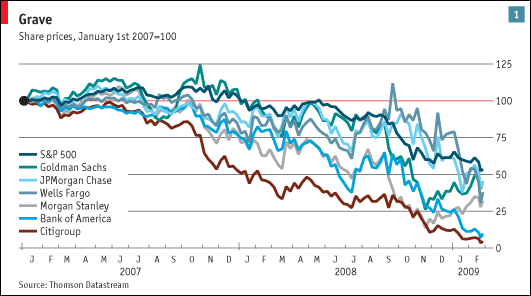
As The Economist went to press, the government was in talks with Citigroup over what would in essence be partial nationalisation: the conversion into common equity of a chunk of its preferred stock, obtained in return for pumping capital into Citi last year. This would give it a stake of up to 40%—eight times the holding of Prince Alwaleed bin Talal, the most influential existing shareholder—and voting power to match.
"As president Ronald Reagan’s secretary of the Treasury, I abhor the idea of government ownership.
Unfortunately, we may have no choice.
US may be repeating Japan’s mistake by viewing our current banking crisis as one of liquidity and not solvency.
Most proposals advanced thus far assume that, once confidence in financial markets is restored, banks will recover.
James Baker, Financial Times March 1 2009
Beginning in 1990, Japan suffered a collapse in real estate and stock market prices that pushed major banks into insolvency. Rather than follow America’s tough recommendation – and close or recapitalise these banks – Japan took an easier approach. It kept banks marginally functional through explicit or implicit guarantees and piecemeal government bail-outs.
The resulting “zombie banks” – neither alive nor dead – could not support economic growth
US may be repeating Japan’s mistake by viewing our current banking crisis as one of liquidity and not solvency. Most proposals advanced thus far assume that, once confidence in financial markets is restored, banks will recover.
As president Ronald Reagan’s secretary of the Treasury, I abhor the idea of government ownership – either partial or full – even if only temporary. Unfortunately, we may have no choice. But we must be very careful.
The true balance sheet of US Investment banks
There are two sides of the balance sheet: the left side and the right side.
On the left side, there is nothing right.
And on the right side, there is nothing left.
Unknown originator, somewhere on the internet, october ? 2008
John McCain: (not Naomi Klein)
"Wall Street has betrayed us.
They've broken the social contract between capitalism and the average citizen"
John McCain, September 16, 2008
Yankee bonds
– dollar-denominated bonds sold by non-American companies into the US
So far this year, 773 have been issued, raising $412.9bn
– beating the $378.1bn raised up to this point last year
The attraction of the US market is lower funding costs.
Banks are the biggest issuers.
Eurointelligence 24/8 2010
Goldman Sachs and other banks should give up their bank status if they want to avoid the ban on proprietary trading proposed by the White House,
Paul Volcker, head of President Barack Obama’s Economic Recovery Advisory Board, FT February 12 2010
Bankerna är ett oligopol som tjänar enorma pengar på att ge dyra lån till företagen.
Hans företag tvingas betala 5-6 procent medan hushållen med rörlig ränta bara betalar drygt 1 procent.
Problemets kärna är bankernas kapitaltäckningsregler
PR-firman Kreabs grundare Peje Emilsson SvD/E24 2010-02-05
Baselkommittén
Dåliga nyheter för SEB, Swedbank, Handelsbanken och Nordea.
De svenska bankerna har väldigt bra kvalitet på sina tillgångar, exempelvis mycket bostadsutlåning.
Men det får man alltså inte tillgodoräkna sig i det nya måttet.
SvD/e24 2009-12-18
– De svenska bankernas skuldsättning kommer framstå som enormt hög.
Jag skulle tro att de svenska storbankerna hamnar på en skuldkvot kring 40 eller mer.
Jämför det med snittet i övriga Europa, som kanske ligger kring 20–30, säger Finansinspektionens chefsekonom Lars Frisell, som själv sitter med i Baselkommittén .
Yankee bonds
– dollar-denominated bonds sold by non-American companies into the US
So far this year, 773 have been issued, raising $412.9bn
– beating the $378.1bn raised up to this point last year
The attraction of the US market is lower funding costs.
Banks are the biggest issuers.
Eurointelligence 24/8 2010
Dutch insurer Aegon said it may buy a small U.S. thrift company
to qualify for potentially more than $1 billion in U.S. government support
CNBC 18/11 2008
We're All Banks Now
Is there any financial institution that does not want to become a bank or a bank holding company?
Mish 16/11 2008
American Express to Be Bank Holding Company
GMAC may become a bank holding company
Raymond James To Become Holding Company
CIT seeks bank status, TARP funds
The end of American capitalism as we knew it
There is a long-standing argument that "there is no real case for private ownership of deposit-taking banking institutions
Willem Buiter, Financial Times September 17, 2008
Do We Still Need Commercial Banks?
Raghuram G. Rajan
Rajan is Director of the NBER’s Program on Corporate Finance and the
Joseph L. Gidwitz Professor at the University of Chicago’s Graduate School of Business.
Låneboomen förvärrades av ett beslut 2004 från den amerikanska finansinspektionen, SEC, att låta de fem investmentbankerna låna ut 40 gånger volymen av det egna kapitalet (mot tidigare 12).
Hans Bergström, kolumn DN 2008-10-09
Detta regleringsbeslut var katastrofalt. Tre av de fem har nu gått omkull och utlöst en total förtroendekollaps. (Inom parentes kan noteras att John McCain har varit en ledande reformförespråkare rörande såväl SEC som Fannie och Freddie, medan Barack Obama är den senator som fått störst kampanjbidrag från F&F).
Beginning in 1992, Congress pushed Fannie Mae and Freddie Mac to increase their purchases of mortgages going to low and moderate income borrowers.
Russel Roberts, Wall Street Journal 3/10 2008
How we have learned the limits to free markets – the hard way
The real economy is engineering plus social organisation. Finance is applied mathematics, mixed with human nature.
It has recently become clear what a combustible mixture the latter is.
Roger Bootle, Daily Telegraph, 21 Sep 2008
The truth is that absolutely free markets and high finance don't mix. Unrestricted financial markets become a machine for blowing bubbles which endanger the stability of the economic system – and threaten capitalism itself. The economics of the corner shop are not the same as the economics of complex derivatives.
Banking is too important to be left to the bankers.
How U.S. banks sold home equity loans
International Herald Tribune, August 15, 2008
Credit crunch a year on: The losers
However you look at them, the figures remain startling.
BBC 3 August 2008
Total bank exposure to the US sub-prime mortgage market, whose collapse infected wider credit markets and triggered an almost overnight liquidity drought, is still far from clear.
The Federal Reserve has put the cost to the bottom line of banks and other lenders of their sub-prime misadventures at $100bn.
Taking into account other failed mortgage loans, devalued mortgage-backed securities and general bad debts, the International Monetary Fund said potential losses could top $945bn.
It is almost exactly a year since the European Central Bank was forced to inject €95bn into the eurozone banking system
Financial Times
Banks with federally insured deposits, which are limited in the risks they’re allowed to take and the amount of leverage they can take on — have been pushed aside by unregulated financial players.
We were assured by the likes of Alan Greenspan that this was no problem: the market would enforce disciplined risk-taking
Paul Krugman 28/7 2008
I Danmark tvingas nu Nationalbanken, alltså landets riksbank, att ingripa för att hindra Roskilde Bank att gå omkull.
Ekot 25/8 2008
: Nationalbanken och en bankorganisation, bildad för att just ta hand om banker i svårigheter, tar över. Det kommer att kosta omkring 5,5 miljarder kronor.
Affären har godkänts av finansministeriet och en stor del av notan får dom danska skattebetalarna stå för. Bankens aktieägare kommer sannolikt att förlora sina pengar, men dess omkring 100 000 kunder, kommer att hållas skadeslösa.
Bankernas problem har bland annat sin bakgrund i den negativa utvecklingen på den danska fastighetsmarknaden där huspriserna stadigt är på väg neråt och har varit så en längre tid. Det tillsammans med dålig kreditvärdering ger bankerna förluster.
Nu befarar man att fler av de regionala bankerna i Danmark kan råka illa ut och bankaktierna faller på måndagen på den danska börsen.
De nordiska bankerna har tillsammans en utlåning på 450 miljarder kronor i Baltikum.
Störst utlåning har Swedbank och SEB med 182 miljarder kronor respektive 139 miljarder kronor
DN 2008-07-03
Misslyckat försök göra en pudel
The world’s leading banks – represented by the Institute of International Finance – concurred with a conclusion long ago reached by the rest of the world:
they screwed up, the credit crisis is largely their fault, and everybody else is suffering for their errors.
The admission may not be enough to prevent a dangerous backlash.
Financial Times editorial April 11 2008
Most people have noticed that when the music stopped – as Chuck Prince might have put it – some of the dance partners left the floor with their pockets stuffed with cash, while others went home to lock up the houses they no longer owned and post the keys back to the bankers.
By accepting much of the blame and proposing various measures to get its house in order, the banking industry hopes to avoid further regulation. It will not succeed. The political atmosphere has become too febrile for that: the mob is at the gates baying for justice.
Fed bailout of Bear Stearns
Remember Friday March 14 2008
it was the day the dream of global free-market capitalism died.
Martin Wolf, Financial Times, March 26 2008
Contrary to popular belief, the stock market crash of 1929 wasn’t the defining moment of the Great Depression.
What turned an ordinary recession into a civilization-threatening slump was the wave of bank runs that swept across America in 1930 and 1931.
This banking crisis of the 1930s showed that unregulated, unsupervised financial markets can all too easily suffer catastrophic failure.
As the decades passed, however, that lesson was forgotten — and now we’re relearning it, the hard way.
To grasp the problem, you need to understand what banks do.
Paul Krugman, New York Times 21/3 2008
Mr. Bernanke and his colleagues at the Fed are doing all they can to end that vicious circle. We can only hope that they succeed. Otherwise, the next few years will be very unpleasant — not another Great Depression, hopefully, but surely the worst slump we’ve seen in decades.
Even if Mr. Bernanke pulls it off, however, this is no way to run an economy. It’s time to relearn the lessons of the 1930s, and get the financial system back under control.
The financial system is a subsidiary of the state.
A creditworthy government can and will mount a rescue.
That is both the advantage – and the drawback – of contemporary financial
capitalism.
Martin Wolf, Financial Times February 26 2008
Highly recommended
Banks are machines for taking liquidity risk.
It is what they do: borrow short-term deposits and make long-term loans.
That makes adequate regulation of bank liquidity crucial
Financial Times editorial, February 13 2008
Like a 1930s bank run
There are now plans to split up the companies
that insure bonds and derivatives based on mortgages and buyout loans.
Jim Jubak 22/2 2008
Bankers, like gangs, just get carried away
“So long as the music is playing, you’ve got to keep dancing. We’re still dancing.”
Chuck Prince, former chairman and chief executive of Citigroup, was interviewed by this paper only a month before the music stopped.
A few weeks later he was out of a job.
With these comments, he got to the heart of the banking crisis.
John Kay, FT February 12 2008 18:15
Groups routinely demonstrate behaviour that few if any members would choose to adopt as individuals. Look at teenage gangs, soccer hooligans, religious zealot
Before the mysteries of structured credit there were the mysteries of witchcraft; before investment banks used initial public offerings to turn dotcom concepts into billions of dollars alchemists claimed to turn base metals into gold.
Shared values and beliefs create a group identity. No matter that the beliefs may be absurd or the values contemptible: that Salem was not besieged by witches, the US was not threatened by communist infiltration, that greed is not good and that suicide bombers will not be greeted in paradise by 71 virgins. The very improbability of the belief, the unacceptability of the values, reinforces their social function; these factors distinguish the real members of the group from the less committed.
It is only halfway through November but I think we can already declare the winner of the 2007 Quote of the Year competition.
It is Chuck Prince, the former chairman and chief executive of Citigroup.
As Mr Prince departs, however, it should be noted that his statement was not, as history will record it, idiotic.
His offence was not that he misunderstood or misstated how banks have operated over the past few years but that he blurted out the truth rather too openly.
Note that he did not say “if” the music stops but “when”.
He recognised then – as did others – that the period of extraordinarily easy money that had prevailed since 2002 was bound to end.
John Gapper, FT November 14 2007
Människan är ett flockdjur. Det förklarar kanske vårt intresse för Paris Hilton?
Rolf Englund blog 2008-01-09
Med länk till Hans Zetterberg mm
The Rising Risk of a Systemic Financial Meltdown:
The Twelve Steps to Financial Disaster
by Nouriel Roubini, February 11, 2008
at John Mauldin
A fundamental question arises:
is the financial system broken, corrupt and in need of reform;
or is the system sound, yet subject to external pressures, notably heavy monetary stimulation,
with which it could not easily cope?
On that diagnosis rests the future of our highly liberalised financial markets.
Financial Times editorial January 25 2008
If the US suffers a recession in 2008 or 2009 it will not be due to an industrial decline or an oil price shock. It will be a recession that began in the financial system. The response of the general public is confusion, tinged with horror, at how intangible finance can impinge on their daily lives.
The rogue trader who cost SocGen €5bn - FT
Bankerna har uppträtt vårdslöst de senaste tio åren och har riskerat allas välfärd. Vem som helst kunde få vilket lån de ville så sent som för tre år sedan.
Jag återvände från Singapore 1999, ansvarig för de förluster på 862 miljoner pund som knäckte Storbritanniens äldsta investeringsbank, personligen dömd som ansvarig för 100 miljoner pund, och fick ändå inom loppet av en vecka erbjudande om fem olika kreditkort.
Nick Leeson, SvD Brännpunkt 21/9 2008
Rogue Trader (Paperback)by Nick Leeson - Amazon
Nobody wants to see a repeat of the 1930s when bank failures ushered in the Depression.
However, the bargain that was made in the 1930s has been broken.
If commercial banks were to be protected, they should not be allowed to gamble in the securities markets.
The Economist print, Jan 31st 2008
While the authorities are happy to leave banks alone when times are good, they are quick to intervene at the first hint of crisis.
This has been shown by the rescue of Northern Rock, steep interest-rate cuts by the Federal Reserve, the European Central Bank's enormous intervention in the money markets last year
The moral hazard is clear; it is not just rogue traders, such as Jérôme Kerviel at Société Générale, who are given huge incentives to take risk. Their bosses are too. One might well describe investment banks as hedge funds backed by an implicit government guarantee.
Two points shine out about the financial system over the past three decades:
its ability to generate crises, and the mismatch between public risk and private reward.
Martin Wolf, FT February 5 2008
The bigger point still, however, concerns macro-prudential regulation. As William White of the Bank for International Settlement has noted, banks almost always get into trouble together.
Making Macroprudential Concerns Operational, 2004, www.bis.org
The most recent cycle of mad lending, followed by panic and revulsion, is a paradigmatic example.
Central banks create an upward-sloping yield curve whenever banks are decapitalised, thereby offering a direct transfer to any institution able to borrow at the low rate and lend at the higher one.
A financial sector that generates vast rewards for insiders and repeated crises for hundreds of millions of innocent bystanders is, I would argue, politically unacceptable in the long run.
Förra året tjänade de fyra storbankerna drygt 91 miljarder kronor
på att ge bankkunderna lägre ränta än utlåningsräntan. Det är en rekordsiffra.
DN 28/2 2008
Anders Borg kräver omedelbara reduceringar av bolåneräntorna.
"Godisskålen är inte till för att bankerna ska vara där och nalla", säger
Anders Borg (m) efter att Riksbanken meddelat sin sänkning av reporäntan till 2 procent.
Di 2008-12-04
European Union states have underwritten their financial sectors
with 4.5 trillion euros ($5.9tn) of aid since the banking crisis hit.
Sweden 161.6 bn euros
BBC December 1, 2010 with nice list
SEB:s vd Annika Falkengren
Vinst 4,3 miljarder bara under det sista kvartalet.
Bonusfest på 1,7 miljarder - en bonusökning med 107 procent.
Och nu väntar höjd utdelning för familjen Wallenberg och de andra aktieägarna.
Expressen 4 feb 2011
Kreditförluster har också slutat att existera inom SEB och istället får banken nu tillbaka pengar som tidigare har klassats som förlorade. En del av förklaringen är att det går bättre i Baltikum för SEB.
Full textSEB:s vd Annika Falkengren avstår från sin bonus för 2008.
För 2007 fick SEB-chefen 4 miljoner i bonus och därmed
totalt 12,1 miljoner kronor i ersättning.
DI 2009-02-05
But bank profits are up tremendously; so where are all these increased profits coming from?
Not to worry! By borrowing trillions of dollars from the FED at ¼% and lending the money right back to the Government by buying FHA bonds paying 4%, that require no reserves be kept, so naturally they show big increases in profits
Aubie Baltin, June 2010
By the way, what ever happened to all those Toxic Assets that were on the banks' books? Oh, they no longer count since they do not have to mark to market anymore
Thanks to Ben Bernanke, banks can borrow as much as they want for practically nothing
... plow that cash into longer-dated U.S. Treasuries... and make perpetually huge profits with little to no risk.
It's like a permanent backdoor bailout subsidy.
Marcet Oracle, Apr 20, 2010 By: Justice_Litle
Det finns jätterisker att det inte fungerar.
Att Irland kommer att misslyckas att få till sin ekonomi i alla fall – att de kommer att gå i statsbankrutt
och vara tvungna att be om att få sina skulder nedskrivna.
Om det händer har privata skulder i banker och finansbolag flyttas över till skattebetalarna.
Ekots Staffan Sonning 22/11 2010
Tyska och brittiska banker har stora fordringar på Irland
och det skulle slå mycket hårt om man på förfallodagarna fick svaret: vi kan inte betala.
SvD 23/11 2010
One can interpret the intransigence of the German government and its EU allies in two ways.
First, they understand neither economics nor politics. As Tallyrand said of the Bourbons, “They have learned nothing, and they have forgotten nothing.”
Alternatively, policy makers in Germany – and in France and Britain – are scared to death over what Ireland restructuring its bank debt would do to their own banking systems. If so, the appropriate response is not to lend to Ireland – to pile yet more debt on the country’s existing debt – but to properly capitalize their own banking systems so that the latter can withstand the inevitable Irish restructuring.
Barry Eichengreen
The two largest creditors to Ireland are /banks in/ the UK and Germany,
with loans outstanding of $149bn and $139bn respectively
An Irish bank default would affect the German and British banking systems directly, and require significant domestic bank bail-outs.
Wolfgang Münchau, FT November 21 2010
The key issue in Europe now is not the merits of the single currency but the parlous state of its banking system.
Philippe Legrain, Eurointelligence 11.01.2011
För att räkna ut den verkliga avkastning som tillexempel en köpare av statsobligationer får på sina utlånade pengar brukar man tala om realränta, det vill säga räntan justerad för inflation.
I USA är den ettåriga realräntan idag minus 3 procent, i Storbritannien minus 4 procent, i Tyskland minus 1 procent.
Även i Sverige är realräntan negativ
Andreas Cervenka, SvD Näringsliv 20 maj 2011
The unpopularity of very low interest rates leads to what is known in financial circles as “the search for yield”.
It is this that lies behind the banking scandals, the epidemic of frauds and, on a lesser level,
the public toleration for bankers’ refusal to pass on to their customers the very low “policy interest rates” established by central bankers
Samuel Brittan, FT March 31 2011
Today’s rock-bottom yields, however, have less to do with disinflation and more to do with providing fuel for an asset-based economy that promotes unsustainable wealth creation and a false confidence in perpetual capital gains.
Bill Gross, Pimco, February 2011
Are zero interest rates a subsidy to banks?
Back and forth between Leijonhufvud and Krugman
Axel Leijonhufvud: The two pioneers of modern monetary economics – Irving Fisher and Knut Wicksell ...
Eurointelligence 26/1 2011
In a Vox column, Axel Leijonhufvud argues that low Central Bank interest rates are an implicit subsidy for banks, which can borrow money for free and place it in on interest-earning treasuries, thus making a profit. This policy of implicit subsidy, at the expense of the taxpayer, is pursued in order to recapitalize the banks without having to take an equity stake (a politically costly move).
Paul Krugman answers that low (short-term) interest rates are not necessarily a subsidy: a bank borrowing from Fed to buy long term treasuries earns more than it pays, but immobilizes money for longer.
Both authors agree, though, that there is downside risk to this strategy: a return to normal interest rates could trigger losses, and optimistic numbers on bank earnings may not be taking sufficiently that possibility into account.
Full textThe two pioneers of modern monetary economics – Irving Fisher and Knut Wicksell – were passionately concerned to find monetary arrangements that would insure against arbitrary redistributions of income and wealth. They saw such distributive effects as offenses against social justice and consequently as a threat to social and political stability.
Fisher and Wicksell thought that price level stability was a sufficient condition for avoiding distributive effects. In this they were in error. A hundred years later, the motivating concern for their work has long since disappeared from monetary economics.
But the error survives. For example:
The Fed is supplying the banks with reserves at a near-zero rate.
Not much results in bank lending to business, but banks can buy Treasuries that pay 3% to 4%.
This hefty subsidy to the banking system is ultimately borne by taxpayers.
Neither the subsidy, nor the tax liability has been voted for by Congress.
Axel Leijonhufvud, 25 January 2011
For the last 20 or 30 years, political independence of central banks has been a popular idea among academic economists and, of course, heartily endorsed by central bankers. Such independence has not been much in evidence in the recent crisis. But central banks would very much like to restore their independence.
The independence doctrine, however, is predicated on the distributional neutrality of their policies. Once it is realised that monetary policy can have all sorts of distributional effects, the independence doctrine becomes impossible to defend in a democratic society.
Eurozone banks have rushed to take out
cheap three-year loans offered by the ECB, borrowing 489bn euros ($643bn)
BBC, 21 December 2011
The ECB said 523 banks asked for the funds, which will be lent
at the average of its benchmark interest rate -- currently 1 percent -- over the period of the loans.
Bloomberg 21 December 2011
The scale of Wednesday's bail-out for eurozone banks by Draghi's European Central Bank (ECB) should simply confirm worst fears.
European banks face a €600bn tsunami of debt coming due in 2012 (mostly in the first quarter)
and many simply can't pay up because the usual source of refinancing, wholesale money markets, are refusing to lend them any more.
Damian Reece, Daily Telegraph, 21 Dec 2011
*
Bankernas bolånemarginaler har ökat kraftigt.
Själva skyller de på ökade upplåningskostnader.
DN Ekonomi, 19 december 2011
Interest rate cuts work their way through to the real economy by a number of transmission channels.
Cui bono? The banks, of course. The bank-bailout channel will be the only monetary transmission mechanism to function like clockwork.
So do not be fooled by anybody who says that the central bank should cut interest rates for the benefit of innocent citizens
Wolfgang Munchau, FT January 20 2008
The first, second and third beneficiaries of the Federal Reserve’s pending helicopter drop of cash will be banks, not ordinary people or companies.
Cui bono
("To whose benefit?", literally "[being] good for whom?") is a Latin adage that is used either to suggest a hidden motive or to indicate that the party responsible for a thing may not be who it appears at first to be.
Wikipedia
- En kund sa till mig, ”förr lånade jag till 14 procent, i dag lånar jag till 3-4 procent. Och jag är mer orolig i dag”.
Och det är nog så, att det är inte sunt med så låga räntor.
Annika Falkengren SvD Näringsliv 13 juli 2012
How to solve the financial crisis?
Let me tell you a little secret, folks.
Play for time. A few years of nice profits will help offset the big losses from past blunders
Allan Sloan, senior editor CNN, August 18, 2008
The gap between short-term interest rates and long-term bond yields is extraordinarily high.
That allows banks, in particular, to borrow at low rates from the central banks and invest the proceeds in government debt;
the same trick was used to rebuild bank profits in the early 1990s.
The Economist print Jan 7th 2010
In fact, banks have virtually ceased to function as financial intermediaries since 2008, preferring to use the zero cost of money provided by the Fed to finance purchases of Treasury securities instead of supplying loans to households and small businesses.
John H. Makin, American Enterprise Institute, July 2010
Transmission channels
(Portal)
Wall Street bonuses fell to $33.2bn, the New York state comptroller said.
Financial firms have written off about $100bn as a result of the crisis.
BBC with good links
De fem största amerikanska investmentbankerna har betalat bonusar om totalt 39 miljarder dollar,
motsvarande 256 miljarder kronor, för 2007.
Det rapporterar Bloomberg News som utifrån bolagens bokslut har tagit fram uppgifterna.
DI 2008-01-17
This huge monetary expansion perpetrated by the Federal Reserve has contributed to the biggest speculation in every conceivable asset category and has been accompanied by unprecedented hubris, greed and outright fraud.
This will be punished. The punishment is likely to fit the crime.
Ian Gordon, Economic Forecaster and Interpreter of Kondratieff Cycle
In 2007 there was one economic event of such overwhelming significance that it dwarfed all the others - the credit crunch. - Who was to blame?, Roger Bootle
The collapse of the modern day banking system, Mike Whitney
Most estimates put the eventual tally for defaults by America’s subprime borrowers at $200 billion-300 billion, The Economist
Foreign funds lead $21bn US bank rescue
FT January 15 2008
Citigroup and Merrill Lynch turned to foreign investors for an unprecedented bail-out on Tuesday, saying they would raise a total of $21.1bn in fresh capital – mainly from outside the US – to shore up balance sheets devastated by the subprime mortgage crisis.
Citigroup also unnerved investors by warning of losses to come from consumer loans as it revealed a 40 per cent dividend cut, a $9.83bn fourth-quarter loss, $18bn in subprime-related credit writedowns and remaining exposure of $37bn to subprime mortgages.
Citi, Merrill Lynch and UBS could face $10 billion in further writedowns tied to last week’s downgrade of bond insurers Ambac and MBIA,
the Financial Times reports.
Fortune June 11 2008
S&P downgrades Ambac, MBIA
CNN/Fortune June 5, 2008
If September 11, 2001 was the day that we had to reassess our ideas about America's role in world politics,
September 15, 2008, the day Lehman Brothers went bankrupt, may well be remembered as the day we had to reassess our ideas about America's role in the world economy.
Anne Applebaum, Daily Telegraph, 28/9 2008
Lehman bondholders could lose $110bn
FT September 22 2008
Why the Fannie and Freddie bail out should not be repeated in Britain
"No one told us we could do that!" This was the response of a Labour Cabinet minister in 1931 when Britain left the Gold Standard after years of painfully trying to stay on it, involving enforced wage cuts, strikes, cuts in public spending and a split in the Labour Party.
Roger Bootle, Daily Telegraph 14/9 2008
With one bound, they were free. The pound plunged, interest rates dropped - and the roof did not fall in.
Last week, as the British Government floundered and the credit crunch ground on, the US government effectively nationalised 50pc of the mortgage market and in the process increased the US government debt by 40pc of gross domestic product. And the markets did not blink - or rather, they smiled.
Nightmare on Wall Street
Even by the standards of the worst financial crisis for at least a generation, the events of Sunday September 14th and the day before were extraordinary.
The Economist Sep 15th 2008
Lehman Bros files for bankruptcy
BBC 15 September 2008
What if Lehman files for bankruptcy and nothing much happens?
Willem Buiter, September 15, 2008
Street Prepares for Worst As Lehman Deal Stalls
In a sign that Wall Street is preparing for the worst — a possible bankruptcy filing by Lehman Brothers brokers Sunday afternoon were streaming into their offices and a special trading session for credit default swaps was called.
CNBC 14 Sep 2008 01:26 PM ET
Still others can't believe there won't be a last minute compromise. One person with knowledge of Sunday's deliberation's called it "a big game of chicken" with all sides digging in their heels.
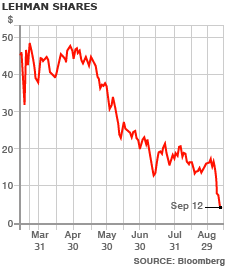
Barclays has pulled out of talks to buy most of Lehman Brothers, the BBC has learned.
The decision, which a source close to the talks said was unlikely to change, is a setback for the rescue effort.
BBC Sunday, 14 September 2008 19:35 UK
Lehman Brothers' stock, which fell another 13.5% Friday, is down 94% so far this year.
CNN
Lehman Brothers
One Wall Street executive involved in the meetings put it this way:
"I'm thinking logically; if they do nothing it's Armageddon. That means they do a deal.
It will be announced at 6 p.m. (ET) Sunday."
CNBC 13/9 2008
Barclays was last night considering a direct plea from Hank Paulson, the US Treasury Secretary, to assemble a cut-price rescue bid for Lehman Brothers
Daily Telgraph 14/9 2008
Paulson, the former head of Goldman Sachs, has urged Barclays and a number of other large financial institutions to intervene in the Lehman crisis, which is threatening the future of one of Wall Street's most venerated businesses.
US officials are concerned that the collapse of Lehman will prompt a fresh contagion among investors worried about the security of institutions such as Merrill Lynch and AIG, the insurance group.
Lehman Brothers plunged 45% - its shares ended down $6.36 to $7.79
The fall sparked a wider sell-off on Wall Street, Dow Jones falling 280 points
This removed almost all of the gains it had enjoyed on Monday.
BBC, Tuesday, 9 September 2008
Can Lehman raise the capital it needs?
CNN September 9, 2008
Lehman Brothers is raising $6bn, expects a $2.8bn loss
BBC 9 June 2008
The bank's public offering of common stock and convertible preferred stock will be aimed at mainly US investors, analysts said.
- UBS balansomslutning är nästan fem gånger så stor som Schweiz BNP
DN/TT 16/10 2008
UBS tillhör den grupp banker som gjort de allra största förlusterna på bolånekrisen i USA. Och banken har tentakler i hela det globala finanssystemet, vilket gör att en kollaps skulle få stora konsekvenser överallt, även i Sverige.
UBS will raise 6bn Swiss francs ($5.3bn) from the Swiss government.
It will also be able to transfer up to $60bn of toxic assets to a fund supported by the Swiss central bank.
BBC 16 October 2008
Credit Suisse also said that the Qatar Investment Authority was among the group of global investors that had helped the bank to shore up its finances.
UBS reported a loss of $329m for the April to June period, despite hopes it might break even in the quarter.
The bank's sub-prime debt write-downs in the quarter totalled $5.1bn.
BBC 12/8 2008
UBS seeks $15.1B in new capital
Switzerland's largest bank, expects writedowns of $19 billion
just as Deutsche Bank AG, Germany's largest bank, announced similar writedowns of about $4 billion.
CNN 1/4 2008
UBS writedowns have reached a staggering $40 billion in the past nine months, the largest reported by any bank to date.
Switzerland's Federal Banking Commission (EBK) is to investigate how UBS became one of the banking sector's worst victims of the credit crunch, BBC
UBS faces rebellion over fund injection, FT
How foreigners are buying up our banks
The fallout from Western bankers' reckless real-estate investments could usher in
an era of 'reverse colonization,' a turning point in the world's financial history.
Jon Markman, CNBC 2007-12-13
It's not too harsh to conclude now, in fact, that bankers essentially threw away their families' life savings on reckless real-estate gambles and that with their shares down 50%-plus and their capital bases in tatters, they're now lying in the proverbial gutter begging for a hand from passers-by. Brother, can you spare a billion?
The purchases were made via convertible securities that pay stunning yields of 9% and 11%, which essentially classify UBS and Citigroup as junk-bond-level credits.
A mere 5.4% decline in the value of Citigroup's assets would make Citigroup insolvent.
Click here
This isn't just a mortgage or housing crisis.
At the center of this still-unfolding disaster is the collateralized debt obligation, or CDO.
Steven Pearlstein, Washington Post, December 10, 2007
What we are witnessing is essentially the breakdown of our modern day banking system,
a complex of levered lending so hard to understand
that Fed Chairman Ben Bernanke required a face-to-face refresher course from hedge fund managers in mid-August.
Bill Gross, December 2007
Goldman Sachs, began reducing its inventory of mortgages and mortgage securities late last year.
Even so, Goldman went on to package and sell more than $6 billion of new securities
backed by subprime mortgages during the first nine months of this year.
IHT 6/12 2007
Why Do Financial Firms Take Too Much Risk?
The principal/agent problem
John H. Makin, American Enterprise Institute, November 20, 2007
The Next Dominos:
Junk Bond And Counterparty Risk
one of the more important editions of Outside the Box this year. This is a must read. You absolutely need to understand the nature of the systemic risk we are facing, and Ted does a great job of explaining in very clear terms the nature of the risks that we have created in our modern markets.
Ted Seides at John Mauldin 26/11 2007
Banks Gone Wild
PAUL KRUGMAN NYT November 23, 2007
It is only halfway through November but I think we can already declare the winner of the 2007 Quote of the Year competition. It is Chuck Prince, the former chairman and chief executive of Citigroup.
As Mr Prince departs, however, it should be noted that his statement was not, as history will record it, idiotic.
His offence was not that he misunderstood or misstated how banks have operated over the past few years but that he blurted out the truth rather too openly.
Note that he did not say “if” the music stops but “when”.
John Gapper, FT November 14 2007
The Federal Deposit Insurance Corp. plans to file a civil suit against at least three former Washington Mutual executives,
including former chief executive Kerry Killinger, seeking to collect more than $1 billion in damages
CalculatedRisk 19/2 2011
Washington Mutual
US officials assumed control of WaMu after its shares lost nearly all their value
This after all is an industry-leading bank with over $320 billion in assets.
September 25 2008 22:33
JPMorgan Chase will acquire deposits and some branches
Under the government take-over, the value of WaMu’s common equity and preferred shares would be wiped out
Under the deal, which was shepherded by federal banking regulators, JPMorgan Chase will acquire all the banking operations of the Seattle-based WaMu, as well as its assets and financial contracts.
The Office of Thrift Supervision shut down the bank on Thursday and named the FDIC as receiver. WaMu is the 13th bank to fail so far this year.
WaMu är en S&L - en släkting till Swedbank
Washington Mutual
Shares of WaMu were down more than 20% in afternoon trading,
suggesting that the endgame for the embattled savings and loan may be rapidly approaching
following ratings agency downgrades
CNN September 25, 2008
- What the heck's happening to our financial system?
That will be a question many people will be asking after shares plunged 17 percent in a single day.
This after all is an industry-leading bank with over $320 billion in assets.
CNN Fortune 2007-11-08
The most sobering thought about the credit crunch so far is that it's happened without anything approaching a recession. Difficulties in the financial system could slow the economy and that in turn that would create new losses at the banks.
If it wanted to, the Federal Reserve could just cut interest rates and cheaper borrowing costs would help the banks and spark economic activity. But with the threat of inflation and the weak dollar, the Fed doesn't have much room to maneuver.
Sorry, but we're only just moving into the second act of the credit crunch.
What we saw this summer is something we've seen before and will undoubtedly see again. The sell-off was predictable and avoidable.
Some people were apparently shocked to learn that gambling was occurring at Rick's Cabaret.
Speech by Michael E. Lewitt, made at the The Bank Credit Analyst Conference
Mauldin's Outside The Box 2007-11-05
A mere 5.4% decline in the value of Citigroup's assets would make Citigroup insolvent.
Michael Shedlock, November 01, 2007
The US subprime lending fiasco and its repercussions on Northern Rock have brought back questions about the banking system - questions such as “What is a bank?” and “What is money?”
Samuel Brittan, FT October 25 2007
The US subprime lending fiasco and its repercussions on Northern Rock and international credit markets in general have brought back questions about the banking system that most macroeconomists had hoped were over and long forgotten. The confidence of what are called, rather disdainfully, “retail depositors” is not the only problem of the world monetary system, but it is still the bedrock on which everything else stands. Outside the US, deposit insurance is rarely complete and there are usually delays before reliable cheques denominated in central bank money duly arrive. In the UK it is only since October 1 this year that the Financial Services Compensation Scheme has been extended to cover eligible deposits of up to £35,000 and the new official discussion paper leaves open the possibility of raising the amount. But the implications of sweeping guarantees have not been digested. They have the dubious feature of bringing questions such as “What is a bank?” and “What is money?” into practical politics.
In fact, the fractional reserve system was severely queried by some US economists in the aftermath of the Great Depression when one-quarter of the US money stock disappeared almost overnight – a more important event than the better-known 1929 stock exchange crash.
Henry Simons, author of A Positive Program for Laissez Faire, proposed the creation of pure deposit-taking institutions holding 100 per cent reserves whose assets had to be held in currency or Federal Reserve deposits. So, barring a break-up of the US or similar disasters, a depositor could always get his or her money back and quickly. Other financial institutions, whether or not called banks, would carry on paying interest and looking for more profitable investments. But the ordinary citizen would know that he was on his own if he invested in them and learn that higher returns came with higher risk.
We urgently need a more open approach than that of the City of London figures who oppose bail-outs and government support for all other industries but condemn the Bank of England for not doing secret deals to rescue threatened financial institutions.
How do the big banks differ from Northern Rock?
Richard Lim, Singapore, Letters FT 2007-10-23
Sir, I would like to thank the FT for your reports on the issues relating to the credit crunch and its potential impact on the global economy. In particular I was shocked to read about special investment vehicles (SIVs) and “SIV-lites”, off-balance-sheet vehicles used by big banks essentially to circumvent banking regulations on maintaining reserves against lendings, and sound liquidity management, such as not covering long-term commitments with short-term fundings, which everyone with a little bit of knowledge would know is risky to the survival of a bank. What is the difference between the big banks and Northern Rock?
Now a more shocking development is the talk about creating a seeming master SIV by the big banks endorsed by the US Treasury. How could the banks be allowed to perpetuate such self-destructive activities, which the SIVs and SIV-lites have proven to be?
The public sector subsidises the banks risk-taking. It does so because banks provide a utility.
What the banks give in return, however, is gung-ho speculation.
Martin Wolf, FT November 27 2007
Mervyn King, governor of the Bank of England,
is playing a game of chicken with the world’s most irresponsible industry.
Sadly, he is losing.
Martin Wolf, Financial Times 21/9 2007
The “Minsky moment” in financial markets – the point where credit supply starts to dry up,
systemic risk emerges and the central bank is obliged to intervene – has duly arrived.
George Magnus, Financial Times August 22 2007 19:14
The decision to guarantee deposits raises large questions.
Deposit liabilities are nationalised, while the financial system’s assets, albeit regulated, remain in private hands.
Martin Wolf, Financial Times September 19 2007
Mervyn King, governor of the Bank of England,
is playing a game of chicken with the world’s most irresponsible industry.
Sadly, he is losing.
Martin Wolf, Financial Times 21/9 2007
For decisions on how to intervene in markets, however, Mr King bears responsibility.
In the paper on the crisis submitted to the Treasury committee last week,
Turmoil in Financial Markets: What Can Central Banks Do?
he defended a line markedly different from that taken by the Federal Reserve and the European Central Bank.* “On the one hand, the provision of greater short-term liquidity against illiquid collateral might . . . reduce term market interest rates. But, on the other hand, the provision of such liquidity support . . . encourages excessive risk-taking, and sows the seeds of a future financial crisis.”
The only reason for intervening, then, would be “strong grounds for believing that the absence of ex post insurance would lead to economic costs on a scale sufficient to ignore the moral hazard in future.” Since then Mr King must have decided that the threat to the financial system posed by the unwillingness of banks to lend had become too dangerous. By advancing three-month money against mortgagecollateral,the Bank has, as a result, abandoned two of its principles for acting as lender of last resort.
Consider, not least, that banks exposed themselves to the risk of illiquidity from which they expect a public rescue, at no charge.
Mr King’s “mistake” – what critics call his “inflexibility” – was the view that banks should no more enjoy a rescue than other businesses. Fortunately, the Bank’s provision of liquidity is not yet free. Let Mr King stick to his guns on the penalty. If not, still more dangerous crises will come.